

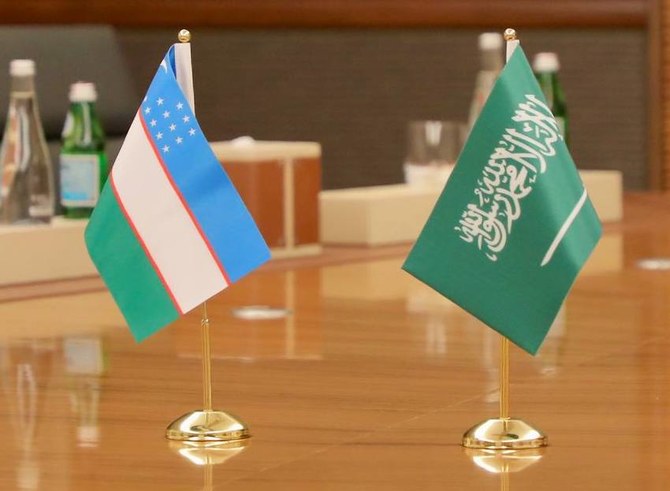
Saudi-Uzbekistan council signs 10 investment agreements worth $12bn

The agreements cover various sectors and include number of deals between Ministry of Investment and Foreign Trade of the Republic of Uzbekistan, the Ministry of Energy of the Republic of Uzbekistan, and ACWA Power, a developer, investor, co-owner and operator of a portfolio of power generation and desalinated water production plants. 
Short Url
Updated 18 August 2022
Follow

Saudi-Uzbekistan council signs 10 investment agreements worth $12bn

JEDDAH: Saudi Arabia and Uzbekistan have signed over 10 investment agreements, worth over SR45 billion ($12 billion), during the Saudi-Uzbek Business Council in Jeddah on Wednesday.

The agreements cover various sectors and include number of deals between Ministry of Investment and Foreign Trade of the Republic of Uzbekistan, the Ministry of Energy of the Republic of Uzbekistan, and ACWA Power, a developer, investor, co-owner and operator of a portfolio of power generation and desalinated water production plants. 
“Over 10 agreements were signed between the Kingdom and Uzbekistan in several sectors, with a value exceeding SR45 billion,” Saudi Minister of Investment Khalid Al-Falih said. 


Pakistan’s Balochistan establishes threat assessment center amid surge in militant attacks

Updated 14 sec ago
Follow

Pakistan’s Balochistan establishes threat assessment center amid surge in militant attacks

  • Provincial Intelligence Fusion and Threat Assessment Center brings police, CTD, intelligence agencies together on one platform, says official
  • Says center helps disrupt terror financing, narcotics trafficking, organized crime and enables action against unregulated communication networks

ISLAMABAD: The government in Pakistan’s southwestern Balochistan province has established a state-of-the-art threat assessment center to strengthen early warning and prevention against “terrorism” incidents, a senior official said on Monday amid a surge in militant attacks recently. 

Balochistan Additional Chief Secretary Hamza Shafqaat wrote on social media platform X that the Provincial Intelligence Fusion and Threat Assessment Center (PIFTAC Balochistan) brings police, the counter-terrorism department (CTD), intelligence agencies and civil administration together on one platform for real-time information sharing and joint analysis. 

“PIFTAC strengthens early warning and prevention against terrorism, helps disrupt terror financing, narcotics trafficking, and organized crime, and enables coordinated action against illegal spectrum and unregulated communication networks,” he wrote.

“Information that was once scattered is now shared and acted upon in time, allowing the state to move from reacting after incidents to preventing them before they occur.”

https://x.com/beyondfiles/status/2010444397163532547

The development takes place amid a steep rise in combat-related deaths in Pakistan during 2025. According to statistics released by the Pakistan Institute for Conflict and Security Studies (PICSS) last month, combat-related deaths in 2025 rose 73 percent to 3,387.

These deaths included 2,115 militants, 664 security forces personnel, 580 civilians and 28 members of pro-government peace committees, the local think tank said. 

Pakistan military spokesperson Lt. Gen. Ahmed Sharif Chaudhry last week highlighted Pakistan’s counter-terrorism efforts in 2025, saying that security forces had conducted 75,175 intelligence-based operations (IBOs) and killed 2,597 militants last year. He also said Pakistan reported 5,397 “terrorism incidents” last year. 

Pakistan frequently accuses Afghanistan of allowing militant groups, including the Tehreek-e-Taliban Pakistan (TTP) and the separatist Balochistan Liberation Army (BLA) to operate from its soil, charges Kabul has repeatedly denied.

Islamabad also accuses India of backing these militant groups against Pakistan. New Delhi rejects the allegations.