

In Karachi’s old town, birthplace of Pakistani founder stands hidden from public eye

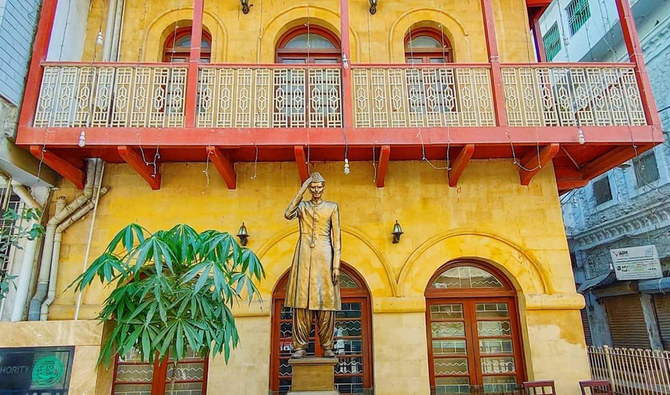
A handout picture, taken on November 13, 2021, shows the statue of Mohammad Ali Jinnah outside Wazir Mansion, the residence of Pakistan's founder in Karachi. (Instagram/sajjadrasheedvlogs)
Short Url
Updated 12 August 2022
Follow

In Karachi’s old town, birthplace of Pakistani founder stands hidden from public eye

  • Wazir Mansion in Newnham Road has been officially recognized as Muhammad Ali Jinnah’s birthplace since 1953
  • Some scholars say the actual place of Quaid-e-Azam’s birth was 20 yards away, a building behind Wazir Mansion

KARACHI: While thousands of people flock daily to Mazar-e-Quaid, the mausoleum and final resting place of Muhammad Ali Jinnah in Karachi, and most know that he spent his last days at the Ziarat Residency in Balochistan, few can tell you with certainty where the founder of Pakistan was born.

Jinnah’s official place of birth, the three-story Wazir Mansion, is just a few kilometers away from his tomb, tucked away in a narrow street on Karachi’s Newnham Road, surrounded by shops and residential apartments.

Wazir Mansion was officially recognized in 1953 as the birthplace of Jinnah, revered as the country’s founder, who led the struggle for a separate homeland for the Muslims of the British-ruled Indian subcontinent from 1937 to Aug. 14, 1947, when Pakistan gained independence. He served as the new republic’s first governor general until his death in 1948.

“It was built during 1860-1870 with stone masonry in lime and jute mortar to suit the volatile weather of Karachi,” an information board on the house reads. “This is a precious national monument that provides inspiration to our nation.”
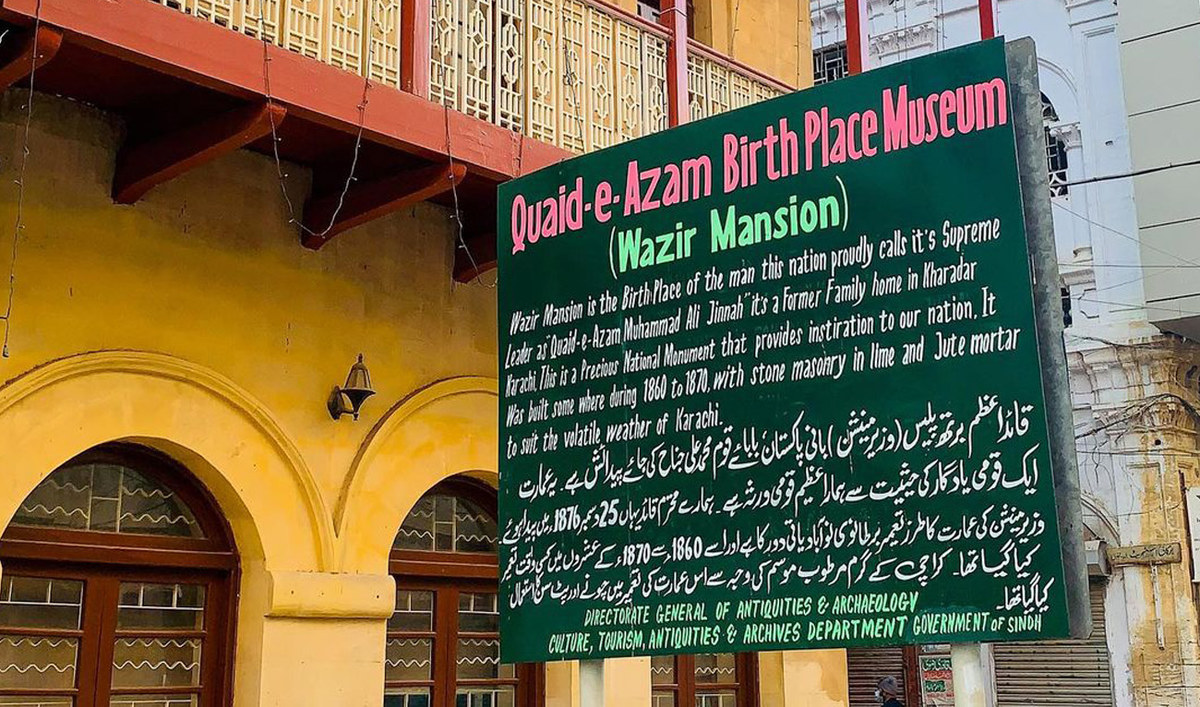


A handout picture, taken on January 10, 2021, shows a board placed by the Sindh government at Wazir Mansion, the residence of Pakistan's founder Muhammad Ali Jinnah, in Karachi. (Instagram/tahirhali)

While there are disputes over whether Wazir Mansion was the actual birthplace of Jinnah — some believe he was born in Jhirk, a small town in Thatta district, over 150 km away from Karachi — the building’s custodian, Muneer Hussain, said the building housed the very room “where Jinnah was born.”

Jinnah’s father, Jinnahbhai Poonja, arrived in Karachi from Mumbai to set up a business, and chose Newnham Road, then a steel trade hub, for his enterprise, Hussain said. He rented an apartment in Wazir Mansion, where Jinnah was born on Dec. 25, 1876.

“Seven siblings of Jinnah were also born in this building,” he told Arab News. “Fifteen hundred to two-thousand people, mostly students, visit us monthly and I want this number to be doubled because this small building has changed the map of the world.”

Dr. Kaleemullah Lashari, an archaeologist and historian, told Arab News theories claiming Jinnah’s birthplace was in another city were incorrect.

“This has been refuted by the statements of Quaid himself,” Lashari said. And then quoting a speech by Jinnah, he added: “He said that, ‘It gives me immense pleasure to stand here in front of you and tell you that I was born in Karachi’.”

However, according to Lashari, it was a building behind Wazir Mansion that was Jinnah’s true place of birth. 

“Jinnahbhai was occupying the part of property which was behind it [Wazir Mansion],” Lashari said.

“So, it’s the building which is behind it and this is the reason that the scholars don’t consider Wazir mansion [as Jinnah’s birthplace] …The Wazir Mansion, the present building which is there, was actually built after 1880, so

Jinnahbhai was occupying the part of property which was behind it ... There is a difference of 20 yards.”

While the difference is small, the scholar said it mattered as much as other details of Jinnah’s legacy and life.

“It is very significant [to know where Jinnah was born] but I tell you, not only the birthplace but every aspect of his life is significant and important,” the scholar said. “And there is need that attention is paid to the studies on his life and his works.”


US sees 18 percent rise in Pakistani students despite UGRAD pause, opens new USEFP headquarters

Updated 9 sec ago
Follow

US sees 18 percent rise in Pakistani students despite UGRAD pause, opens new USEFP headquarters

  • USEFP inaugurates purpose-built campus in Islamabad as Fulbright program marks 75 years in Pakistan
  • Undergraduate UGRAD program remains suspended but graduate scholarships and visas continue, US officials say

ISLAMABAD: The United States inaugurated a new purpose-built headquarters for the United States Educational Foundation in Pakistan (USEFP) this week, as American officials reported an 18 percent rise in Pakistani students studying in the US, despite the suspension of a major undergraduate exchange scheme earlier this year.

The launch comes as the Fulbright program completes 75 years in Pakistan, the world’s largest US-funded scholarship portfolio for master’s and PhD study. Officials said growing student mobility and stable visa issuance reflect continued academic engagement between the two countries, even after the UGRAD exchange program was paused in April.

USEFP Executive Director Peter Moran told Arab News that Pakistani students are still securing visas without unusual difficulty and enrollment levels remain strong.

“We are not finding that Pakistani students are facing undue difficulties getting their visas when they want to go and study on their own. The number of Pakistani students who are studying in the United States, actually based on data from the year before last, because you know there’s always a lag, it’s up 18 percent,” Moran said, citing 2023 figures.

He said nearly 10,000 Pakistanis are currently enrolled in US institutions, including self-funded students. While UGRAD, which previously sent 100–130 undergraduates per year, remains paused under US budget adjustments, Moran said there is hope it will return.

“So, the UGRAD program for now is on pause ... the UGRAD program sent undergraduate, actually high school students. That program ended in April. We don’t know when that will come back, but we sure hope that it will.”

USEFP clarified that no reductions have been applied to graduate programs.

“There is no cut on Fulbright… and we don’t anticipate there being any,” Moran added.

Around 65 Pakistani scholars left for the US through Fulbright this year, another 10–12 departed under the Humphrey Fellowship, and USEFP expects next year’s Fulbright cohort to rise to 75–80.

The inauguration of the new headquarters brought together US officials, scholarship alumni and education leaders.

US Embassy Minister Counselor for Public Diplomacy Andy Halus said the new facility reflects the depth of the bilateral academic partnership.

“We have over 9,000 students in Pakistan that have had experience in the United States on the Fulbright programs that started 70 years ago. Our commitment to sending more and more students to the United States on the Fulbright program is strong and it’s going to continue.”

Among attendees was Fulbright alumnus Aftab Haider, the CEO of Pakistan Single Window, the government-backed digital trade clearance platform. He credited the scholarship with shaping his career:

“I am a very proud Fulbrighter from 2008. I think it is one of the most transformational programs that can be offered to young Pakistanis to have the opportunity to be educated abroad, come back to Pakistan and contribute in public service delivery as well as in enhancement of the private sector.”