

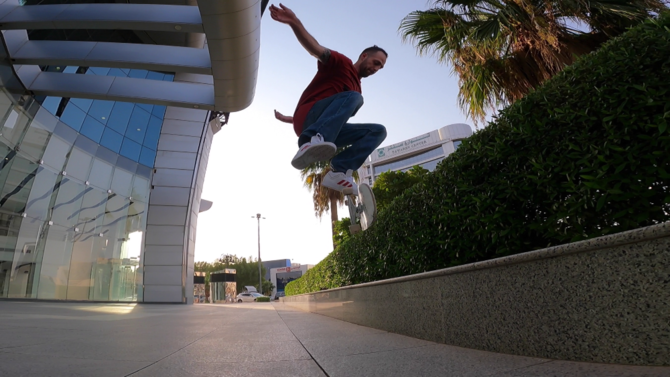
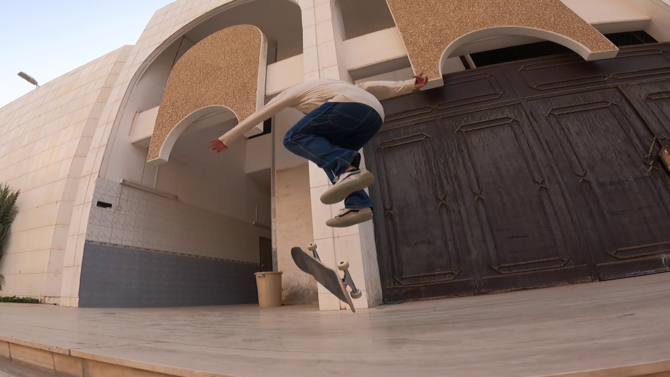
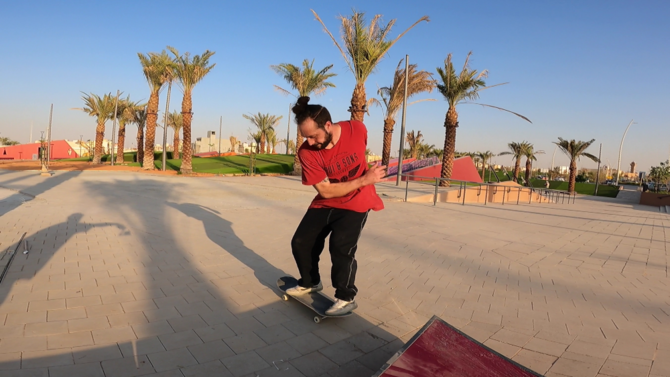
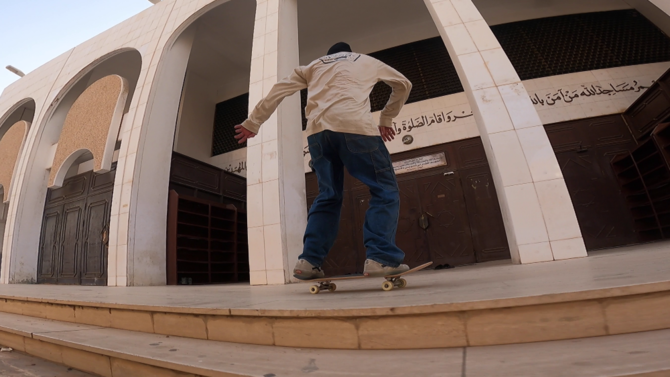

RIYADH: Sitting on the upper level of LocoSonix, a skate shop based in Riyadh, Saudi skateboarder Shareef Masarani is approached by a young girl. The mixture of excitement and shyness overwhelm her expressions as she presents a board she picked out from the shop.
“I just wanted to ask you, I am buying this board. Is it cool?” She wanted his input on buying her first ever skateboard after seeing he was at the shop through Instagram Live.
“The Hydroponic is good, as a startup board, yeah … That’s actually a good choice,” he responded.
The girl had found his account on Instagram one day, and later on met him at the Riyadh Boulevard skatepark. The coincidence inspired her to hop on her very own skateboard for the first time.
Masarani has been a skater on and off for almost 20 years, beginning his journey at 15. After leaving his job as a chef to focus on growing the skate community in Saudi Arabia, he has become somewhat of a go-to resource for all things skateboard-related for many up-and-coming skaters, alongside his 11-person skate community Sandlifers.
Masarani went from pursuing skateboarding as a hobby while living in the US to becoming a learning resource and collaborating with big-name brands such as Vans and Mountain Dew.
One of his young client’s mothers called him one day, thanking him for his work. Not only were her daughter’s skills improving, but she became a more outward and confident person as a result.
“Her personality developed. At the house, she’s a quiet kid, she doesn’t talk to anybody. Now, it gave her confidence and gave her a personality, she’s talking with the family. It changes people, it really does,” Masarani told Arab News.
“When you learn a trick, you do things that you didn’t think you could do,” he said. “I’ve seen what it did to me, and I would love to kick start it here in the Middle East,” he said.
Masarani’s client, 15-year-old Reef Khalid Hassan, said her training helped her manage the tricks she aimed to master. His support inspired her to keep going.
“Ever since I met him, he’s been telling me that I could be something … Masarani also helped me with explaining to me how skateboarding works, different tricks and how to think in the right mindset,” she told Arab News.
“You need to know when to bail and when to commit,” he told her during a lesson.
Hassan started skating on her own a few months back and has become one of the rising young stars in the Riyadh skate scene, according to Masarani.
“A few months ago, I used to need a little bit of help with a couple of tricks, so I got a month’s training, which helped me a lot,” she said.
Her first two tricks were a revert and an ollie. “It felt really good, actually, because I tried for so long until I got it … Skating gives me something to look forward to because there are more tricks (to learn) every day,” she said.
But the skate scene was not always this popular in Saudi Arabia. According to Masarani, only a few groups of people, including Sandlifers and some Filipino residents who had brought the practice from their country, were skating until 2020.
That is when Al-Nakheel skatepark opened to the public. Slowly, more parks became accessible like the private Diriyah club and the purpose-built Riyadh Boulevard skatepark, which rents out gear on the spot.
As his following increases, Masarani has been using Instagram as a learning tool for others. He utilizes the app’s live feature as a platform to answer common questions that people have around the sport, or to demonstrate which of LocoSonix’s goods are best to purchase for your needs.
“That’s my goal. I want people to be better than me,” he said.
Masarani is also a partner of LocoSonix, the only specialized skate shop in the Kingdom, and frequently shows off their newest gear. Walking into the active lifestyle store is like entering an art gallery.
“I see great potential in the sport as it’s becoming increasingly integrated into the Saudi culture,” Safi Marroun, founder of LocoSonix, told Arab News.
“The moment you learn how to balance on a board and start to ride around with your own board, you have entered a new way of living. LocoSonix brings together the artist, the pro players, and those who want to just have fun on wheels.”
LocoSonix is planning to create skateparks to promote the sport in 2023.
Skateboarding has recently been legitimized with its recognition as an Olympic sport by the International Olympic Committee, making its debut appearance at the 2020 Summer Olympics in Tokyo.
In the Kingdom, the Saudi Arabian Extreme Sports Federation recently concluded two rounds of skateboarding camps in Riyadh, with 111 participants. It also held its first two-day skateboarding and aggressive in-line skating competition that hosted 38 female and male participants.
“I see (the scene) becoming bigger, if people continue doing what they’re doing. Like anything, if they stay consistent with it, it’s only going to get bigger,” said Masarani.


