Popular French dictionary adds Levantine food term to its pages

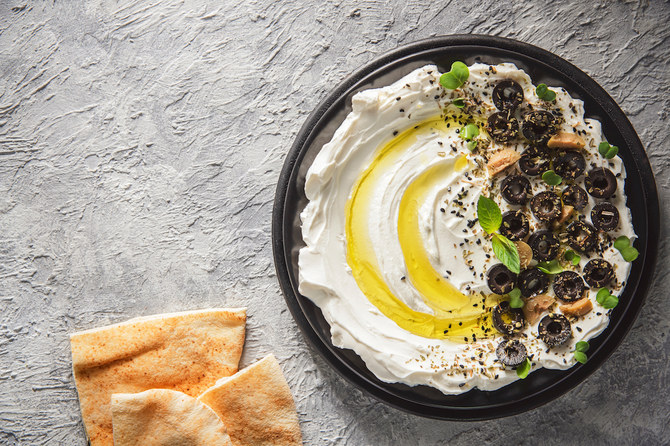
Labne has entered the 2023 edition of the French dictionary, 'Le Petit Robert'. (Shutterstock)
Short Url
Updated 03 August 2022
Follow

Popular French dictionary adds Levantine food term to its pages

DUBAI: A new Arabic word has entered the 2023 edition of the well-known French dictionary, "Le Petit Robert," established by lexicographer Paul Robert in the 1960s. The word is “labne” or “labneh.”

Derived from the Arabic word “laban” (yogurt), it is a creamy yoghurt cheese that is a staple of a typical Levantine breakfast.

“I am happy and proud to have parts of our products, dishes and traditions recognized internationally, and especially in France,” the French-Lebanese chef Karim Haidar told Arab News. “Adding a new kind of cheese to the country of cheese is amazing.”

The Paris-based chef said that the decision did not come as a surprise as over the years his French clients and friends have come to love labne, found in countless restaurants and delis in the French capital. Not only does it taste good but it has health benefits as it is high in protein and calcium, he said.  

According to Haidar, labne is traditionally made with goat’s milk. It has great acidity, prepared in terracotta, rolled into small balls, and later preserved in olive oil. Labne can also be made with sheep and cow’s milk.

While labne can usually be found in any Middle Eastern supermarket, preparing labne at home is easy — it requires adding salt to yogurt and straining it in a cloth overnight.

It can be eaten in a number of ways. Whether consumed in a sandwich-to-go or as a dip, it is drizzled with olive oil and often topped with either zaatar, mint or sumac. In recent years, international chefs have incorporated labne into dessert dishes.

The introduction of labne into "Le Petit Robert" comes at a time when Lebanese immigration to France has increased in the past few years due to the economic crisis hitting Lebanon. But Haidar believes that French interest in this yogurt goes back a few decades.

“I don’t think the last Lebanese emigration episode had an effect,” he said. “Labne arrived on French tables since the 1975 emigration. We are witnessing for years now the love of French people for labne, and French food culture opened itself to foreign food cultures in the last 30 years. Just like mozzarella or parmigiano, you can find labne on the shelves of some big supermarket chains now.”


Saja Kilani shines at BAFTAs 2026

Updated 23 February 2026
Follow

Saja Kilani shines at BAFTAs 2026

DUBAI: Palestinian-Jordanian-Canadian actress Saja Kilani, one of the stars of “The Voice of Hind Rajab,” stepped onto the BAFTA Film Awards 2026 red carpet in a sculptural look from Bottega Veneta’s Spring 2026 collection.

Nominated for Best Film Not in the English Language, Kaouther Ben Hania’s “Voice of Hind Rajab” tells the story of Hind Rajab Hamada, who was fleeing the Israeli military in Gaza City with six relatives last year when their car came under fire.

The sole survivor of the Israeli attack, who was then shot and killed, her desperate calls recorded with the Red Crescent rescue service caused international outrage.

Kilani plays Rana Faqih, the real-life Palestine Red Crescent Society volunteer who spoke to Hamada in the final hours of her life as she waited, surrounded by the bodies of her family, for help to come. 

Meanwhile, politically charged thriller “One Battle After Another” won six prizes, including Best Picture, at the British Academy Film Awards on Sunday, building momentum ahead of Hollywood’s Academy Awards next month.

Blues-steeped vampire epic “Sinners” and gothic horror story “Frankenstein” won three awards each, while Shakespearean family tragedy “Hamnet” won two, including Best British Film.

“One Battle After Another,” Paul Thomas Anderson’s explosive film about a group of revolutionaries in chaotic conflict with the state, won awards for directing, adapted screenplay, cinematography and editing, as well as for Sean Penn’s supporting performance as an obsessed military officer.

“This is very overwhelming and wonderful,” Anderson said as he accepted the directing prize. He paid tribute to his longstanding assistant director, Adam Somner, who died of cancer in November 2024, a few weeks into production.

“We have a line from Nina Simone that we used in our film, ‘I know what freedom is: It’s no fear,’” the director said. “Let’s keep making things without fear. It’s a good idea.”

Bookies’ favorite Jessie Buckley won the Best Actress prize for her portrayal of grieving mother Agnes Hathaway, wife of William Shakespeare, in “Hamnet.” Buckley, 36, is the first Irish performer to win the Best Actress prize at the awards.

She dedicated her award “to the women past, present and future who taught me and continue to teach me how to do it differently.”

Horror film “Sinners” took home trophies for director Ryan Coogler’s original screenplay, the film’s musical score and for Wunmi Mosaku’s supporting actress performance as herbalist and healer Annie.

The British-Nigerian actor said that in the role she found “a part of my hopes, my ancestral power and my connection, parts I thought I had lost or tried to dim as an immigrant trying to fit in.”