

PM visits flood relief camps in Balochistan as provincial death toll jumps to 136

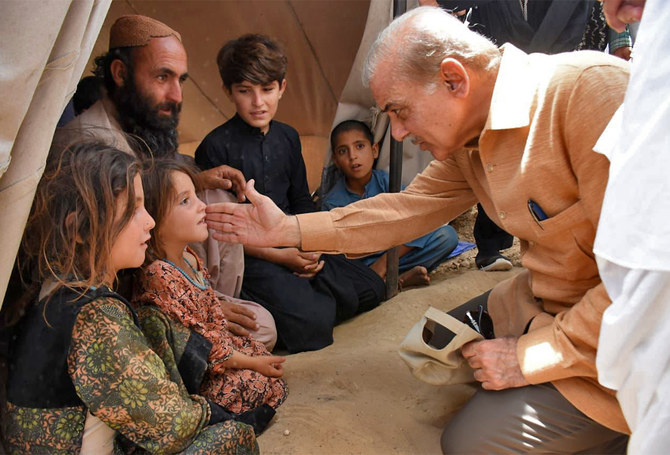
Pakistan Prime Minister Shehbaz Sharif (R) visits the flood relief camps in Balochistan’s Qila Saifullah district on August 1, 2022. (Government of Pakistan)
Short Url
Updated 01 August 2022
Follow

PM visits flood relief camps in Balochistan as provincial death toll jumps to 136

  • People at the camps tell the prime minister local authorities have not been providing them food
  • PM Sharif also describes absence record in medical camp as ‘weakness’ that must be addressed

QUETTA: Prime Minister Shehbaz Sharif on Monday visited flood relief camps in Balochistan’s Qila Saifullah district where he also interacted with their inhabitants and asked the province’s chief minister to act against local administration officials for not providing food to people. 

Pakistan has witnessed torrential rains since monsoon began in June, causing flash floods in different parts of the country. 

According to the latest statistics circulated by the National Disaster Management Authority (NDMA), 434 people lost their lives in rains across Pakistan since the onset of the season. 

Nine people were killed in Balochistan in the last 24 hours, taking the total number of rain-related deaths in the region to 136 since mid-June. 

Sharif, who was also accompanied by Chief Minister Mir Abdul Quddus Bizenjo, said he had witnessed several administrative weaknesses in the relief camps, including the absence of proper record maintained by doctors and paramedics responsible for treating flood victims. 

“There are camps in which people have come from adjoining areas with their families, leaving behind their houses which have been destroyed in rains,” the prime minister said. “I have met them, including children and elderly people. However, I could not get any confirmation that they were given food. In fact, the inhabitants of the relief camps clearly told us they had not been fed.” 
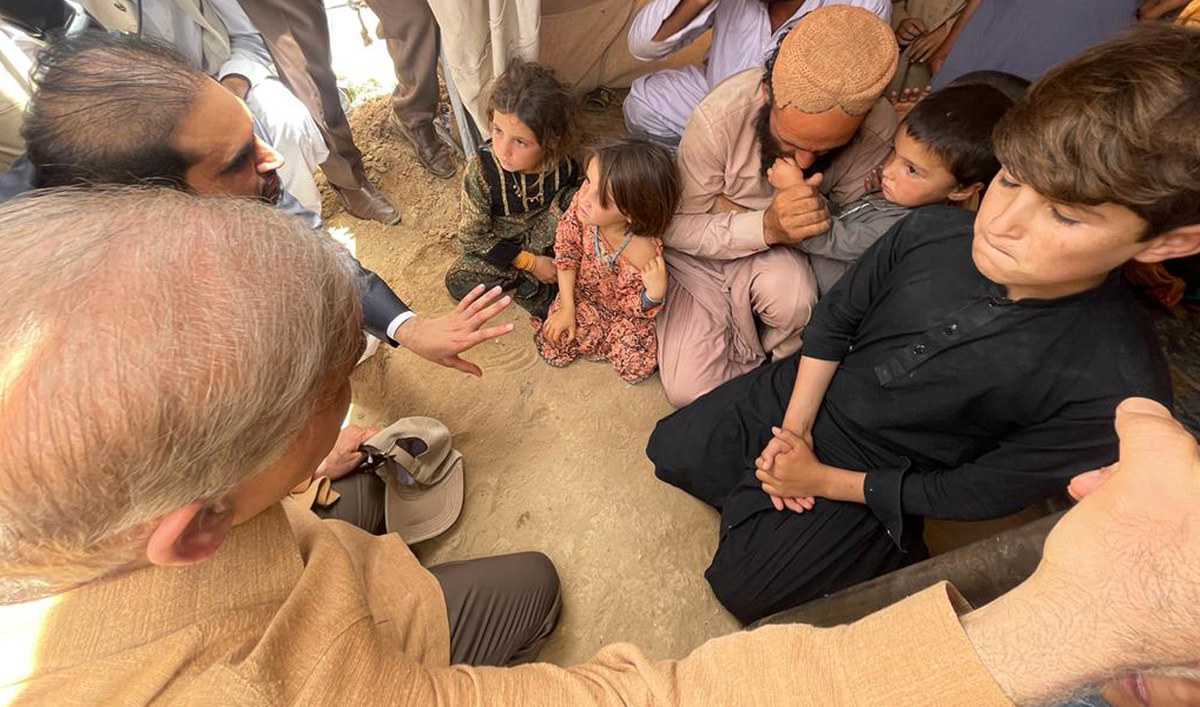


Pakistan Prime Minister Shehbaz Sharif (L) visits the flood relief camps in Balochistan’s Qila Saifullah district on August 1, 2022. (Government of Pakistan)

Sharif directed the chief minister to take immediate and strict action against all negligent officials. 

According to a statement issued by his office, the prime minister gave instructions to NDMA officials to pay the compensation amount within 24 hours to the next of kin of those who had died in monsoon rains in Balochistan. 

“It is our national tragedy that timely construction of dams was not ensured in the past,” Sharif said. 

Meanwhile, Bizenjo said his administration was told by the district and provincial disaster management officials that one-month ration had been distributed among people in relief camps. 

He announced to act against all officials who had misguided the provincial government. 

Earlier, the prime minister arrived in Quetta to evaluate the flood situation in the province and was received by Bizenjo. 

His visit to the southwestern province came soon after the meteorological department of Pakistan predicted “above-normal” rain in the month of August. 

The Met Office also forecast relatively high temperatures in mountainous regions, indicating a faster rate of snowmelt that could cause floods in the northern areas. 

Experts have already warned that climate change has made monsoon highly erratic in terms of its onset, intensity and area of coverage. 

One of them, Dr. Ghulam Rasul, told Arab News last week that monsoon had started penetrating “shadow zones,” including Balochistan and high mountains of Khyber Pakhtunkhwa and Gilgit-Baltistan which mostly remained dry in the past. 


Pakistan, ADB sign $730 loan agreements to boost SOE reforms, energy infrastructure

Updated 25 December 2025
Follow

Pakistan, ADB sign $730 loan agreements to boost SOE reforms, energy infrastructure

  • Both sign $330 million Power Transmission Strengthening Project and $400 million SOE Transformation Program loan agreements
  • Economic Affairs Division official says Transmission Project will secure Pakistan’s energy future by strengthening national grid’s backbone

KARACHI: Pakistan and the Asian Development Bank (ADB) on Thursday signed two loan agreements totaling $730 million to boost reforms in state-owned enterprises (SOEs) and energy infrastructure in the country, the bank said.

The first of the two agreements pertains to the SOE Transformation Program worth $400 million while the second loan, worth $330 million, is for a Power Transmission Strengthening Project, the lender said. 

The agreements were signed by ADB Country Director for Pakistan Emma Fan and Pakistan’s Secretary of Economic Affairs Division Humair Karim. 

“The agreements demonstrate ADB’s enduring commitment to supporting sustainable and inclusive economic growth in Pakistan,” the ADB said. 

Pakistan’s SOEs have incurred losses worth billions of dollars over the years due to financial mismanagement and corruption. These entities, including the country’s national airline Pakistan International Airlines, which was sold to a private group this week, have relied on subsequent government bailouts over the years to operate.

The ADB approved the $400 million loan for SOE reforms on Dec. 12. It said the program seeks to improve governance and optimize the performance of Pakistan’s commercial SOEs. 

Karim highlighted that the Power Transmission Strengthening Project will enable reliable evacuation of 2,300 MW from Pakistan’s upcoming hydropower projects, relieve overloading of existing transmission lines and enhance resilience under contingency conditions, the Press Information Department (PID) said. 

“The Secretary emphasized that both initiatives are transformative in nature as the Transmission Project will secure Pakistan’s energy future by strengthening the backbone of the national grid whereas the SOE Program will enhance transparency, efficiency and sustainability of state-owned enterprises nationwide,” the PID said. 

The ADB has supported reforms by Pakistan to strengthen its public finance and social protection systems. It has also undertaken programs in the country to help with post-flood reconstruction, improve food security and social and human capital. 

To date, ADB says it has committed 764 public sector loans, grants and technical assistance totaling $43.4 billion to Pakistan.