QAMISHLI, Syria: Syria’s semi-autonomous Kurdish administration handed Tajikistan 146 women and children related to Daesh group militants, a Kurdish official said Monday, in the first such repatriation to the ex-Soviet state.
Thousands of foreign extremists joined Daesh as fighters, often bringing their wives and children to live in the “caliphate” declared by the group across swathes of Iraq and Syria in 2014.
The militants were dislodged in 2019 from their last scrap of territory in Syria by Kurdish-led forces backed by a US-led coalition, and Kurdish authorities have repeatedly called on countries to repatriate their citizens from crowded displaced camps.
But nations have mostly received them only sporadically, fearing a domestic political backlash.
The Kurds handed over “42 women and 104 children, including orphans, who were held in the Al-Hol and Roj camps” in northeast Syria to Tajikistan’s ambassador to Kuwait Zabidullah Zabidov, Kurdish foreign affairs official Fanar Al-Kaeet said.
Zabidov is handling the repatriation process for Tajikistan.
The ex-Soviet state has been in contact with Syria’s Kurds “for months” to repatriate their citizens, Kaeet said during a press conference in the northeastern city of Qamishli.
The women “did not commit any crimes or terrorist acts in northeastern Syria,” he said.
Al-Hol and Roj camps are home to tens of thousands of relatives of Daesh militants from Syria and abroad, with the former holding 10,000 foreigners.
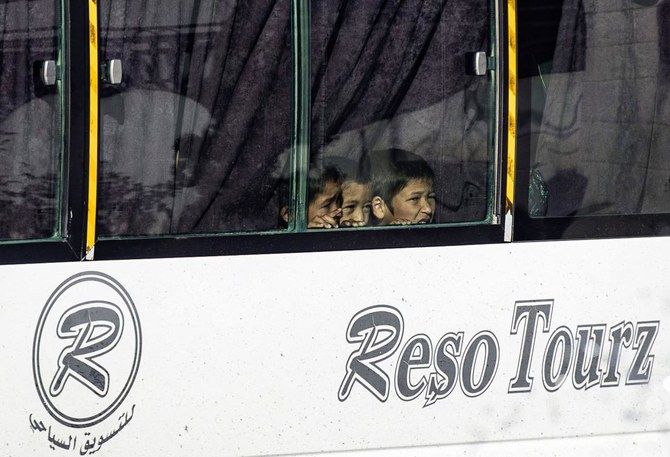
Kurdish-led forces escorted the women, some in colorful clothing, others in long black robes, and the children, as they were bused out to Qamishli airport, AFP correspondents in Qamishli reported.
Some women tried to hide their faces.
Young children timidly peeked through the bus windows, from behind thick curtains that hid the other passengers.
Rights groups have long decried grim living conditions and rampant criminality in the north Syrian camps holding militants’ relatives.
According to HRW, more than 41,000 foreign citizens — the majority under 12 years old — are being held in camps and prisons in northeast Syria over alleged Daesh links.

Syria’s Kurds repatriate nearly 150 Daesh-linked Tajiki women, children
https://arab.news/z2ewb
Syria’s Kurds repatriate nearly 150 Daesh-linked Tajiki women, children
- The ex-Soviet state has been in contact with Syria’s Kurds ‘for months’ to repatriate their citizens
- Al-Hol and Roj camps are home to tens of thousands of relatives of Daesh militants from Syria and abroad
Arab Coalition announces ‘limited’ airstrike targeting two ships that smuggled weapons to Yemen
- Coalition urges evacuation of the Port of Mukalla, signaling that a major military operation to force an STC withdrawal could be imminent
- Spokesman says the two ships transported weapons from the UAE port of Fujairah to Mukalla without getting permission from Coalition command
RIYADH: The Coalition to Support Legitimacy in Yemen on Tuesday said it conducted a “limited” airstrike targeting two ships that smuggled weapons and other military hardware into Mukalla in southern Yemen.
In a statement carried by the Saudi Press Agency (SPA), the Coalition Forces spokesman, Major General Turki Al-Maliki, said that two ships coming from the port of Fujairah in the United Arab Emirates entered the Port of Mukalla in Hadramaut without obtaining official permits from the Joint Forces Command of the Coalition.
“The crews of the two ships disabled the tracking systems of the two ships and unloaded a large quantity of weapons and combat vehicles to support the Southern Transitional Council forces in the eastern governorates of Yemen (Hadramawt, Al-Mahra) with the aim of fueling the conflict. This is a clear violation of imposing a truce and reaching a peaceful solution, as well as a violation of UN Security Council Resolution No. (2216) of 2015 AD,” said the spokesman.
The coalition urged civilians and fishermen to evacuate the Port of Mukalla, signaling that a major military operation to force an STC withdrawal could be imminent.
Al-Maliki said the Coalition Forces acted on a request by Rashad Al-Alimi, the president of the Yemeni Presidential Leadership Council, “to take all necessary military measures to protect civilians in the governorates of Hadramawt and Al-Mahra.”
Al-Alimi, the president of the Yemeni Presidential Leadership Council, warned last week that unilateral actions by the STC were pushing the country toward a dangerous tipping point.
“Given the danger and escalation posed by these weapons, which threaten security and stability, the Coalition Air Forces conducted a limited military operation this morning targeting weapons and combat vehicles unloaded from the two ships at the port of Al-Mukalla. This was done after documenting the unloading, and the military operation was carried out in accordance with international humanitarian law and its customary rules, ensuring no collateral damage occurred,” spokesman Al-Maliki said on Tuesday.
READ MORE: Analysis: The risks of carving up Yemen
He affirmed the Coalition’s "continued commitment to de-escalation and enforcing calm in the governorates of Hadramawt and Al-Mahra, and to prevent any military support from any country to any Yemeni faction without coordination with the legitimate Yemeni government and the Coalition. This is aimed at ensuring the success of the Kingdom and the Coalition’s efforts to achieve security and stability and prevent the conflict from spreading.”
Disregarding previous agreements with the Coalition, the group calling itself Southern Transitional Council, or STC, launched a sweeping military campaign early in December, seizing the governorates of Hadramaut along the Saudi border and the eastern governorate of Al-Mahra in Yemen’s border with Oman.
The UAE-backed STC forces captured the city of Seiyun, including its international airport and the presidential palace. They also took control of the strategic PetroMasila oilfields, which account for a massive portion of Yemen’s remaining oil wealth.
This prompted Saudi Arabia to issue a firm demand for the STC to withdraw and hand over the seized areas to the National Shield Forces, a Saudi-backed unit.
The coalition warned that any military movements undermining de-escalation efforts would be dealt with immediately to protect civilians, according to the Saudi Press Agency.
On Dec. 26, the UAE issued a statement welcoming Saudi Arabia’s efforts to support security and stability in Yemen.
The statement carried by state news agency WAM praised Saudi Arabia’s constructive role in advancing the interests of the Yemeni people and supporting their legitimate aspirations for stability and prosperity.


