

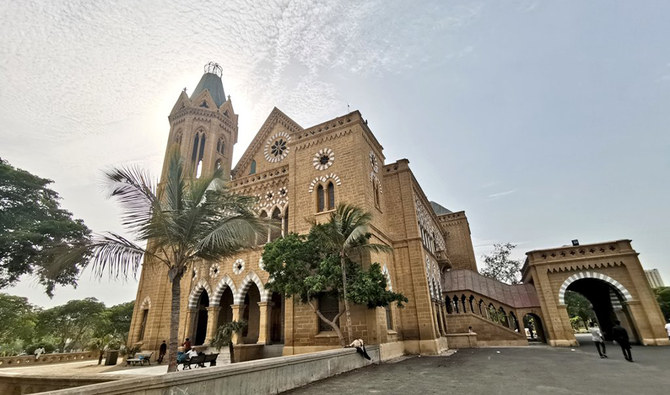

KARACHI: Set in a 19th-century garden, Frere Hall is one of the most iconic buildings in Karachi, but despite being a background of many TikTok videos, its accessibility remains limited as little has been done to keep it in shape.
Designed by Henry St, Clair Wilkins, a British army officer who served the East India Company, Frere Hall was completed in 1865 as a town hall. It is situated at the junction of Karachi’s Saddar and Clifton areas and is named after Sir Henry Bartle Edward Frere, an administrator in Pakistan’s southern Sindh province in the 1850s.
The first structure in south Pakistan built in the Indo Gothic style of British colonial architects, it is not only a majestic monument, but was also home to the city’s first library.
“It was the largest building in Sindh to be built until that time and it cost Rs 180,000. Before that the buildings that were made were not that expensive,” Yasmeen Lari, one of Pakistan’s most renowned architects, told Arab News.
“No cost was spared, it is very well built. It has got some beautiful stones of different kinds, it has got a lot of different kinds of imagery, beautiful windows which is very gothic, a very steep sloping roof which gives it a very distinctive kind of architectural character. The building had a very imposing presence.”
Frere Hall was built by local craftsmen, but it was an “imperial building,”
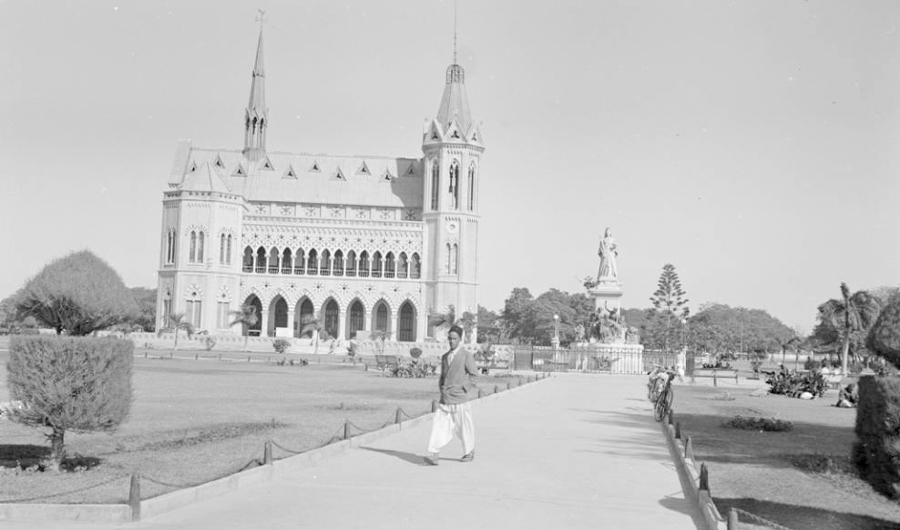
Frere Hall and statue of Queen Victoria in Jinnah Garden, Karachi, Pakistan, 1952. (Photo courtesy: @vintagepakistan/Facebook)
“The British used the architecture to also express how they wanted to govern the empire. So, when they really wanted to take over various areas and wanted to show their mind, they used the classical style,” Lari said. “It was only for the British at that time, no local or native was allowed to even enter.”
But now that colonial powers are long gone, little has been done to keep the site accessible for everyone. It has also significantly decayed over the past few decades.
Journalist and social activist Afia Salam recalled how she had visited Frere Hall in the 1960s.
“From my childhood, I know of Frere Hall as one of the most recognizable and important landmarks of Karachi. As a child, I used to visit it with my parents and siblings, like any Karachiite, to play around in the gardens as well as see the exhibits in the hall,” she told Arab News. “At that time, it was an exhibition hall, a gallery, then over the years, changed different hands. There was a time when it became very dilapidated.”
Columnist and rights activist Akhtar Baloch has been visiting Frere Hall for a book market that is held there every Sunday.
“A lot of students come to visit now as well as families, particularly on the weekend,” he said. “Unfortunately, there are no facilities for the public. There aren’t any male or female washrooms nor is drinking water available for visitors.”
Local authorities say they are doing their best to make the historical site as accessible to the public as possible.
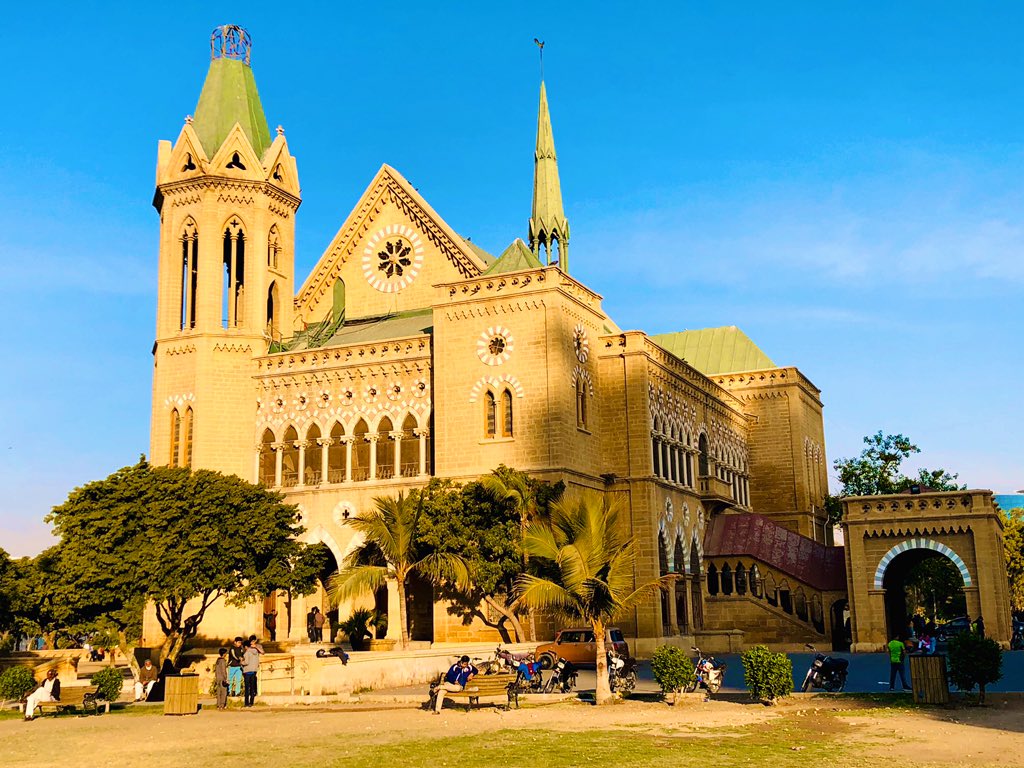
People are sitting outside Pakistan's iconic building located in Karachi, (Photo courtesy: @Sangrisaeed)
“In the last one year, ever since Murtaza Wahab sahab became the administrator (of Karachi), there have been a lot of changes,” Junaid Ullah, director general of parks at the Karachi Municipal Corporation, told Arab News.
“It has become one of the best parks in the city. Fountain that was built in 1890 have been reactivated while other facilities have also been added. Children who cannot afford to pay for parks in bigger areas come here, make photos and TikTok videos and enjoy their time.”
Major restoration works, however, are still to take place.
Some conservation is planned under the Ambassadors Fund for Cultural Preservation grant which was by the US Consulate General in Karachi to the Sindh Exploration and Adventure Society (SEAS) in October las year.
Dr. Asma Ibrahim, director of the Museum, Archives and Art Gallery Department of the State Bank of Pakistan, who is involved in the conservation project with SEAS president Dr. Kaleemullah Lashari, told Arab News that restoration works under the grant are focused on the Frere Hall’s fittings such as windows, doors, stairs.
But the “issues existing in the building may not be resolved in a single phase.”
“It shall present the Frere Hall to general public, city masters, and government to utilize it for the public activities in all its glory, and make every stake holder realize how much this landmark matters in the lives of the citizens,” she said.
“It shall help in attracting long-term intervention plan.”


