

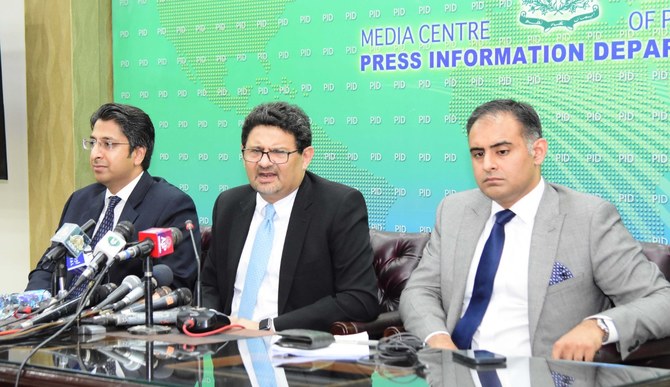

KARACHI: Federal Minister for Finance and Revenue Miftah Ismail blamed the country’s ongoing political turmoil for the rapid depreciation of national currency on Wednesday, as the Pakistani rupee hit another historic low of Rs224.92 against the US dollar.
Despite the recent staff-level agreement between Pakistan and the International Monetary Fund (IMF), the rupee has lost 4.5 percent of its value this week.
The finance minister said the recent depreciation of the Pakistani rupee was mainly triggered by the current political situation in the country, adding the market trend would reverse with greater stability and official measures taken to curtail imports.
“The rupee depreciation during the last two days is due to the political turmoil in the country,” he told a news conference in Islamabad. “Otherwise, there is no economic reason why the rupee is taking all be battering.”
“Our imports reached the historic high of $80 billion during the last fiscal year which continued to build pressure on the rupee throughout the year, particularly in the last six to eight months,” he added.
However, the finance minister said measures taken by the government to curtail the country’s import bill were producing encouraging results for the rupee.
“During the last three months, we tried to cut the imports and succeeded in June by reducing imports of non-energy products by 15 percent,” he continued. “However, the energy imports rapidly increased by 120 percent due their high costs. The overall imports were $7.4 billion out of which $3.7 billion were energy imports.”
“The measures have yielded the desired results and by July 18, 2022, the imports were recorded at $2.609 billion, or 20 percent below last year,” Ismail informed. “This indicates the imports will not more than $5.5 billion in this month. We will be saving around $2 billion on the imports which will also positively impact the rupee.”
However, the finance minister conceded all measures taken to curtail the imports had not worked and only some of them had succeeded.
“I do admit that some of the measures materialized and we benefited from them while others did not,” he said. “Restricting buildup units of vehicles and mobile phones have saved us foreign exchange.”
Asked about the recently signed agreement with the IMF, he said all measures recommended by the fund had been met.
“The agreement has been reached with the IMF and there is no hindrance,” he continued. “We have already met prior actions and there is no problem with the IMF program and we will not do anything that will create any obstacle. We expect that the IMF board will ratify the agreement and we will also get financing from the World Bank and Asian Development Bank.”
The finance minister reiterated the funding gap of $4 billion would be met through friendly countries in the form of oil and gas financing on deferred payment and deposits.
“A friendly country has assured $1.2 billion in oil financing on deferred payment and we hope it will be finalized in a few days,” Ismail said. “The facility will help fund oil worth $100 million per month. Another friendly country wants to invest $1-2 billion in stocks on G2G basis. The mechanism for that has been approved and sent to the Cabinet Committee on Legislative Cases for enactment of law. One more friendly country has agreed to give gas on deferred payment worth $200-300 million.”
The finance minister said he even expected more than $4 billion from a friendly nation in the form Special Drawing Rights (SDRs) and investments during the current fiscal year.
“A friendly country has asked to deposit $2 billion and another friendly country has asked to give $2 billion under SDRs. In fact, we estimate that the amount will be far more than $4 billion and exceed $8 billion during this year,” he maintained.
Ismail said he expected to receive $2-3 billion through investment in Balloki and Haveli Bahadur Shah power plants in Punjab on the G2G arrangement with some friendly nations.
He noted the government was trying to create a balance between imports and exports to curtail the increasing trade and current account deficits. “We are trying strike a balance by making imports equal to exports and remittances.”
Miftah ruled out the country would need to import diesel next month, saying it had enough of the commodity in its stock to last for 60 days.


