Russia is China’s top oil supplier for 2nd month, Saudi volumes tumble — data

(Shutterstock)
Short Url
Updated 20 July 2022
Follow

Russia is China’s top oil supplier for 2nd month, Saudi volumes tumble — data

SINGAPORE: Russia held its spot as China’s top oil supplier for a second month in June as Chinese buyers cashed in on lower-priced supplies, slashing more costly shipments from Saudi Arabia, data showed on Wednesday.

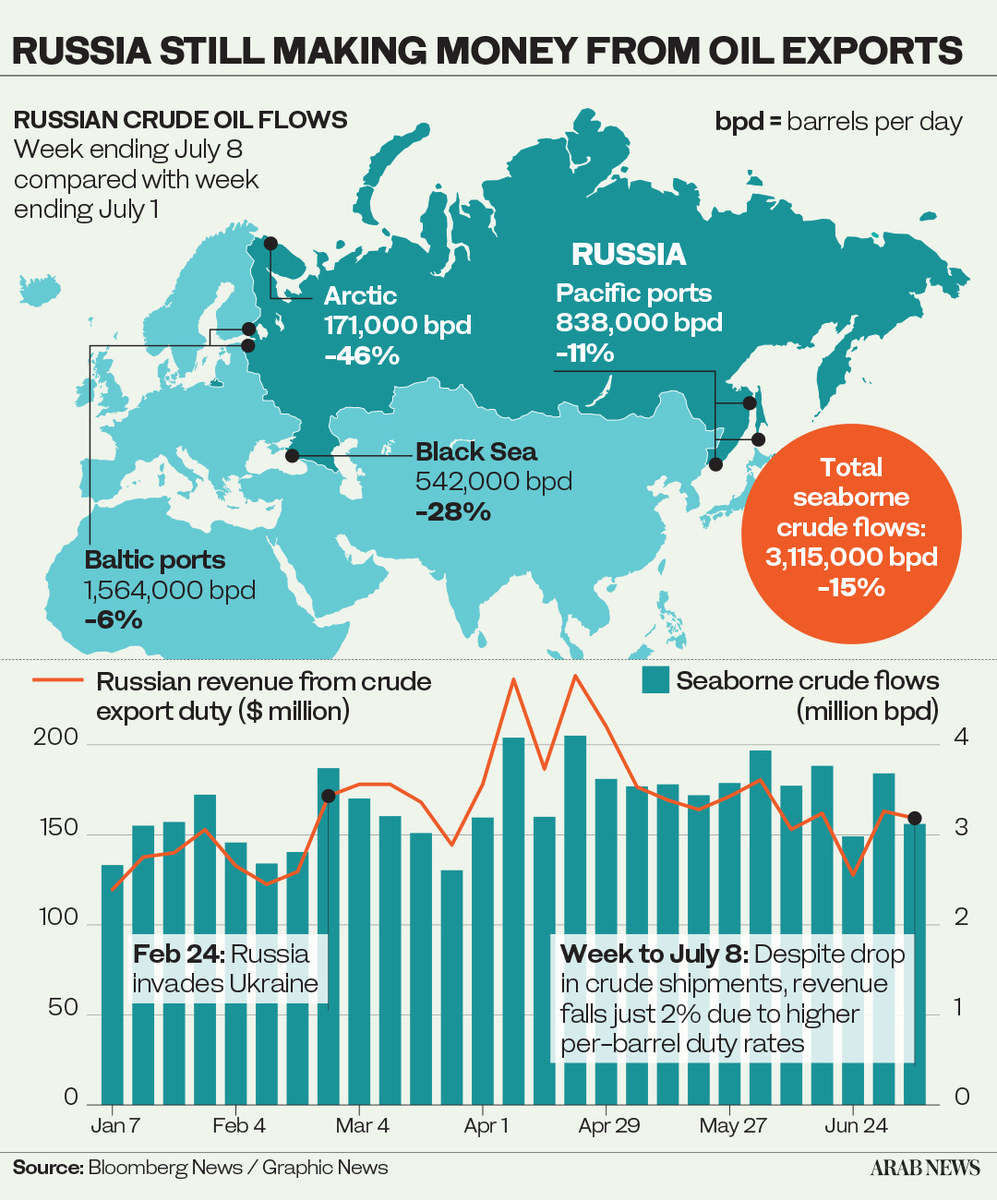
Imports of Russian oil, including supplies pumped via the East Siberia Pacific Ocean pipeline and seaborne shipments from Russia’s European and Far Eastern ports, totalled 7.29 million tons, up nearly 10 percent from a year ago, according to data from the Chinese General Administration of Customs.

Still, Russian supplies in June, equivalent to about 1.77 million barrels per day (bpd), were below May’s record of close to 2 million bpd, a level analysts had expected to be maintained.

China imported 5.06 million tons from Saudi Arabia, or 1.23 million bpd, down from 1.84 million bpd in May and 30 percent below the level in June last year.

Year-to-date imports from Russia totalled 41.3 million tons, up 4 percent on the year but still trailing behind Saudi Arabia, which supplied 43.3 million tons.

China’s total crude oil imports sank in June to near a four-year low as rigid lockdowns to contain the spread of coronavirus reduced fuel demand.

The rise in imports from Russia also displaced supplies from Angola and Brazil.
The Customs data showed China imported 260,000 tons of Iranian crude oil last month, its fourth shipment of Iran oil since last December, confirming an earlier Reuters report.

Despite US sanctions on Iran, China has kept taking Iranian oil, usually passed off as supplies from other countries. These supplies, roughly 7 percent of China’s total crude oil imports, are facing competition from the growing Russian flows.

Customs reported zero imports from Venezuela. State oil firms have shunned purchases since late 2019 for fear of falling foul of secondary US sanctions.
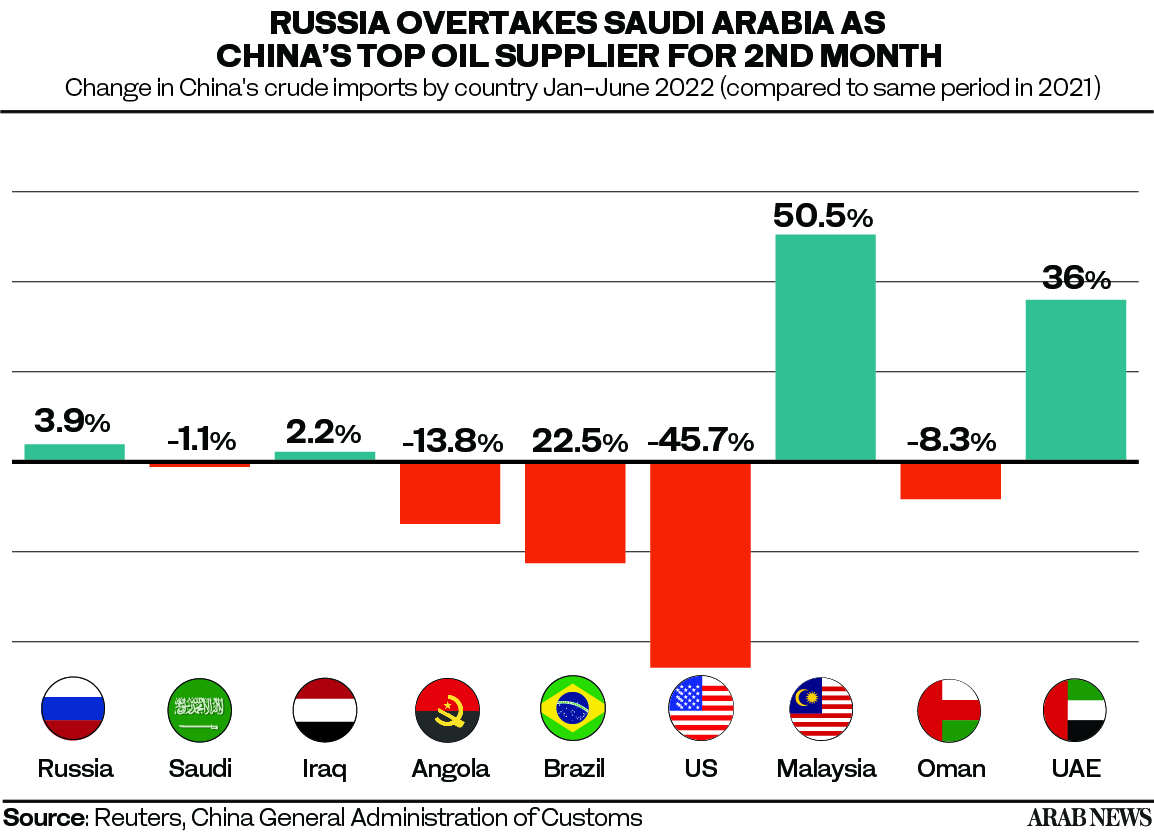
Imports from Malaysia, often used as a transfer point in the past two years for oil originating from Iran and Venezuela, soared 126 percent year-on-year to 2.65 million tons. Below is the detailed breakdown of oil imports, with volumes in metric tons


Egypt defies African FDI trend with inflows of $11bn in 2025: UNCTAD 

Updated 4 sec ago
Follow

Egypt defies African FDI trend with inflows of $11bn in 2025: UNCTAD 

RIYADH: Egypt emerged as Africa’s top destination for foreign direct investment in 2025, attracting an estimated $11 billion in inflows in a year marked by declining investment across the continent. 

According to UNCTAD’s latest Global Investment Trends Monitor, the North African country ranked ahead of other major African economies despite a sharp regional slowdown. 

The performance underscores Egypt’s relative resilience at a time when foreign investment into Africa has normalized following an unusually strong 2024, which UNCTAD said was inflated by a single large project. As a result, the 2025 data reflects a return to more typical investment levels across the continent. 

“Among African economies, inflows to Angola reached an estimated $3 billion, marking a return to positive values after nine consecutive years of net divestments,” the report stated. 

It added: “Egypt, with inflows of $11 billion, remained the largest FDI host country in Africa.”  

While Egypt solidified its position as Africa’s leading FDI host, other notable movements on the continent included Mozambique, where inflows surged 80 percent to $6 billion, driven by renewed activity in major liquified natural gas projects.  

Angola also saw a positive shift, recording an estimated $3 billion in FDI after nine consecutive years of net divestments. 

UNCTAD noted that Egypt’s strength extended beyond headline inflows, with the country also contributing to an increase in greenfield investment activity across Africa. While the number of greenfield projects fell globally and across most lower-income economies, Africa recorded a 5 percent increase in project numbers in 2025, supported in part by growth in Egypt and Côte d’Ivoire. 

Globally, FDI flows rose by 14 percent in 2025 to approximately $1.6 trillion, though growth was heavily concentrated in developed economies, which saw a 43 percent increase.  

In contrast, flows to developing economies declined by 2 percent, with the least developed countries particularly affected; three-quarters experienced stagnant or falling investment. 

The report highlighted that new project announcements remained weak globally amid elevated policy uncertainty, with international project finance declining for the fourth consecutive year.  

Looking ahead, UNCTAD warned that geopolitical tensions, regional conflicts, and economic fragmentation could continue to suppress real investment activity in 2026, even as financing conditions are expected to ease.  

For Africa, sustaining FDI inflows will require navigating persistent challenges such as financing constraints, risk perceptions, and structural vulnerabilities.