

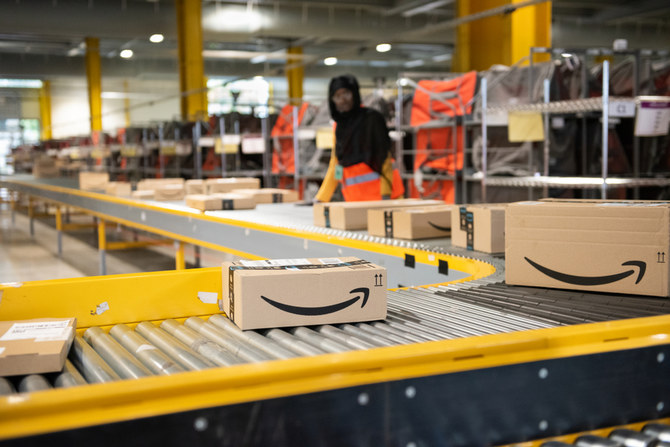
Amazon reducing its private-label items as sales fall: Wall Street Journal

Disappointing sales for many of the in-house brand items partly caused the decision to scale them back (Shutterstock)
Updated 15 July 2022
Follow

Amazon reducing its private-label items as sales fall: Wall Street Journal

REUTERS: Amazon.com Inc. has started reducing the number of items it sells under its own brands amid weak sales, the Wall Street Journal reported on Thursday, citing people familiar with the matter.

The company has also discussed the possibility of exiting the private-label business entirely to alleviate regulatory pressure, the report added. Amazon, however, said it has never considered closing the private label business.

“We continue to invest in this area, just as our many retail competitors have done for decades and continue to do today,” its spokesperson said.

Disappointing sales for many of the in-house brand items partly caused the decision to scale them back, the WSJ report said. (https://on.wsj.com/3aMjXIW)

The company’s leadership has also instructed its private-label team over the past six months to cut the list of items and not to reorder many of them, while also discussing reducing its in-house label assortment in the United States by well more than half, according to the report.

The decision was triggered after a review of the business by Dave Clark, a longtime Amazon executive who took over as the head of its global consumer business in January 2021, the report added.

The company’s house-brand business has drawn controversy, with the European Commission in 2020, charging Amazon with using its size, power and data to push its own products and gain an unfair advantage over rival merchants that also use its platform.

The US online retail giant has now offered to refrain from using sellers’ data for its own competing retail business and its private label products.


BYD Americas CEO hails Middle East as ‘homeland for innovation’

Updated 7 sec ago
Follow

BYD Americas CEO hails Middle East as ‘homeland for innovation’

  • In an interview on the sidelines of Davos, Stella Li highlighted the region’s openness to new technologies and opportunities for growth

DAVOS: BYD Americas CEO Stella Li described the Middle East as a “homeland for innovation” during an interview with Arab News on the sidelines of the World Economic Forum.

The executive of the Chinese electric vehicle giant highlighted the region’s openness to new technologies and opportunities for growth.

“The people (are) very open. And then from the government, from everybody there, they are open to enjoy the technology,” she said.

BYD has accelerated its expansion of battery electric vehicles and plug-in hybrids across the Middle East and North Africa region, with a strong focus on Gulf Cooperation Council countries like the UAE and Saudi Arabia.

GCC EV markets, led by the UAE and Saudi Arabia, rank among the world’s fastest-growing. Saudi Arabia’s Public Investment Fund has been aggressively investing in the EV sector, backing Lucid Motors, launching its brand Ceer, and supporting charging infrastructure development.

However, EVs still account for just over 1 percent of total car sales, as high costs, limited charging infrastructure, and extreme weather remain challenges.

In summer 2025, BYD announced it was aiming to triple its Saudi footprint following Tesla’s entry, targeting 5,000 EV sales and 10 showrooms by late 2026.

“We commit a lot of investment there (in the region),” Li noted, adding that the company is building a robust dealer network and introducing cutting-edge technology.

Discussing growth plans, she envisioned Saudi Arabia and the wider Middle East as a potential “dreamland” for innovation — what she described as a regional “Silicon Valley.” 

Talking about the EV ambitions of the Saudi government, she said: “If they set up (a) target, they will make (it) happen. Then they need a technology company like us to support their … 2030 Vision.”