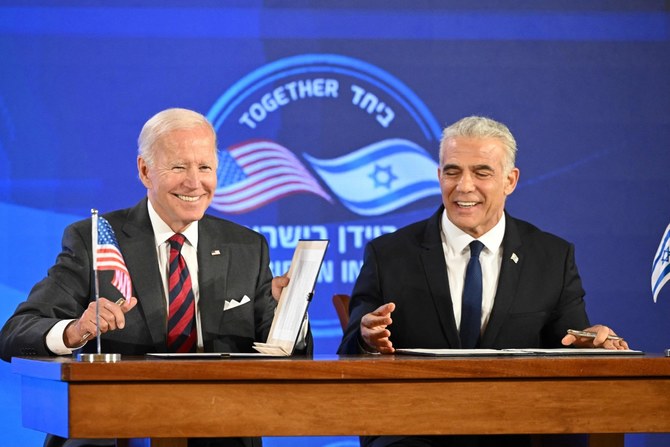
JERUSALEM: President Joe Biden and Israeli Prime Minister Yair Lapid on Thursday discussed Iran’s rapidly progressing nuclear program, with the Israeli leader vowing afterward that “there will be no nuclear Iran.”
The US president, who is set to travel to Saudi Arabia on Friday, said he also stressed to Lapid the importance of Israel becoming “totally integrated” in the region.
Their one-on-one talks are the centerpiece of a 48-hour visit by Biden aimed at strengthening already tight relations between the USand Israel. The leaders also issued a joint declaration emphasizing military cooperation and a commitment to preventing Iran, which Israel considers an enemy, from obtaining a nuclear weapon.
“We discussed the Iranian threat,” Lapid told reporters afterward. “There will be no nuclear Iran.”
Israeli officials have sought to use Biden’s first visit to the Middle East as president to underscore that Iran’s nuclear program has progressed too far and e ncourage the Biden administration t o scuttle efforts to revive a 2015 agreement with Iran to limit its development.
Resurrecting the Iran nuclear deal brokered by Barack Obama’s administration and abandoned by Donald Trump in 2018 was a key priority for Biden as he entered office. But administration officials have become increasingly pessimistic about the chances of getting Tehran back into compliance.
In the joint statement, the United States said it is ready to use “all elements of its national power” to prevent Iran from obtaining a nuclear bomb.
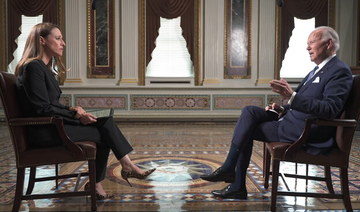
Biden, in an interview with Israel’s Channel 12 that aired Wednesday, offered strong assurances of his determination to stop Iran from becoming a nuclear power, saying he’d be willing to use force as a “last resort” if necessary.
Iran announced last week that it has enriched uranium to 60 percent purity, a technical step away from weapons-grade quality.
The joint declaration being announced Thursday could hold important symbolic importance for Biden’s meeting this weekend with Arab leaders in Saudi Arabia as he seeks to strengthen a regionwide alliance against Iran.
“I talked about how important it was … for Israel to be totally integrated in the region,” Biden said after the one-on-one meeting with Lapid.
Thursday’s meeting could also provide a boost to Lapid, who is serving as interim prime minister until elections in November, Israel’s fifth in less than four years. Lapid’s main opponent is the former prime minister, Benjamin Netanyahu, and the joint appearance with Biden could help burnish his credentials as a statesman and leader.
Biden and Lapid also scheduled a joint news conference Thursday and participated in a virtual summit with India and the United Arab Emirates, a collection of countries called the I2U2. The United Arab Emirates announced it will help finance a $2 billion project supporting agriculture in India.
Lapid, 58, is a former journalist and television anchor who entered politics only a decade ago. He served as finance minister under Netanyahu, the country’s longest-serving prime minister, before becoming leader of the opposition and cobbling together a diverse, eight-party coalition ending Netanyahu’s government.
Naftali Bennett became prime minister, with Lapid as his foreign minister. But the coalition collapsed after months of infighting, and Bennett agreed to step aside for Lapid until the election.
Lapid worked hard to solidify his credentials as a statesman while foreign minister. His aides believe the private face time, public appearances and demonstrations of friendship with Biden — who, at 79, is making his 10th trip to Israel — will strengthen that image and get the electorate more comfortable with the idea of Lapid as their leader.
However, Netanyahu is running for prime minister again, and opinion polls have projected that his conservative Likud party will win the most seats in the next election, well ahead of Lapid’s centrist Yesh Atid party.
Neither party is poised to singlehandedly capture the majority of seats needed to form a government, and it is unclear whether either man could cobble together a ruling coalition with smaller parties.
Biden played down the political uncertainty in an interview with Israel’s Channel 12 that aired Wednesday.
“We’re committed to the state, not an individual leader,” he said.
Biden didn’t mention the election during the public portion of Thursday’s meeting with Lapid, but told reporters “we had a good beginning of a long, God willing, relationship.”
Biden is expected to meet only briefly with Netanyahu, with whom who he’s had a rocky relationship in the past.
Much like Lapid, Biden also faces a political threat from his predecessor. Trump, an ally of Netanyahu who still enjoys strong support from Republican voters despite his attempt to overturn the last election, may run for another term.
Asked by Channel 12 if he expected a rematch, Biden replied, “I’m not predicting, but I would not be disappointed.”
Given the US’s status as Israel’s closest and most important ally, Biden is at the center of the country’s attention during his visit.
Israel staged an elaborate welcoming ceremony for him at the Tel Aviv airport, including a red carpet and a band that played the national anthem of both countries. Major television channels set up special live coverage of Biden’s arrival, and even broadcast a nonstop loop of his motorcade traveling on the highway to Jerusalem.
Israel opposed the original nuclear deal, reached under President Obama in 2015, because its limitations on Iran’s nuclear enrichment would expire and the agreement didn’t address Iran’s ballistic missile program or military activities in the region.
Instead of the US reentering the deal, which Trump withdrew from in 2018, Israel would prefer strict sanctions in hopes of leading to a more sweeping accord.
Biden also will receive Israel’s top civilian honor, the presidential medal of honor, from President Isaac Herzog on Thursday.
He’s also scheduled to meet with US athletes participating in the Maccabiah Games. Also known as the “Jewish Olympics,” it’s the country’s largest sporting event and held every four years for Israeli and Jewish athletes from all over world.


![]()
Biden says US will use all ‘national power’ to stop Iran atomic bomb

Short Url
https://arab.news/8bdxc
Biden says US will use all ‘national power’ to stop Iran atomic bomb
- The United States and Israel have separately made veiled statements about possible preemptive war with Iran
- Some Israeli as well as Gulf Arab officials believe the deal’s sanctions relief would provide Iran with far more money to support proxy forces

Latest updates





Recommended


© 2026 SAUDI RESEARCH & PUBLISHING COMPANY, All Rights Reserved And subject to Terms of Use Agreement.