

IMF agrees to resume Pakistan loan after fuel, tax hikes

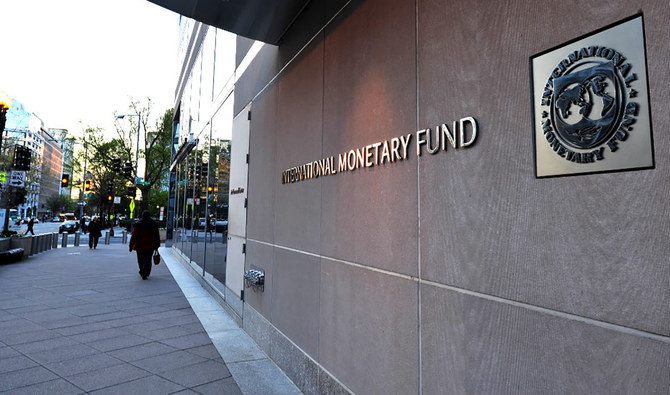
The International Monetary Fund (IMF) building sign is viewed in Washington DC on April 5, 2016. (AFP/File)
Short Url
Updated 14 July 2022
Follow

IMF agrees to resume Pakistan loan after fuel, tax hikes

  • Pakistan is at a “challenging economic juncture,” says Nathan Porter, who headed the IMF team
  • New agreement follows months of deeply unpopular belt-tightening by the government of Shehbaz Sharif

ISLAMABAD: The International Monetary Fund (IMF) said Thursday it had agreed with Pakistan to resume a suspended loan program that will inject $1.17 billion into the struggling economy.

A statement from the IMF said a “staff level agreement” — which is still subject to board approval — will bring to $4.2 billion the amount dispersed under an extended fund facility (EFF) that could increase to $7 billion and stretch until June next year.

An original $6 billion bailout package was signed by former prime minister Imran Khan in 2019, but repeatedly stalled when his government reneged on subsidy agreements and failed to significantly improve tax collection.

The new agreement follows months of deeply unpopular belt-tightening by the government of Shehbaz Sharif, which took power in April and has effectively eliminated fuel subsidies and introduced new measures to broaden the tax base.

“Pakistan is at a challenging economic juncture,” Nathan Porter, who headed the IMF team, said in a statement, adding external factors and domestic policies were to blame.

Pakistan is desperate for international support for its economy, which suffers from poor revenue collection and dwindling foreign reserves to pay its crippling debt.

The new government has slashed a raft of subsidies to meet the demands of global financial institutions but risks the wrath of an electorate already struggling under the weight of double-digit inflation.

A new coalition government — which came to power after Khan was ousted by a parliamentary no-confidence vote — has said it will make the tough decisions needed to turn the economy around.

Successive administrations blame their predecessors for the country’s economic woes, but analysts say the malaise stems from decades of poor management and a failure to tackle endemic corruption and widespread tax avoidance.

In a bid to secure the IMF loan, Prime Minister Sharif has imposed three fuel price hikes — cumulatively totalling 50 percent — and raised the cost of electricity to effectively end the subsidies introduced by Khan.

Islamabad has so far received $3 billion from the program, but with the facility due to end later this year, officials sought an extension until June 2023.

“It became essential to resume the IMF program to save the country from default,” finance minister Miftah Ismail told the national assembly last month.

“We knew it would damage our political reputation, but still we did it.”

The latest budget has earmarked 3.95 trillion rupees ($18.8 billion) just to service the country’s whopping debt of $128 billion.

Agreed policy priorities included steadfast implementation of the budget, the IMF’s Porter said in the statement.

Pakistan also agreed to continue power sector reforms, introduce a proactive monetary policy to tackle inflation, strengthen governance, combat corruption, and improve the social security net.

“The authorities should nonetheless stand ready to take any additional measures necessary to meet program objectives, given the elevated uncertainty in the global economy and financial markets,” the statement added.



Pakistan says ‘national security is non-negotiable’ after Afghanistan strikes

Updated 58 min 52 sec ago
Follow

Pakistan says ‘national security is non-negotiable’ after Afghanistan strikes

  • Islamabad says recent cross-border strikes targeted Afghanistan-based militants behind recent attacks
  • Kabul has condemned strikes, accused Pakistan of violating territorial sovereignty and killing civilians

ISLAMABAD: Pakistan’s Parliamentary Secretary for Information and Broadcasting Danyal Chaudhry said on Monday “national security is non-negotiable,” defending Islamabad’s recent cross-border strikes inside Afghanistan following a number of recent militant attacks.

The remarks come after Pakistan said it launched “intelligence-based selective targeting” of seven militant camps along the Afghan border in response to a mosque bombing in Islamabad and violence in the northwestern border districts of Bajaur and Bannu, among other attacks. Authorities say many of the assaults have been carried out by the Tehreek-e-Taliban Pakistan (TTP) and allied groups that Islamabad alleges are operating from sanctuaries in Afghanistan, whose government denies this.

Kabul has condemned Sunday’s strikes as a violation of its sovereignty and claimed civilians were killed. Pakistan has not responded to that allegation.

Tensions between the two neighbors have escalated sharply despite a fragile ceasefire agreed after deadly clashes in October. 

“Pakistan has always chosen the path of dialogue and peaceful coexistence. But when Afghan soil continues to be used for proxy attacks, we have no choice but to defend our homeland. National security is non-negotiable,” Chaudhry said in a statement.

He said the recent operation had “successfully neutralized militants involved in attacks on Pakistani soil,” adding that “every precaution was taken to protect innocent lives.”

Pakistan has repeatedly accused Afghanistan’s Taliban rulers of allowing TTP militants and fighters linked to the Islamic State Khorasan Province (ISKP), the regional affiliate of the Daesh group, to operate from Afghan territory, claims Kabul denies.

Chaudhry referred to a recent United Nations report, saying militants from 21 countries were now operating from Afghan territory and posed a threat to regional stability.

Afghanistan’s defense ministry earlier condemned what it called a breach of international law and vowed a “measured response at a suitable time.” Its foreign ministry summoned Pakistan’s ambassador over what it described as violations of Afghan airspace.

Islamabad has also accused neighboring India of backing anti-Pakistan militant groups, a charge New Delhi has consistently denied.

The latest exchange has raised concerns of renewed instability along the 2,600-kilometer frontier, where repeated border closures have disrupted trade and strained diplomatic ties. Analysts say the escalation risks undoing recent efforts at de-escalation, including the Saudi-mediated release of three Pakistani soldiers earlier this month.