

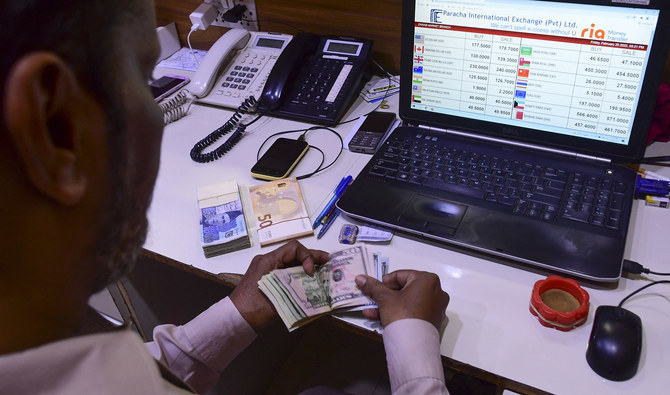

ISLAMABAD: The Pakistani rupee depreciated by Rs2.19 against the US dollar during interbank trading on Wednesday, with currency dealers and economists attributing the downward slide to fears over a delay in the revival of a stalled $6 billion International Monetary Fund (IMF) loan program.
The local currency closed at Rs210.1 against the greenback on Thursday, according to the State Bank of Pakistan. Last Thursday, it had closed at Rs207.91.
The US dollar has consistently risen in the Pakistani currency market in the last two months due to political and economic uncertainty.
Pakistan last month said it had received economic and financial targets from the IMF that once agreed and ratified should pave the way for the lender to unlock a suspended $6 billion loan program.
Pakistan desperately needs the money to avert a balance of payment crisis that is being brought closer by the day as a result of the sharp rise in global oil and commodity prices. Central bank foreign currency reserves have fallen dangerously low, and the economy is reeling from a sharp depreciation in the Pakistani rupee and double-digit inflation.
“We have no update on the IMF loan program so far,” Birj Lal Dosani, director-general media at the Ministry of Finance, told Arab News on Wednesday. Finance minister Miftah Ismail did not respond to questions. Bloomberg reported an agreement with the IMF had been reached.
Pakistan entered the IMF program in 2019 spread over three years and three months, but with less than half the amount disbursed, the IMF suspended the bailout earlier this year after the previous prime minister, Imran Khan, announced unfunded subsidies for the oil and power sectors. Khan’s government was ousted in April. The new government has since raised the prices of petroleum products at least four times to meet IMF conditions.
Economists and financial experts said the consistent devaluation of the rupee was attributed to numerous factors, but the burgeoning current account deficit and delay in the IMF deal were the major reasons behind the depreciation.
“This is obvious, the rupee is under significant pressure over delay in the IMF deal,” Samiullah Tariq, head of research at Pakistan Kuwait Investment Company (Private) Limited, told Arab News.
Listing other reasons behind the rupee depreciation, he said export inflows were slow as factories remained closed during the Eid holidays, which ran from Friday to Tuesday, while import pressure was high on the first working day.
“Our foreign remittances usually remain high before Eid holidays and then start drying up during the month, so this could be another reason behind the rupee depreciation against the dollar,” he said.
Tariq said the dollar index had also risen 1.5 percent in the international market in recent days and this had also brought the Pakistani rupee under pressure.
Currency dealers said an increasing import bill and uncertainty over the IMF loan program were major reasons behind a sharp rupee depreciation after the Eid holidays. The state bank has $9.8 billion in reserves, sufficient to cover the import bill of only five to six weeks.
“Our import bill has increased manifold in recent months with soaring prices of energy and food commodities in the international market while our forex reserves have been falling,” Malik Bostan, president of the Pakistan Forex Association, told Arab News.
“The rupee could appreciate up to two hundred against the greenback but only after the IMF $1 billion tranche was credited to the central bank,” he said.
Dr. Khaqan Hassan Najeeb, former adviser to the Ministry of Finance, said considering the jitteriness in the markets, it was important for Pakistan to reach a staff-level agreement with the IMF as soon as possible.
“Both the international bond market and forex market remain under pressure as Pakistan’s bonds yield has risen to uncomfortable level maturing in December 22 is now yielding 41 percent which was floated at 5.88 percent,” he told Arab News.
“A deal with the IMF would ensure that Pakistan’s foreign reserves are not only built by the money it receives from the international lender but also other sources, which could help remove pressure on the rupee.”


