

Baby stars, dancing galaxies: NASA shows new cosmic views

The edge of a nearby, young, star-forming region NGC 3324 in the Carina Nebula. (NASA, ESA, CSA, and STScI)
Short Url
Updated 13 July 2022
Follow

Baby stars, dancing galaxies: NASA shows new cosmic views

GREENBELT, Md: A sparkling landscape of baby stars. A foamy blue and orange view of a dying star. Five galaxies in a cosmic dance. The splendors of the universe glowed in a new batch of images released Tuesday from NASA's powerful new telescope.
The unveiling from the $10 billion James Webb Space Telescope began Monday at the White House with a sneak peek of the first shot — a jumble of distant galaxies that went deeper into the cosmos than humanity has ever seen.
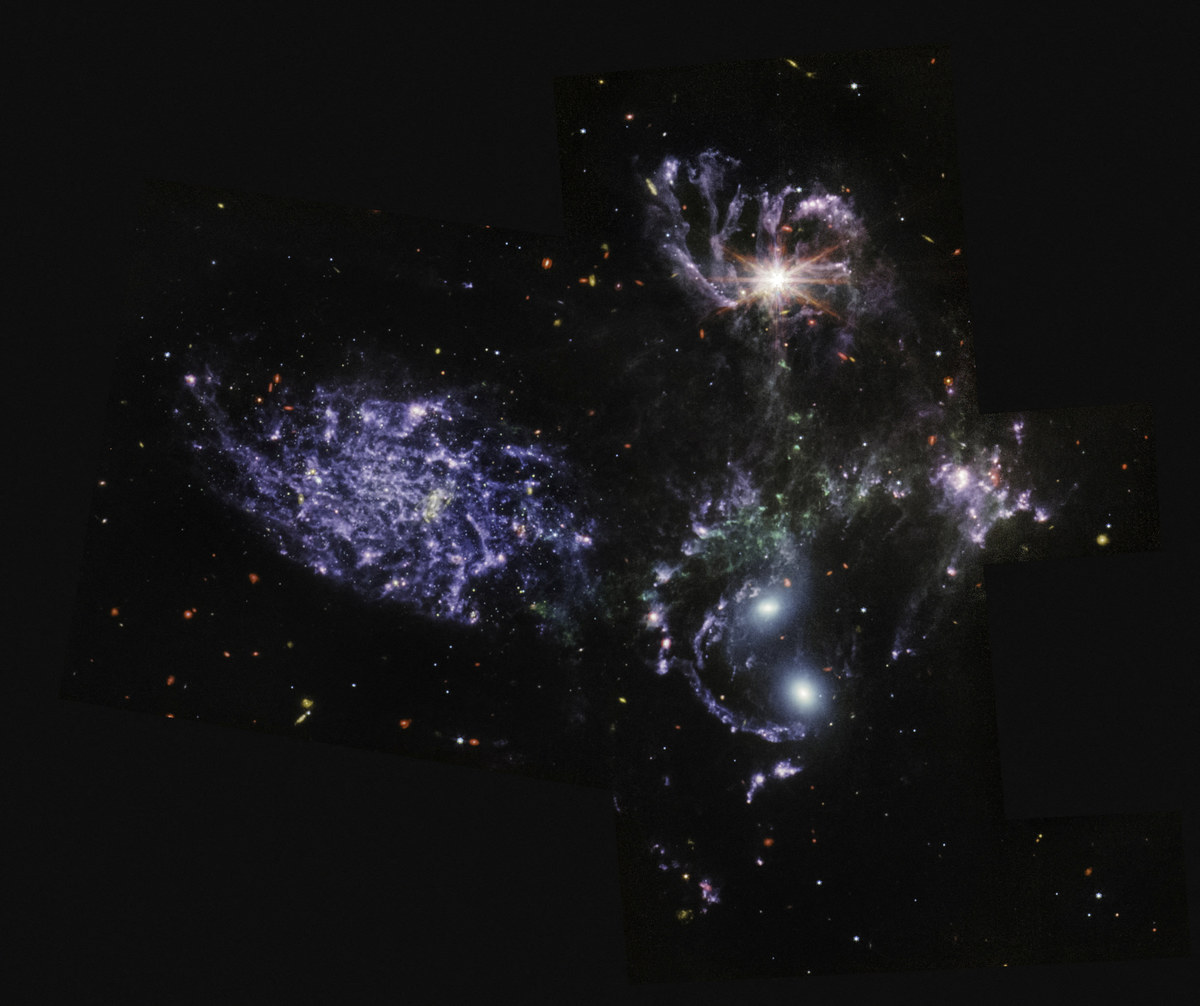


Stephan’s Quintet, a collection of five galaxies, as seen by MIRI from NASA's James Webb Space Telescope. (NASA, ESA, CSA, STScI)

Tuesday's releases showed parts of the universe seen by other telescopes. But Webb’s sheer power, distant location from Earth and use of the infrared light spectrum showed them in a new light.
“It’s the beauty but also the story,” NASA senior Webb scientist John Mather, a Nobel laureate, said after the reveal. “It’s the story of where did we come from.”
And, he said, the more he looked at the images, the more he became convinced that life exists elsewhere in those thousands of stars and hundreds of galaxies.
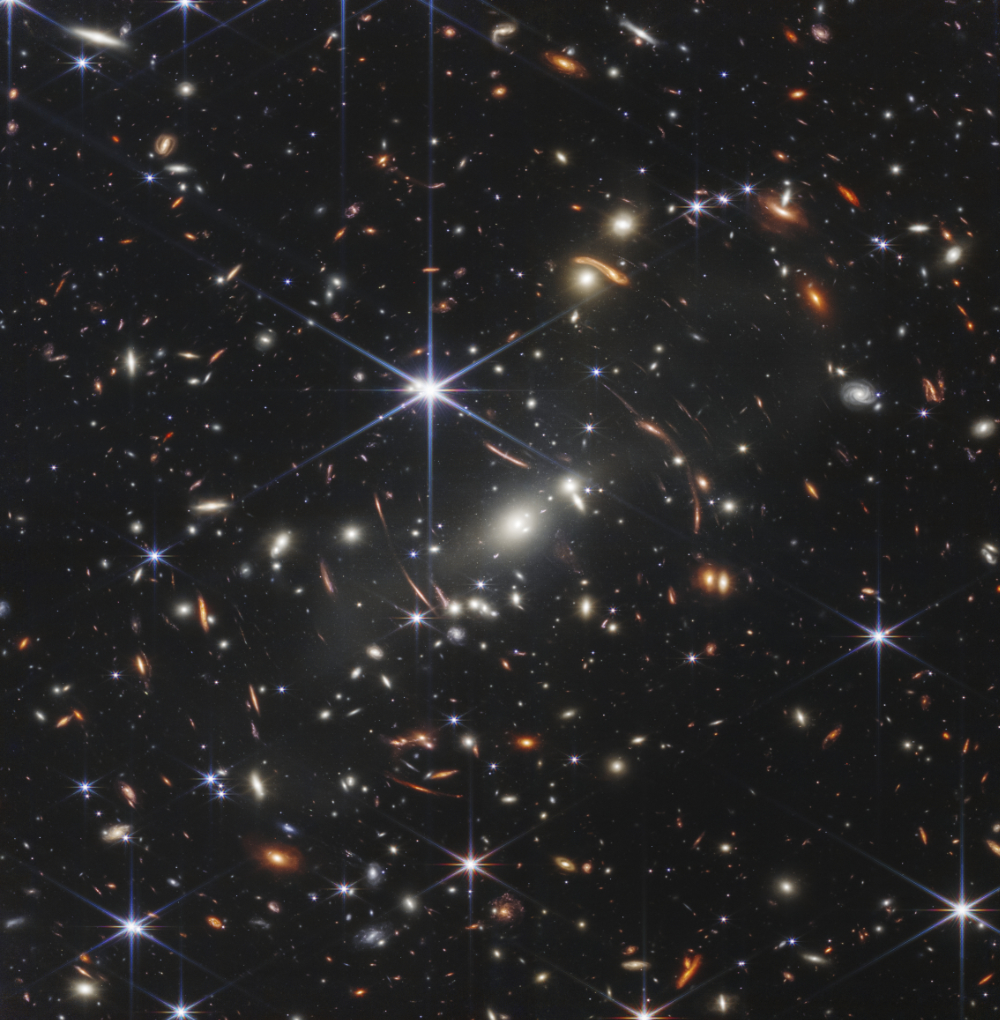


Galaxy cluster SMACS 0723 captured by the James Webb Space Telescope. ((NASA, ESA, CSA, STScI)

With Webb, scientist hope to glimpse light from the first stars and galaxies that formed 13.7 billion years ago, just 100 million years from the universe-creating Big Bang. The telescope also will scan the atmospheres of alien worlds for possible signs of life.
“Every image is a new discovery and each will give humanity a view of the humanity that we’ve never seen before,’’ NASA Administrator Bill Nelson said Tuesday, rhapsodizing over images showing “the formation of stars, devouring black holes.”
Webb’s use of the infrared light spectrum allows the telescope to see through the cosmic dust and see faraway light from the corners of the universe, he said.
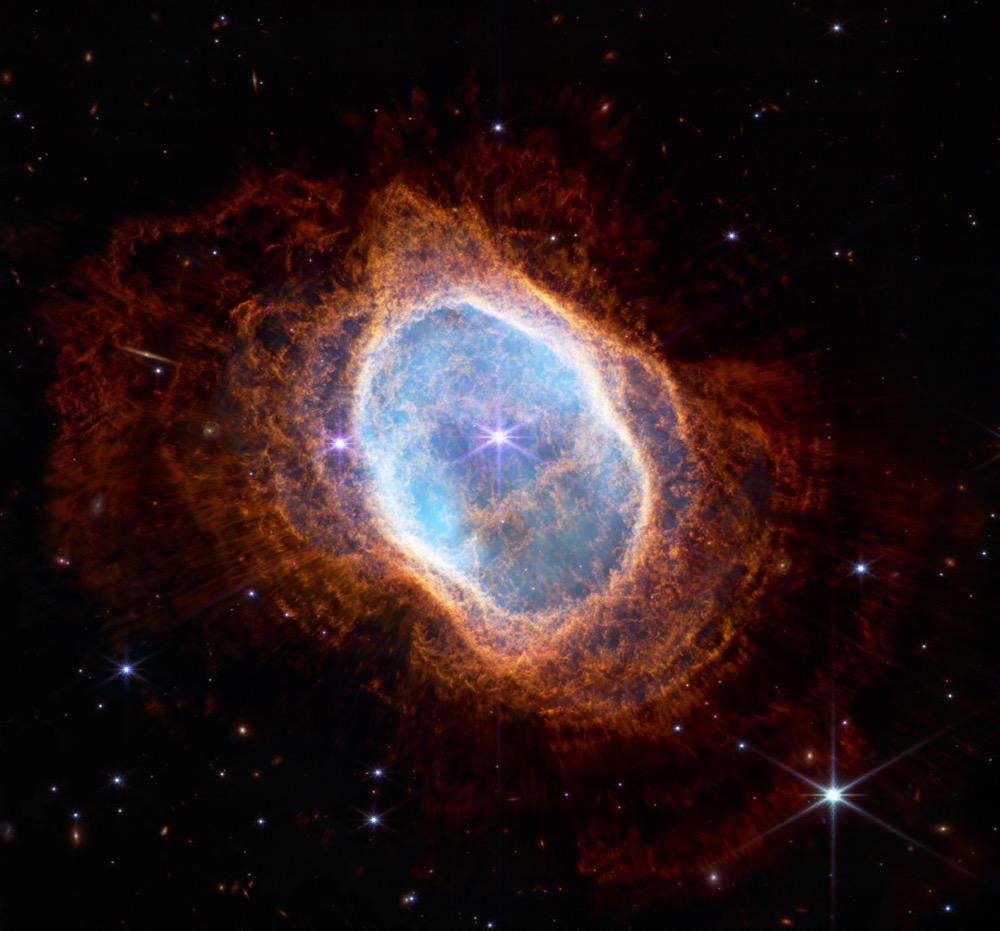


The bright star at the center of NGC 3132, the Southern Ring Nebula, for the first time in near-infrared light. (NASA, ESA, CSA, STScI)

“We’ve really changed the understanding of our universe,” said European Space Agency director general Josef Aschbacher.
The European and Canadian space agencies joined NASA in building the telescope, which was launched in December after years of delays and cost overruns. Webb is considered the successor to the highly successful, but aging Hubble Space Telescope.
Shown Tuesday:
— Southern Ring nebula, which is sometimes called “eight-burst." Images show a dying star with a foamy edge of escaping gas. It's about 2,500 light-years away. A light-year is 5.8 trillion miles.
— Carina nebula, one of the bright stellar nurseries in the sky, about 7,600 light-years away. One view was a stunning landscape of orange cliffs.
— Stephan's Quinet, five galaxies in a cosmic dance that was first seen 225 years ago in the constellation Pegasus. It includes a black hole that scientists said showed material “swallowed by this sort of cosmic monster.” Webb “has just given us a new, unprecedented 290 million-year-old view of what this Quintet is up to," Cornell University astronomer Lisa Kaltenegger, who wasn’t part of the Webb team, said in an email.
— A giant planet called WASP-96b. It’s about the size of Saturn and is 1,150 light-years away. A gas planet, it’s not a candidate for life elsewhere but a key target for astronomers. Instead of an image, the telescope used its infrared detectors to look at the chemical composition of the planet’s atmosphere. It showed water vapor in the super-hot planet's atmosphere and even found the chemical spectrum of neon.
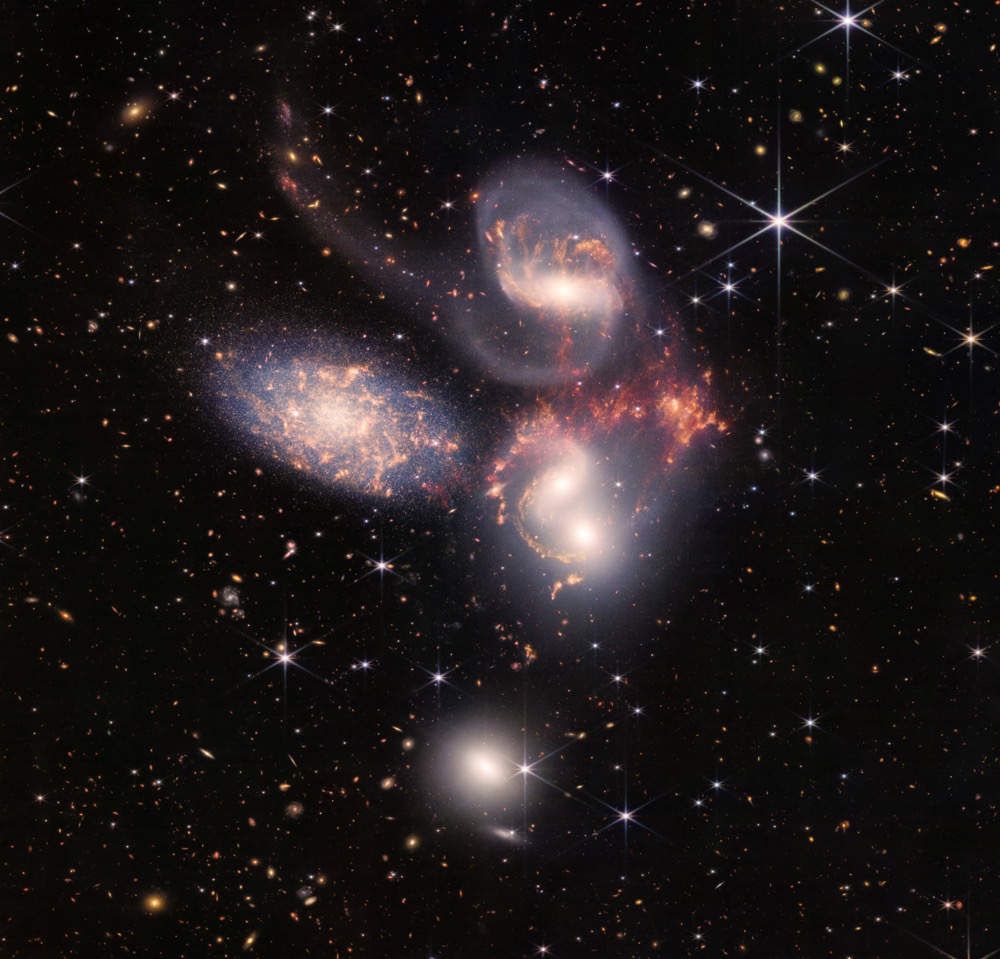


Stephan's Quintet, a visual grouping of five galaxies captured by the Webb Telescope's Near-Infrared Camera (NIRCam) and Mid-Infrared Instrument (MIRI). (NASA, ESA, CSA, STScI)

The images were released one-by-one at an event at NASA’s Goddard Space Center that included cheerleaders with pompoms the color of the telescope’s golden mirrors.
“It moves you. This is so so beautiful,” Thomas Zurbuchen, chief of NASA’s science missions, said after the event. "Nature is beautiful. To me this is about beauty.”
The world’s biggest and most powerful space telescope rocketed away last December from French Guiana in South America. It reached its lookout point 1 million miles (1.6 million kilometers) from Earth in January. Then the lengthy process began to align the mirrors, get the infrared detectors cold enough to operate and calibrate the science instruments, all protected by a sunshade the size of a tennis court.


Palestinian envoy pledges return to UN’s founding ideals in his bid for presidency of General Assembly

Updated 5 sec ago
Follow

Palestinian envoy pledges return to UN’s founding ideals in his bid for presidency of General Assembly

  • Riyad Mansour presents a vision for his candidacy grounded in the 3 core pillars of the UN: human rights, development, and peace and security
  • World of today ‘needs more, not less, United Nations,’ he says. ‘It needs us to honor our commitments … uphold our responsibilities … respect the rules of international law’

As Palestine’s envoy to the UN, Riyad Mansour, launched his candidacy for president of the 81st session of the UN General Assembly, he urged member states to recommit, at this time of growing global division, to multilateral cooperation, the principles of international law and the founding ideals of the UN.

Mansour, whose candidacy was endorsed by the UN’s Arab Group, presented a vision grounded in the three core pillars of the UN: human rights, development, and peace and security.

In his vision statement, he said: “The world we live in today needs more, not less, United Nations. It needs us to honor our commitments, not renege on them; to uphold our responsibilities, not abandon them; to respect the rules of international law, not grow accustomed to their breach.”

The 81st session of the UN General Assembly begins in September, and the election of its president will take place on June 2 in the General Assembly Hall at the UN headquarters in New York. In accordance with the established regional rotation of the position, the next president will be chosen from among the Asia-Pacific group of states.

Two others candidates have announced their intentions to stand so far: veteran diplomats Touhid Hossain from Bangladesh and Andreas S. Kakouris from Cyprus.

Mansour, who has served as the permanent observer of the State of Palestine to the UN since 2005, framed his candidacy through the lens of personal experience, describing himself as “a refugee, a migrant, the son of a steelworker,” who had lived through conflict, poverty and displacement.

“I know what it means when the United Nations is at its best, and I know only too well its shortcomings,” he said.

In his vision, Mansour reflected on the origins of the UN in the aftermath of a global conflict, describing the institution as a response to humanity’s “darkest moments” and a platform designed to replace war with cooperation.

He credited the General Assembly with enabling collective action that has delivered tangible gains, including advances in development, health, human rights and environmental protections.

“Together, we rejected the impulses of war and destruction and chose cooperation, common security and shared prosperity,” he said, citing milestones such as the Millennium Development Goals, the 2030 Agenda for Sustainable Development, and international agreements on climate change, disarmament and gender equality.

Despite those achievements, however, Mansour warned that many pledges have not been kept and trust in the international system is eroding.

“Too many promises remain unfulfilled, and too much suffering continues,” he said. “The international order has grown increasingly uncertain, and the ideals of the United Nations are too often left unenforced.”

He cautioned against a return to a world in which “conflict prevails over dialogue” and “coercion replaces diplomacy,” arguing that the scale of present-day crises — from armed conflict and humanitarian emergencies to climate change and technological risks — requires a renewed, collective resolve.

“We cannot risk a return to a world where disorder undermines the rule of international law,” Mansour said. “We must rise above division and recommit to partnership.”

He called for reforms within the UN system itself with the aim of improving efficiency, inclusivity and engagement, saying that such changes were necessary to restore confidence in the organization’s ability to deliver peace and security.

“This moment demands engagement grounded in mutual interest and sustained by persistent action,” he said, adding that reform was essential “to restore trust in our United Nations and its enduring capacity to contribute to international peace and security.”

He described his vision as pragmatic rather than ideological, shaped by decades of multilateral diplomacy and a belief in the UN as “an anchor for a more peaceful and just world.”

He continued: “At a time of profound strain on the multilateral system, my vision seeks to mobilize member states and stakeholders to preserve and safeguard what we have accomplished, and to pursue progress with urgency, so that dignity, opportunity and hope are extended to all.”

The president of the General Assembly is elected annually and is responsible for presiding over its sessions, representing its decisions, and facilitating negotiations among member states.