

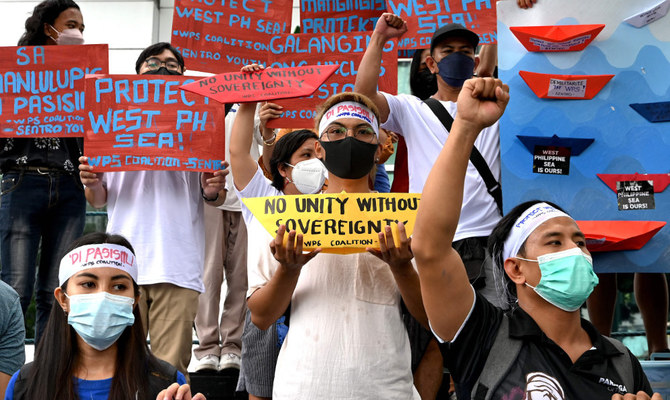
Manila asserts sovereignty on South China Sea arbitration anniversary

Protesters stage a demonstration to commemorate the 6th anniversary of the Hague Ruling that rejected China’s historical claims to the disputed waterway, in front of the Chinese Cultural Consulate in Manila on July 12, 2022. (AFP)
Short Url
Updated 12 July 2022
Follow

Manila asserts sovereignty on South China Sea arbitration anniversary

  • US warns it will defend the Philippines if China breaks international court ruling
  • Last week, Chinese FM Wang Yi visited Manila to ‘open up new golden era’ in bilateral ties

MANILA: The Philippines’ newly appointed foreign minister pledged on Tuesday to uphold a 2016 ruling by an international tribunal that invalidated most of Beijing’s claims in the contested South China Sea, a week after China sought to strengthen ties with the new Philippine government.

Manila and Beijing have a long-running dispute over the South China Sea, which is claimed by China almost in its entirety.

In 2013, following a standoff, the Philippines lodged a case with the Permanent Court of Arbitration in the Hague seeking clarification of its sovereign entitlements under international law.

In 2016, the court ruled in favor of the Philippines, but Beijing rejected the ruling and continued to send fishing vessels, and raise structures in the strategic and resource-rich waterway, part of which is a Philippine exclusive economic zone.

The Philippines has filed hundreds of diplomatic protests against Chinese activity since the 2016 decision.

Marking the sixth anniversary of the award and the 40th anniversary of the UN Convention on the Law of the Sea, on which the court decision was based, Foreign Secretary Enrique Manalo said that the ruling was “final” and called for the international community to support it.

“These findings are no longer within the reach of denial and rebuttal, and are conclusive as they are indisputable,” he said.

“We firmly reject attempts to undermine it; nay, even erase it from law, history, and our collective memories. At the same time, we welcome the support of a growing list of countries for the award.”

The Philippine foreign minister’s statement comes a week after he hosted his Chinese counterpart, Wang Yi, who said at the time he was visiting Manila to “open up a new golden era for the bilateral relationship.”

Manalo was appointed earlier this month by new Philippine President Ferdinand Marcos Jr., who during his presidential campaign committed to continuing a Beijing-friendly direction embraced by his predecessor, former president Rodrigo Duterte, but not at the expense of sovereignty.

He also promised the Southeast Asian country would seek to strengthen ties with the US, which said on Tuesday it would protect the Philippines, its oldest ally in the region, with whom it has a decades-old defense treaty that is seen as a bulwark against China’s growing influence in the region.

In a statement marking the anniversary of the Hague ruling, US Secretary of State Antony Blinken said the arbitration was final, and called on China to “abide by its obligations under international law and cease its provocative behavior.”

“We will continue to work with allies and partners, as well as regional institutions such as ASEAN, to protect and preserve the rules-based order,” he said. “We also reaffirm that an armed attack on Philippine armed forces, public vessels, or aircraft in the South China Sea would invoke US mutual defense commitments.”


Indian teacher who created hundreds of learning centers wins $1 million Global Teacher Prize

Updated 55 min 20 sec ago
Follow

Indian teacher who created hundreds of learning centers wins $1 million Global Teacher Prize

  • Nagi is the 10th teacher to win the award, which the foundation began handing out in 2015

DUBAI: An Indian teacher and activist known for creating hundreds of learning centers and painting educational murals across the walls of slums won the $1 million Global Teacher Prize on Thursday.
Rouble Nagi accepted the award at the World Governments Summit in Dubai in the United Arab Emirates, an annual event that draws leaders from across the globe.
Her Rouble Nagi Art Foundation has established more than 800 learning centers across India. They aim to have children who never attended school begin to have structured learning. They also teach children already in school.
Nagi also paints murals that teach literacy, science, math and history, among other topics.
The prize is awarded by the Varkey Foundation, whose founder, Sunny Varkey, established the for-profit GEMS Education company that runs dozens of schools in Egypt, Qatar and the UAE.
“Rouble Nagi represents the very best of what teaching can be – courage, creativity, compassion, and an unwavering belief in every child’s potential,” Varkey said in a statement posted to the Global Teacher Prize website. “By bringing education to the most marginalized communities, she has not only changed individual lives, but strengthened families and communities.”
Nagi plans to use the $1 million to build an institute that offers free vocational training.
Stefania Giannini, UNESCO Assistant Director-General for Education, said Nagi’s prize “reminds us of a simple truth: teachers matter.”
In comments carried on the prize website, Giannini said UNESCO was “honored to join the Global Teacher Prize in celebrating teachers like you, who, through patience, determination, and belief in every learner, help children into school — an act that can change the course of a life.”
Nagi is the 10th teacher to win the award, which the foundation began handing out in 2015.
Past winners of the Global Teacher Prize have included a Kenyan teacher from a remote village who gave away most of his earnings to the poor, a Palestinian primary school teacher who teaches her students about non-violence and a Canadian educator who taught a remote Arctic village of Inuit students. Last year’s winner was Saudi educator Mansour Al-Mansour, who was known for his work with the poor in the kingdom.
GEMS Education, or Global Education Management Systems, is one of the world’s largest private school operators and is believed to be worth billions. Its success has followed that of Dubai, where only private schools offer classes for the children of the foreigners who power its economy.