

After weeks of work, Pakistan’s rare woman cattle trader celebrates Eid with food, family holiday

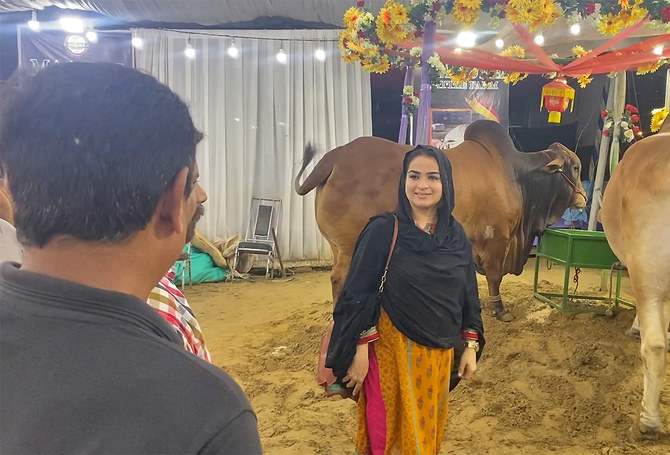
A woman cattle trader Sidra Khan speaks to customers in Karachi, Pakistan, on July 4, 2022. (AN Photo)
Short Url
Updated 11 July 2022
Follow

After weeks of work, Pakistan’s rare woman cattle trader celebrates Eid with food, family holiday

  • Sidra Khan is one of two women among over 40,000 traders selling sacrificial animals at Karachi Cattle Market this year
  • Has run successful meat business for four years, on Eid third day Khan will leave on vacation with kids and “switch off phone”

KARACHI: Sidra Khan spent the days of Eid Al-Adha this year like millions of other Pakistani women: cooking up a storm of traditional holiday dishes for her immediate family and larger community.

But her work in the kitchen has not kept Khan tethered only to household responsibility, and out of the workforce. Until very late on Saturday night, the eve of Eid, she was one of only two women among over 40,000 traders selling sacrificial animals at the Karachi Cattle Market.

Every year, Pakistan’s southern port city of Karachi hosts the country’s largest livestock fair, spread over 2,000 acres of land, with 425,000 animals for sale.

Khan, 37, was a rarity among the thousands of male traders this year.

Having hovered around 10 percent for over 20 years, female labor force participation in urban Pakistan is among the lowest in the world, according to the World Bank.

To combat this, Khan had special message for other women ahead of the Eid holiday.

“Don’t spend your whole time shopping for Eid only or at home,” she told Arab News, advising women to put their savings to good use during the Eid Al-Adha season by investing in sacrificial animals and selling them through an experienced trader.

“If you sell two animals a season, it can cover your shopping expenses,” she said, smiling. “Ladies should come forward, do it, even if at a small scale.”
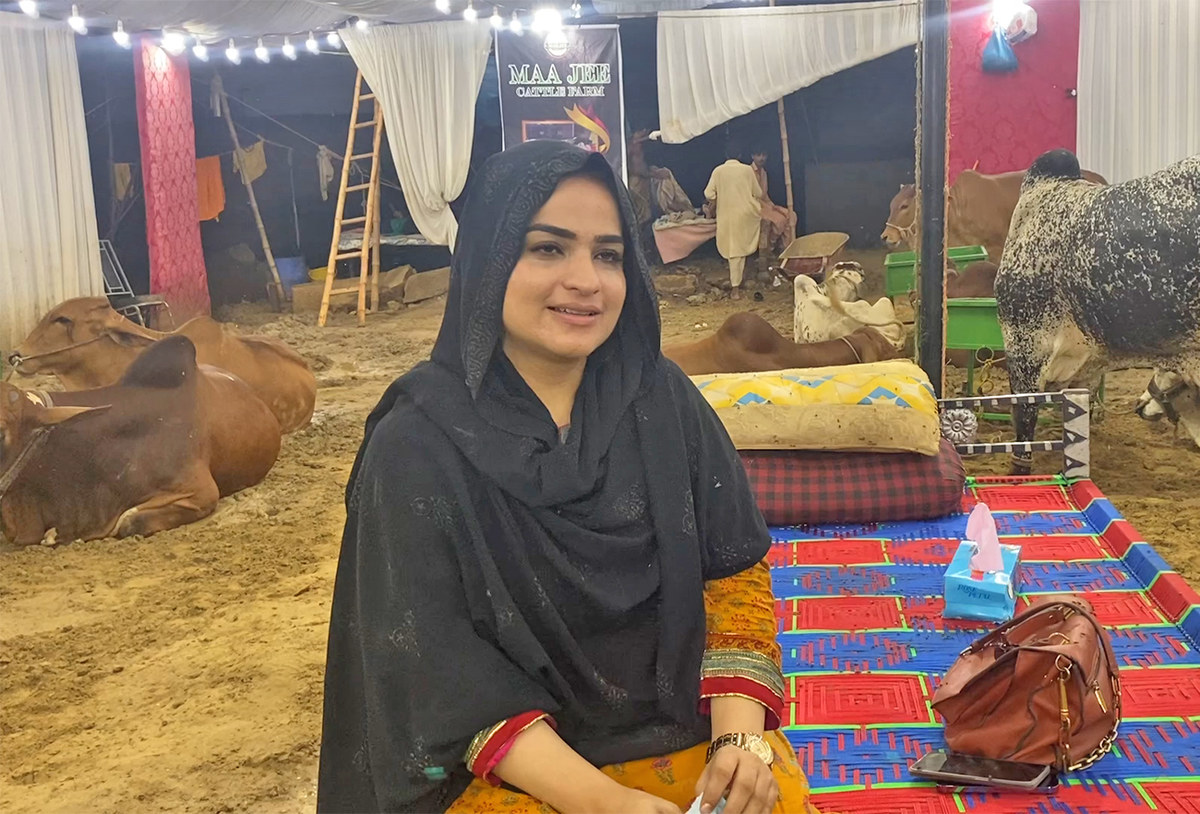


A woman cattle trader Sidra Khan speaks to Arab News in Karachi, Pakistan, on July 4, 2022. (AN Photo)

After graduating from Karachi University in 2012, Khan landed a job with Pakistan International Airlines (PIA) as a member of the cabin crew. She worked there for six years but quit in 2018 after getting married, as many Pakistani women do, when her husband told her she didn’t need to earn a living.

“Then I thought: I should do my own business,” Khan said.

Trading in cattle proved to be a natural choice for Khan, since her maternal grandfather had a business slaughtering cattle in Swabi city in Pakistan’s northwestern Khyber Pakhtunkhwa province. 

“This is in [my] blood,” Khan said.

Despite that, however, the cattle business was gruelling, Khan said, who has to regularly visit cattle markets in southern Punjab’s Multan and Bahawalpur cities and in Mirpurkhas and Dadu in Pakistan’s southern Sindh province, for procurement purposes. The searing heat, especially during summers, and the male-dominated environments are a challenge but the trader said she tried to keep her focus solely on work.

“You cannot do work by becoming a shameplant,” she said with a laugh, referring to a plant famous for its sensitivity to touch, its leaves folding inward and drooping when touched or shaken.

In four years, Khan has managed to set up a successful cattle business, leading a team of 15 men in the purchase, marketing and trading departments. 

This is the first year, however, that she set up a stall at the Karachi livestock market, where Khan described being mocked by her male colleagues and having to face a range of other issues as a woman seller.

“But I don’t get annoyed,” she said. “I explain it to them, I make them understand that there is nothing that ladies cannot do. I can do this. I have the courage.”

Khan said she was also a better planner and supervisor than many of her male colleagues.

“I think I am doing it better than the men,” Khan said with a glint in her eye, saying that she been trading cattle round the year, providing them to slaughterhouses, offices and seminaries, and facilitating families who lived abroad.

“Those who are out of the country, they trust in us from abroad, and on their behalf we have to sacrifice the animals and distribute among the poor in a proper way,” the trader explained. “And then we provide NGOs and seminaries with sacrificial animals also in large quantities.”

In the future, Khan said she wanted to open her own slaughterhouse but her biggest goal was to bring more women into the cattle business. 

“I want to bring women to this field so, I was thinking of designing some classes,” she said.

“It is a good field and I’m available for any help [for other women], may it be in the form of sharing an experience or teaching them,” she said. “No matter what perspective you look from, women are not inferior in anything and to anyone. If they want to do something, they can achieve a lot.”

Managing her business efficiently was doubly important for Khan, she said, as she needed to save time for her children. Her husband passed away last year from the coronavirus. 

“When I have free time, the entire time belongs to the children, to my home,” she said. “On the third day of Eid [Tuesday], I will leave for a vacation with my kids for a week or ten days and switch off my phone.”


Pakistan condemns Netanyahu’s ‘hexagon of alliances’ plan, says alert to growing India-Israel defense ties

Updated 26 February 2026
Follow

Pakistan condemns Netanyahu’s ‘hexagon of alliances’ plan, says alert to growing India-Israel defense ties

  • Israel’s Netanyahu last week proposed an alliance of countries in and around Middle East against its adversaries
  • Pakistan maintains “robust military preparedness” to deter any potential aggression, says foreign office spokesperson

ISLAMABAD: Pakistan’s foreign office spokesperson on Thursday condemned Israeli Prime Minister Benjamin Netanyahu’s recent statement about forming a “hexagon of alliances” within or around the Middle East, saying Islamabad was alert to growing defense ties between New Delhi and Tel Aviv. 

Netanyahu on Sunday outlined plans to form a new regional bloc, describing it as a “hexagon of alliances” that he said could include Israel, India, Greece and Cyprus, along with other unnamed Arab, African and Asian states. He said the grouping would collectively stand against what he described as “radical” adversaries.

His comments came days before Indian Prime Minister Narendra Modi arrived in Israel on Wednesday for a two-day trip to bolster ties. The two are expected to discuss cooperation in science and technology, innovation, agriculture, water management, technology, defense and security during the trip. 

The statement drew a sharp response from Pakistan’s Senate, which unanimously passed a resolution on Tuesday rejecting Netanyahu’s remarks.

“I would also like to draw your attention to the recent resolution adopted by the Senate of Pakistan that strongly condemned such remarks and attempts to undermine Muslim unity,” Foreign Office spokesperson Tahir Andrabi told reporters during a weekly press briefing.

“We continue to condemn these provocative steps and statements by the leadership of the occupying power that threaten regional peace and stability,” he added.

Netanyahu had also said Israel’s goal was to create an axis of nations that see eye to eye against what he described as the “radical Shia” and “radical Sunni” axis of nations. 

Andrabi said attempts to divide the Muslim world along sectarian lines were a “nefarious design” on Netanyahu’s part.

India is Israel’s largest arms buyer and second-largest trading partner in Asia, after China. In response to a question on India’s growing defense ties with Israel, Andrabi said Pakistan remained cognizant of the risks posed by such cooperation.

“Yes, we remain seized of the defense ties between Israel and India,” the spokesperson said, noting that certain “systems and platforms” may have been used by India against Pakistan in the past.

“We are alive to the threats they pose to our security, sovereignty and territorial integrity, as well as to regional peace and stability.”

Andrabi said Pakistan maintained “robust military preparedness” to deter any potential aggression from hostile forces.

‘UTMOST CAUTION EXERCISED’

Andrabi spoke about Pakistan’s recent strikes against alleged militant camps in Afghanistan, saying Islamabad had conducted them in self-defense and with extreme caution to avoid casualties. 

Pakistan said it carried out airstrikes in Afghanistan against militant camps and hideouts in three provinces on Saturday night, killing over 100 militants. Afghanistan accused Pakistan of violating its territorial sovereignty and killing dozens of civilians. Kabul has vowed to retaliate. 

Andrabi said the strikes were carried out to ensure protection for the lives of the people of Pakistan and to prevent “imminent terrorist attacks.”

“These actions were directed solely against identified terrorist camps and hideouts, and utmost caution was exercised to prevent harm to civilians,” he said. 

He warned Pakistan would take necessary measures under its right to self-defense against “terrorist threats” emanating from Afghan territory.

On the safety of Pakistani nationals in Afghanistan following the strikes, Andrabi said Islamabad had raised the issue with Afghan authorities, adding that Islamabad expected “foolproof security” for Pakistani diplomats and civilians.