

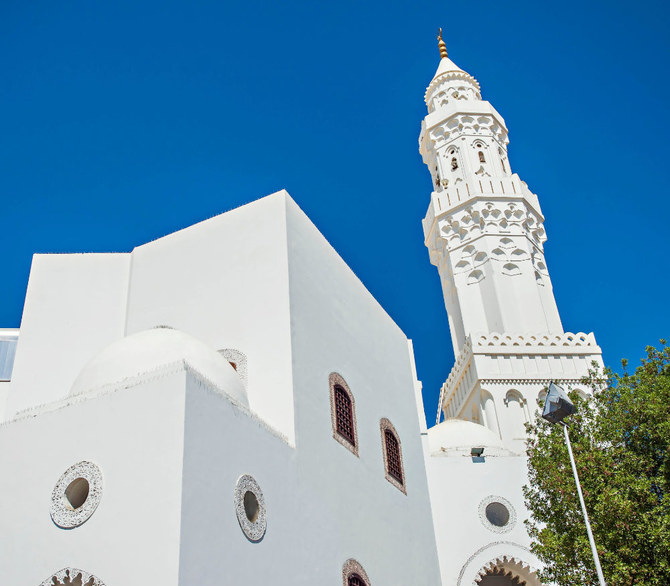
ThePlace: Masjid Al-Qiblatain, where the direction of prayer was reoriented to Makkah

Masjid Al-Qiblatain in Madinah. (SPA)
Short Url
Updated 11 July 2022
Follow

ThePlace: Masjid Al-Qiblatain, where the direction of prayer was reoriented to Makkah

  • Masjid Al-Qiblatain, meaning “two directions,” was built two years after Prophet Mohammed arrived in Madinah, a city known for its rich Islamic history, and a customary stop for millions of Umrah and Hajj pilgrims every year

Thousands of pilgrims arriving for Hajj this year will again flock to Masjid Al-Qiblatain in Madinah, where Prophet Muhammad (peace be upon him) was urged by Qur'anic injunction to change the direction of prayers from Al-Aqsa Mosque in Palestine to the Grand Mosque in Makkah.

Masjid Al-Qiblatain, meaning “two directions,” was built two years after Prophet Mohammed arrived in Madinah, a city known for its rich Islamic history, and a customary stop for millions of Umrah and Hajj pilgrims every year.

It was in Madinah where the Almighty revealed a Qur'anic verse to His messenger: “Verily! We have seen the turning of your face towards the sky. Surely, We shall turn you to a Qibla that shall please you. So, turn your face in the direction of Al-Masjid-Al-Haram.”

Mud bricks, fronds, and palm trunks were the initial material used to build the mosque.

It has been renovated and expanded several times over the centuries, with the first expansion taking place during the era of Caliph Omar bin Abdulaziz in 706. The size of the mosque remained unchanged for nearly 800 years. It was then renovated by Shaheen Al-Jamali in 1488.

King Abdulaziz in the early 1930s also ordered further renovations which included the construction of a minaret, a surrounding wall, and the expansion of the mosque to 425 square meters.


‘Masterpieces of Saudi Orchestra’ shine at Maraya in AlUla

The “Masterpieces of Saudi Orchestra” concert opened at Maraya Concert Hall in AlUla on Thursday. (Supplied)
Updated 23 January 2026
Follow

‘Masterpieces of Saudi Orchestra’ shine at Maraya in AlUla

  • The concert on its opening night presented a seamless artistic journey, where orchestral works met Saudi musical identity
  • It underlined the Music Commission’s aim to present Saudi artistry at a high professional level

RIYADH: The “Masterpieces of Saudi Orchestra” concert opened at Maraya Concert Hall in AlUla on Thursday under the patronage of the Kingdom’s Minister of Culture and Chairman of the board of the Music Commission Prince Bader bin Abdullah.

Organized by the Music Commission, the concert on its opening night presented a seamless artistic journey, where orchestral works met Saudi musical identity.

The Saudi National Orchestra and Choir, conducted by Maestro Hani Farhat, led audiences through carefully curated pieces reflecting heritage and modern creativity.

The repertoire combined traditional influences with orchestral scoring, offering listeners heritage-based compositions alongside recent arrangements.

Regional rhythms and layered musical textures were used to echo the Kingdom’s history, while pieces rooted in Saudi classical music tradition connected audiences with familiar cultural references in a fresh format.

The concert underlined the Music Commission’s aim to present Saudi artistry at a high professional level.

The series seeks to honor national heritage while encouraging contemporary artistic engagement, and its growing local and international presence was highlighted throughout the evening.

The program also featured a visual dimension led by the Theater and Performing Arts Commission, which staged live performances of Saudi folk arts. 

Audiences saw presentations of Samri, Dahha, Rafeihi, Yanbawi, Zair and Khabeeti, synchronized with the orchestra to create one integrated artistic experience.

These folk elements were arranged to complement the orchestral sound, reinforcing the richness and variety of Saudi cultural identity. The combination of music and movement aimed to show how traditional forms can engage with large-scale concert settings while retaining their historical character and community roots.

This performance is an extension of the series of successes achieved by the Saudi Orchestra’s masterpieces both locally and internationally, and reaffirms the Music Commission’s commitment to showcasing Saudi music in its finest form.