

Sri Lankan PM ‘will resign’ after mass protests in Colombo 

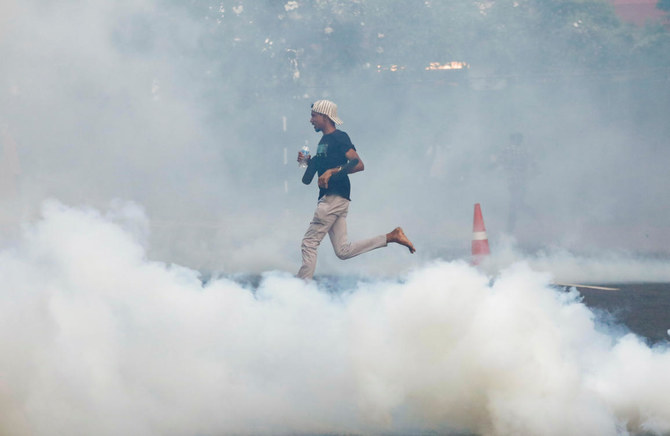
Police used tear gas and water cannons to disperse demonstrators near the presidential residence during anti-government protest. (REUTERS)
Short Url
Updated 09 July 2022
Follow

Sri Lankan PM ‘will resign’ after mass protests in Colombo 

  • Protesters had stormed Sri Lankan president’s home and office in capital on Saturday
  • PM willing to step down for a unity government, his office said

COLOMBO: Sri Lanka’s Prime Minister Ranil Wickremesinghe said on Saturday he is willing to step down and allow an all-party government to take over after thousands of protesters descended on the capital Colombo in one of the largest anti-government marches in the crisis-hit country this year.

The bankrupt country of 22 million people is facing its worst economic crisis in memory and has been unable to pay for essential imports for months due to a severe dollar crunch caused by economic mismanagement and the aftermath of the COVID-19 pandemic on its tourism-dependent economy.

Struggling under extreme shortages of petrol, food and medicines, which forced schools to shut and led to record inflation that reached 54.6 percent in June, Sri Lankans from across the country marched to Colombo on Saturday, demanding the resignation of President Gotabaya Rajapaksa.

The mass protests, which saw hundreds storm into the president’s house and nearby office in Colombo, prompted Wickremesinghe to call for an emergency meeting of political party leaders, as they urged him and Rajapaksa to resign immediately.

Wickremesinghe, who took over in May, said he is willing to give up his premiership.

“To ensure the continuation of the government including the safety of all citizens I accept the best recommendation of the party leaders today, to make way for an all-party government,” Wickremesinghe said on Twitter.

“To facilitate this I will resign as prime minister.”

Wickremesinghe’s resignation will only take place after an all-party government is formed and parliament secures a majority, a statement issued by his office said, and he is expected to stay in office until then.  

Though Sri Lankans have been holding protests outside of the president’s office since March, Saturday’s protests are one of the biggest demonstrations yet, as tens of thousands took to the streets to express their anger over Rajapaksa, the leader they hold responsible for the island nation’s economic meltdown.

Protesters had come from other parts of the country and abroad, marching into the government district in the capital and breaking police barricades, while shouting slogans against the president, such as “Gota go home.” Hundreds of people eventually breached parts of the presidential complex, with footage on social media showing people inside as they waved flags and milled about on the grounds.

“We came here to participate in the protest,” Mohammed Hussain Mohammed Manasique, a Sri Lankan who was working in Kuwait and flew into Colombo on Friday, told Arab News.

“Our families are suffering here without proper food, transport and education.”


French court rejects bid to reopen probe into black man’s death in custody

Updated 2 sec ago
Follow

French court rejects bid to reopen probe into black man’s death in custody

PARIS: France’s top court on Wednesday ruled against reopening an investigation into the 2016 death of a young black man in police custody, confirming a previous decision to dismiss the case against three arresting officers.
The Court of Cassation’s decision definitively closes the case nearly a decade after the death of 24-year-old Adama Traore following his arrest in the Paris suburb of Beaumont-sur-Oise, a fatality that triggered national outcry over police brutality and racism.
Traore’s family was contesting a 2024 appeal court ruling confirming a prior decision to drop the case, after an investigation led to no charges against the military policemen — or gendarmes — involved and therefore no case in court.
A lawyer representing his family announced after Wednesday’s ruling they would take the case to the European Court of Human Rights to “have France convicted.”
Three gendarmes pursued the young man on July 19, 2016, when temperatures reached nearly 37C, pinning him down in an apartment, after which he told officers he was “having trouble breathing.”
He then fainted during the journey to a gendarmerie station, where he died.
’Probably’ not fatal
In 2023, French investigating magistrates dropped the case against the three gendarmes, in a ruling that was upheld on appeal in 2024.
They had been tasked with probing whether the three arresting officers used disproportionate force against Traore during a police operation targeting his brother, Bagui.
According to the magistrates, Traore’s death was caused by heatstroke that “probably” would not have been fatal without the officers’ intervention — though it concluded their actions were within legal bounds.
His family however has accused the gendarmes of failing to help the young man, who was found by rescue services unconscious and handcuffed behind his back.
In their appeal, Traore’s family criticized the justice system for not carrying out a reconstitution of events as part of the investigation.
But prosecutors requested that the appeal be dismissed.
Internal investigations
Activists have repeatedly accused French police of violence and racism, but few cases make it to criminal court in France as most are dealt with internally.
In January, several thousand people protested in Paris over the death in custody of a Mauritanian immigrant worker, El Hacen Diarra, 35, who died after passing out at a police station following his violent arrest.
Paris police launched an internal investigation after video filmed by neighbors, shared on social media, showed a policeman punching what appears to be a man on the ground as another officer stands by and watches.
In 2024, a judge gave suspended jail sentences to three officers who inflicted irreversible rectal injuries to a black man, Theo Luhaka, during a stop-and-search in 2017.
Prosecutors have also called for a police officer to be tried over the 2023 killing of a teenager at a traffic stop, in a case that sparked nationwide protests.
A court is to rule in March whether he will face a criminal trial over the killing of 17-year-old Nahel M.
Europe’s top rights court in June condemned France over its police discriminating against a young man during identity checks, in the first such ruling against the country over alleged racial profiling.