

Two test positive in Ghana for highly infectious Marburg virus

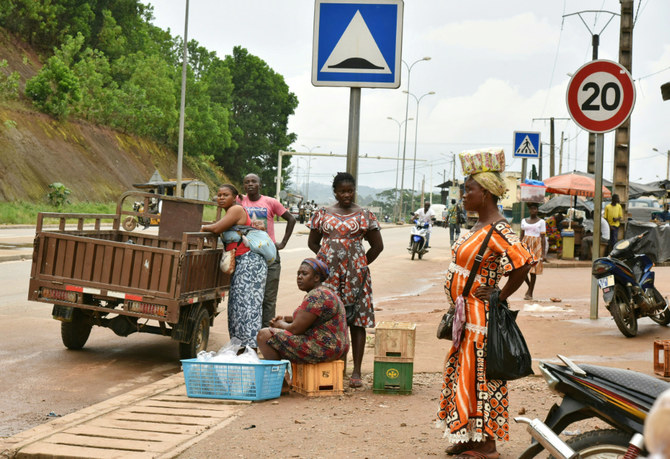
Street vendors in Noe, a border town between Ivory Coast and Ghana where residents have not been able to cross due to the COVID-19 pandemic on September 22, 2021. (AFP)
Short Url
Updated 08 July 2022
Follow

Two test positive in Ghana for highly infectious Marburg virus

  • Tests conducted in Ghana came back positive, but those results must be confirmed by a laboratory in Senegal for the cases to be considered confirmed, the WHO said in a statement

DAKAR: Two people in Ghana who later died tested positive for Marburg virus, a highly infectious disease similar to Ebola, the World Health Organization (WHO) said on Thursday.
Tests conducted in Ghana came back positive, but those results must be confirmed by a laboratory in Senegal for the cases to be considered confirmed, the WHO said in a statement.
The two patients in the southern Ashanti region both had symptoms including diarrhea, fever, nausea and vomiting, before dying in hospital, the statement said.
If the cases are confirmed, this would be only the second outbreak of Marburg in West Africa. The first ever case of the virus was detected last year in Guinea, with no further cases identified.
“Preparations for a possible outbreak response are being set up swiftly as further investigations are underway,” the WHO said.
There have been a dozen major Marburg outbreaks since 1967, mostly in southern and eastern Africa. Fatality rates have varied from 24 percent to 88 percent in past outbreaks depending on the virus strain and case management, according to the WHO.


Bangladesh says at least 287 killed during Hasina-era abductions

Updated 3 sec ago
Follow

Bangladesh says at least 287 killed during Hasina-era abductions

DHAKA: A Bangladesh commission investigating disappearances during the rule of ousted prime minister Sheikh Hasina said Monday at least 287 people were assumed to have been killed.
The commission said some corpses were believed to have been dumped in rivers, including the Buriganga in the capital, Dhaka, or buried in mass graves.
The government-appointed commission, formed after Hasina was toppled by a mass uprising in August 2024, said it had investigated 1,569 cases of abductions, with 287 of the victims presumed dead.
“We have identified a number of unmarked graves in several places where the bodies were presumably buried,” Nur Khan Liton, a commission member, told AFP.
“The commission has recommended that Bangladesh seek cooperation from forensic experts to identify the bodies and collect and preserve DNA samples from family members.”
In its final report, submitted to the government on Sunday, the commission said that security forces had acted under the command of Hasina and her top officials.
The report said many of those abducted had belonged to the country’s largest Islamist party, Jamaat-e-Islami, or the Bangladesh Nationalist Party (BNP), both in opposition to Hasina.
In a separate investigation, police in December began exhuming a mass grave in Dhaka.
The grave included at least eight victims of the uprising against Hasina, bodies all found with bullet wounds, according to Criminal Investigation Department (CID) chief Md Sibgat Ullah.
The United Nations says up to 1,400 people were killed in crackdowns as Hasina attempted to cling to power.
She was sentenced to death in absentia in November for crimes against humanity.
“We are grateful for finally being able to know where our brother is buried,” said Mohamed Nabil, whose 28-year-old sibling Sohel Rana was identified as one of the dead in the grave in Dhaka.
“But we demand a swift trial for the police officials who shot at the people during the uprising.”