

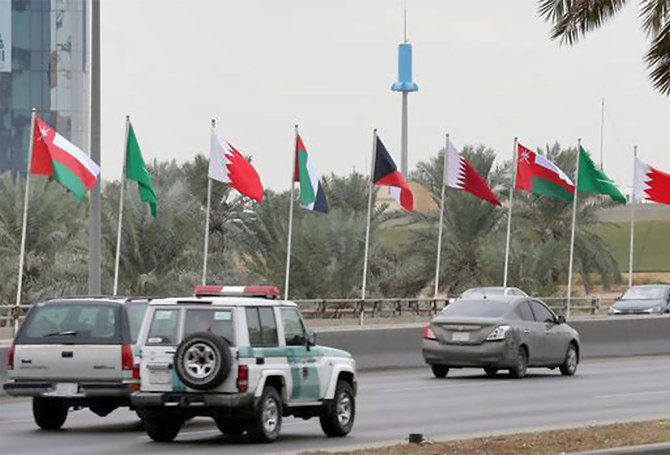

KARACHI: Pakistan and the Gulf Cooperation Council (GCC) are expected to hold the second round of technical-level talks for a Free Trade Agreement (FTA) in the last week of July, a senior Pakistani diplomat said, with local traders saying a deal would help boost exports to the six-country bloc comprising the United Arab Emirates (UAE), Saudi Arabia, Bahrain, Oman, Qatar and Kuwait.
Last year, Pakistani and GCC officials resumed talks on a delayed FTA after a gap of almost 12 years. The South Asian country currently has free trade agreements with China, Malaysia, and Sri Lanka.
“First technical round is completed, tariff lines lists have been shared between Pakistan and GCC, and the private sector and FBR [Federal Board of Revenue] are analyzing these tariff lists,” Azhar Ali Dahar, Minister Trade and Investment at the Embassy of Pakistan in Riyadh, told Arab News on Tuesday.
“GCC has asked for a second technical meeting and the commerce ministry is waiting for a response from private sector. It is expected that in the last week of July this second meeting may take place.”
Pakistani industrialists and traders said the FTA was very important for the country to increase multilateral trade volumes, and the apex body of the private sector, the Federation of Pakistan Chambers of Commerce and Industry (FPCCI), was “fully involved” in pushing forward the process.
“Our Research and Development is working on it and we want to take it forward in a better way that is good for Pakistan,” FPCCI president Irfan Iqbal Sheikh told Arab News on Saturday.
“FTA is very important if you need to enhance your trade, but we have to keep in view all aspects, including economic value and our economic conditions, before signing the agreement so that we [Pakistan] could benefit.”
The FPCCI president said the FTA was important to tap markets other than the traditional EU, United States and United Kingdom, where Pakistan exports around 80 percent of its goods.
“We have not yet tapped the other markets.. and we want to tap the other markets.. we want to work with GCC,” Sheikh added. “New markets and products that would increase Pakistan’s exports … that is what we need.”
The FTA with the GCC has remained in the cold storage since the signing of the Framework Agreement (FA) on August 26, 2004 in Islamabad. Only two rounds were held between 2006 and 2008.
The first round of negations took place in Riyadh in March 2006 where both sides agreed to jointly declare the establishment of a Trade Negotiating Team (TNT). The parties also agreed to concessions in services under the World Trade Organization’s framework.
The second round of negotiations was also held in Riyadh from September 7-8, 2008, where both sides agreed to a broader outline in the areas of Market Access in Goods & Services, Rules of Origin and some General Provisions, according to the Dahar in Riyadh.
“The FTA with GCC should have been signed much earlier because these are major economies, especially the UAE is our major trading partner, as our high-end imports are mostly coming from UAE,” Dr. Vaqar Ahmed, a joint executive director at the Sustainable Development Policy Institute (SDPI), told Arab News.
“We have been engaged with GCC countries since 2008 and still after a lapse of around 15 years this [FTA] has not materialized … we discuss with them security and other issues but FTA remains off the agenda.
“Now it must be on top of the agenda and the joint working group needs to set the deadline to finalize the FTA as we did in case of FTA with China,” he added. “Our exports, mainly services, are being processed from UAE where companies, especially the IT companies, have set up backend offices. We have a big advantage with the FTA so this needs to be taken very seriously.”
Pakistani investors in GCC countries have also called on their home government to aggressively pursue GCC authorities for the FTA.
“Pakistan has very special relations with GCC countries and they have been supportive. The FTA will largely benefit Pakistani traders through ease of tariff and non-tariffs measures,” Muhammad Iqbal Dawood, a director at the Pakistan Business Council Dubai, told Arab News via phone from Dubai.
“Currently, India is going on the top of the countries signing FTAs ... We need to aggressively move on and sign these kinds of agreements.”
Pakistani experts said the country had a limited list of products to offer the GCC bloc but the government should demand zero or reduced import duties on certain goods from Pakistan.
“We should demand zero or reduced customs duty from GCC for textile and garments, on processed food, rice, leather, sports and surgical goods,” SDPI’s Ahmed said. “In the services sector, we want incorporation fee waiver for example for our IT companies that set up back-end offices in Dubai, Doha, and Bahrain.”
“In return we should be very open about what we can offer them, we would not be in a position to restrict flow of goods coming from there as recently we have done to restrict imports,” he added, referring to recent ban on the import of luxury items to save foreign reserves. “We should be prepared that this would be reciprocal.”


