

Fruit growers in Indian-administered Kashmir face losses as trucks caught in pilgrimage traffic jams

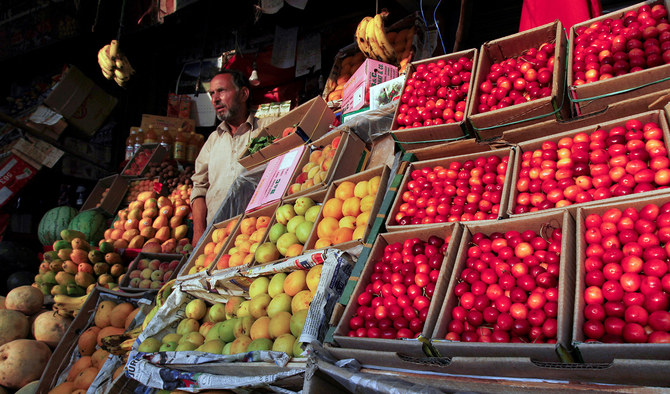
A man sells fruit from his stall along a road in Srinagar June 23, 2011. (REUTERS/File)
Short Url
Updated 04 July 2022
Follow

Fruit growers in Indian-administered Kashmir face losses as trucks caught in pilgrimage traffic jams

  • Thousands have come to contested region to visit Hindu shrine for Amarnath Yatra
  • Fruit-laden trucks were stranded as security forces held up traffic to check for threats

SRINAGAR: Fruit growers in Indian-administered Kashmir said on Monday they were facing huge losses as truck-loads of apples, pears and other produce got caught up in traffic jams caused by a security crackdown during an annual Hindu pilgrimage.

Hundreds of thousands of people have come through the contested region to visit a shrine in a Himalayan cave for the Amarnath Yatra pilgrimage.

Numbers are even higher this year, as the event was shut down in 2021 during the pandemic - and security is tighter after police said last week they had uncovered a militant plot to attack pilgrims.

Fruit-laden trucks were stranded as security forces held up traffic to check for threats, Bashir Ahmad Basheer, from the Kashmir Valley Fruit Growers and Dealers Union, told Reuters.

"Freshly harvested plums, peaches, pears and apples need to be transported outside Kashmir or else they may rot in this heat and we will face heavy losses," he said.

Lieutenant Governor Manoj Sinha, who leads the region, acknowledged there was a problem and said the government was working on plans to ease traffic.

"Trucks will only be stopped when pilgrims travel on the highway and trucks loaded with perishables won’t face any inconvenience," he told reporters.

Indian soldiers carrying automatic assault rifles and wearing flak jackets have been out guarding roads since the Hindu pilgrimage began in the Muslim-majority region in June.

"Pilgrims are our guests but our trucks should not be stopped," orchard owner Ghulam Mohammad Malik told Reuters.

He said farmers and traders would together face losses of 30 million Indian rupees ($380,000) per day if congestion did not ease.

Fruit cultivation is the backbone of Kashmir's economy, and gives work to about 3 million people, according to the growers union.

During the pilgrimage, Hindus cross glaciers and waterlogged trails to reach the mountain cave which contains an ice stalagmite that is considered a physical manifestation of the god Lord Shiva.

The cave is covered in snow for most of the year, but authorities let pilgrims visit it for 45 days over the summer as rising temperatures clear the passes.

India and Pakistan have twice gone to war over Kashmir, which is divided between them but both claim in full, and it remains at the heart of decades of hostility.


Ten cops killed as separatist militants launch ‘coordinated’ attacks in Pakistan’s southwest — police

Updated 10 min 35 sec ago
Follow

Ten cops killed as separatist militants launch ‘coordinated’ attacks in Pakistan’s southwest — police

  • The attacks began in Balochistan’s capital of Quetta at around 6am with a powerful explosion, followed by intense gunfire

QUETTA: At least 10 security officials and 37 militants were killed as “coordinated” attacks were launched by separatist militants, affiliated with the Balochistan Liberation Army (BLA), across several cities of Pakistan’s southwestern Balochistan province, an official quoted by AFP said Saturday.

The attacks in the provincial capital of Quetta began at around 6am with a powerful explosion, followed by intense gunfire that lasted for two hours along with multiple explosions.

Residents of Dalbandin and Nuhski said they heard explosions and gunfire in the districts early Saturday morning, while there were reports of similar attacks in Mastung, Gwadar, Pasni and Turbat.

A senior police official, who requested anonymity, told Arab News that the militants attempted to enter the provincial capital of Quetta but police and other law enforcement agencies stopped them.

“The terrorists attacked a police mobile at Sariab road which resulted in the killing of two policemen,” he said. “Police and other law enforcement agencies denied space to the terrorists in Quetta city and a clearance operation is still going on.”

Balochistan, which borders Iran and Afghanistan, is the site of a decades-long insurgency waged by Baloch separatist groups who often attack security forces and foreigners, and kidnap government officials.

Shahid Rind, the Balochistan chief minister’s aide for media and political affairs, said police and paramilitary Frontier Corps (FC) had foiled the attacks and were chasing the assailants.

“After the killing of more than 70 terrorists at different places in Balochistan in the last two days, terrorists have attempted to attack at a few places in Balochistan, which have been foiled by timely action by the police and FC,” he said on X.

“At present, the pursuit of the fleeing terrorists is underway. More details will be revealed very soon.”

In a statement issued on Saturday, BLA said the group had launched ‘Operation Herof 2.0,’ which included a series of attacks in multiple cities of Balochistan.

Saturday’s attacks follow coordinated attacks carried out by the group in Aug. 2024 in various districts of Balochistan which killed dozens of people.

The separatists accuse the central government of stealing the region’s resources to fund development elsewhere in the country. The Pakistani government denies the allegations and says it is working for the uplift of local communities in Balochistan.

Pakistan Railways has suspended train service from Balochistan to other parts of the country for a day, following Saturday’s attacks.

“Quetta-Peshawar bound Jaffar Express, and Quetta-Chaman passenger trains have been canceled due to the prevailing security situation in Balochistan,” Muhammad Kashif, the railways controller in Quetta division, told Arab News.

At least four police officials in as many districts confirmed to AFP the situation was not completely under control yet.
“At least four policemen were killed in Quetta alone,” he added, speaking on condition of anonymity as he was not authorized to speak to the media.
A senior military official based in Islamabad confirmed the attacks, adding they were “coordinated but poorly executed.”