

Australia floods worsen as thousands more Sydney residents evacuate

1 / 4
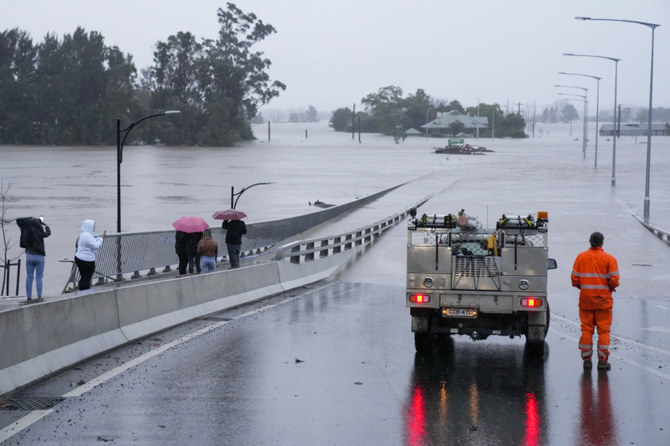
An emergency vehicle blocks access to the flooded Windsor Bridge on the outskirts of Sydney, Australia, Monday, July 4, 2022. (AP)
2 / 4
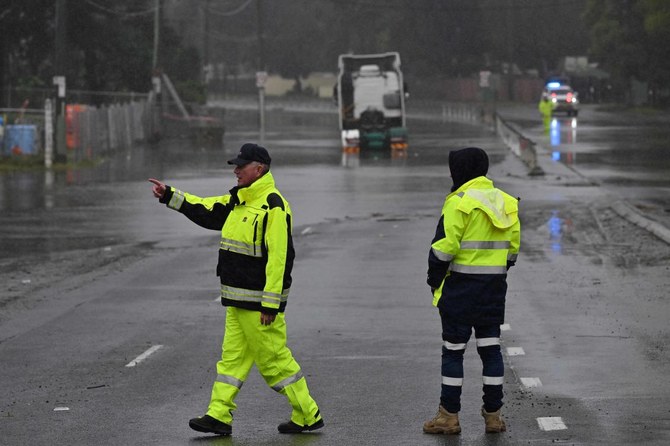
Floodwaters submerge residential areas following heavy rains in the Windsor suburb of Sydney, Australia, July 5, 2022. (REUTERS)
3 / 4
A woman walks through her flooded front yard in her home at Windsor on the outskirts of Sydney, Australia, Tuesday, July 5, 2022. (AP)
4 / 4
About 100 millimeters of rain could fall in the next 24 hours over a swath of more than 300km along the New South Wales coast from Newcastle to the south of Sydney. (AFP)
Short Url
Updated 05 July 2022
Follow

Australia floods worsen as thousands more Sydney residents evacuate

  • An intense low-pressure system off Australia’s east coast is forecast to bring heavy rain through Monday across New South Wales

SYDNEY: Hundreds of homes have been inundated in and around Australia’s largest city in a flood emergency that was impacting 50,000 people, officials said Tuesday.
Emergency response teams made 100 rescues overnight of people trapped in cars on flooded roads or in inundated homes in the Sydney area, State Emergency Service manager Ashley Sullivan said.
Days of torrential rain have caused dams to overflow and waterways to break their banks, bringing a fourth flood emergency in 16 months to parts of the city of 5 million people.
The New South Wales state government declared a disaster across 23 local government areas overnight, activating federal government financial assistance for flood victims.
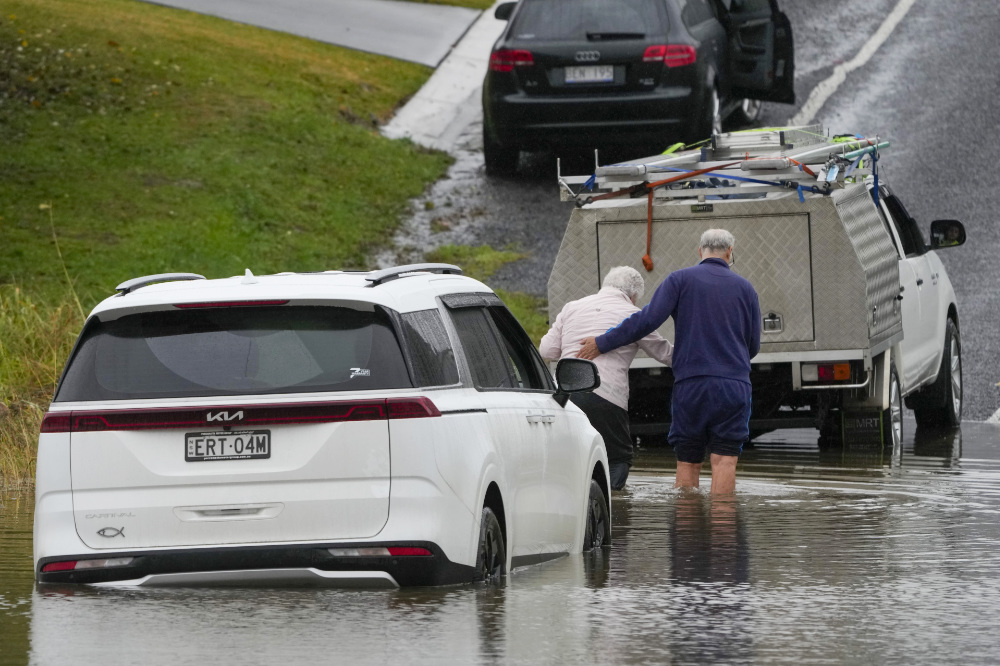


A couple walk through flood waters from their semi-submerged car at Richmond on the outskirts of Sydney, Australia, Tuesday, July 5, 2022. (AP)

Evacuation orders and warnings to prepare to abandon homes impacted 50,000 people, up from 32,000 on Monday, New South Wales Premier Dominic Perrottet said.
“This event is far from over. Please don’t be complacent, wherever you are. Please careful when you’re driving on our roads. There is still substantial risk for flash flooding across our state,” Perrottet said.
Emergency Services Minister Steph Cooke credited the skill and commitment of rescue crews for preventing any death or serious injury by the fourth day of the flooding emergency.
Parts of southern Sydney had been lashed by more than 20 centimeters (nearly 8 inches) of rain in 24 hours, more than 17 percent of the city’s annual average, Bureau of Meteorology meteorologist Jonathan How said.
Severe weather warnings of heavy rain remained in place across Sydney’s eastern suburbs on Tuesday. The warnings also extended north of Sydney along the coast and into the Hunter Valley.
The worst flooding was along the Hawkesbury-Nepean rivers system along Sydney’s northern and western fringes.
“The good news is that by tomorrow afternoon, it is looking to be mostly dry but, of course, we are reminding people that these floodwaters will remain very high well after the rain has stopped,” How said.
“There was plenty of rain fall overnight and that is actually seeing some rivers peak for a second time. So you’ve got to take many days, if not a week, to start to see these floodwaters start to recede,” How added.
The wild weather and mountainous seas along the New South Wales coast thwarted plans to tow a stricken cargo ship with 21 crew members to the safety of open sea.
The ship lost power after leaving port in Wollongong, south of Sydney, on Monday morning and risked being grounded by 8-meter (26-foot) swells and winds blowing at 30 knots (34 mph) against cliffs.
An attempt to tow the ship with tugboats into open ocean ended when a towline snapped in an 11-meter (36-foot) swell late Monday, Port Authority chief executive Philip Holliday said.
The ship was maintaining its position on Tuesday farther from the coast than it had been on Monday with two anchors and the help of two tugboats. The new plan was to tow the ship to Sydney when weather and sea conditions calmed as early as Wednesday, Holliday said. The original plan had been for the ship’s crew to repair their engine at sea.
“We’re in a better position than we were yesterday,” Holliday said. “We’re in relative safety.”
Perrottet described the tugboat crews’ response on Monday to save the ship as “heroic.”
“I want to thank those men and women who were on those crews last night for the heroic work they did in incredibly treacherous conditions. To have an 11-meter (36-foot) swell, to be undergoing and carrying out that work is incredibly impressive,” Perrottet said.


EU leaders to reassess US ties despite Trump U-turn on Greenland

Updated 22 January 2026
Follow

EU leaders to reassess US ties despite Trump U-turn on Greenland

  • Diplomats stressed that, although Thursday’s emergency EU talks in Brussels would now lose some of their urgency, the longer-term issue of how to handle the relationship with the US remained

BRUSSELS: EU leaders will rethink their ties with the US at an emergency summit on Thursday after Donald Trump’s threat of tariffs and even military action to ​acquire Greenland badly shook confidence in the transatlantic relationship, diplomats said.
Trump abruptly stepped back on Wednesday from his threat of tariffs on eight European nations, ruled out using force to take Greenland, a semi-autonomous territory of NATO ally Denmark, and suggested a deal was in sight to end the dispute.
German Chancellor Friedrich Merz, welcoming Trump’s U-turn on Greenland, urged Europeans not to be too quick to write off the transatlantic partnership.
But EU governments remain wary of another change of mind by a mercurial president who is increasingly seen as a bully that Europe will have to stand up to, and they are focused on coming up with a longer-term plan on how to deal with the ‌United States under this ‌administration and possibly its successors too.
“Trump crossed the Rubicon. He might do ‌it ⁠again. ​There is no ‌going back to what it was. And leaders will discuss it,” one EU diplomat said, adding that the bloc needed to move away from its heavy reliance on the US in many areas.
“We need to try to keep him (Trump) close while working on becoming more independent from the US It is a process, probably a long one,” the diplomat said.
EU RELIANCE ON US
After decades of relying on the United States for defense within the NATO alliance, the EU lacks the needed intelligence, transport, missile defense and production capabilities to defend itself against a possible Russian attack. This gives the US substantial leverage.
The US ⁠is also Europe’s biggest trading partner, making the EU vulnerable to Trump’s policies of imposing tariffs to reduce Washington’s trade deficit in goods, and, as in ‌the case of Greenland, to achieve other goals.
“We need to discuss where ‍the red lines are, how we deal with this bully ‍across the Atlantic, where our strengths are,” a second EU diplomat said.
“Trump says no tariffs today, but does ‍that mean also no tariffs tomorrow, or will he again quickly change his mind? We need to discuss what to do then,” the second diplomat said.
The EU had been considering a package of retaliatory tariffs on 93 billion euros ($108.74 billion) on US imports or anti-coercive measures if Trump had gone ahead with his own tariffs, while knowing such a step would harm Europe’s economy as well ​as the United States.
WHAT’S THE GREENLAND DEAL?
Several diplomats noted there were still few details of the new plan for Greenland, agreed between Trump and NATO Secretary General Mark Rutte late on ⁠Wednesday on the sidelines of the World Economic Forum in Davos, Switzerland.
“Nothing much changed. We still need to see details of the Greenland deal. We are a bit fed up with all the bullying. And we need to act on a few things: more resiliency, unity, get our things together on internal market, competitiveness. And no more accepting tariff bullying,” a third diplomat said.
Rutte told Reuters in an interview in Davos on Thursday that under the framework deal he reached with Trump the Western allies would have to step up their presence in the Arctic.
He also said talks would continue between Denmark, Greenland and the US on specific issues.
Diplomats stressed that, although Thursday’s emergency EU talks in Brussels would now lose some of their urgency, the longer-term issue of how to handle the relationship with the US remained.
“The approach of a united front in solidarity with Denmark and Greenland while focusing on de-escalation and finding an off-ramp has worked,” a fourth EU diplomat said.
“At the ‌same time it would be good to reflect on the state of the relationship and how we want to shape this going forward, given the experiences of the past week (and year),” he said.