

Ahead of Eid, lumpy skin disease spreads fast among cattle in northwestern Pakistan

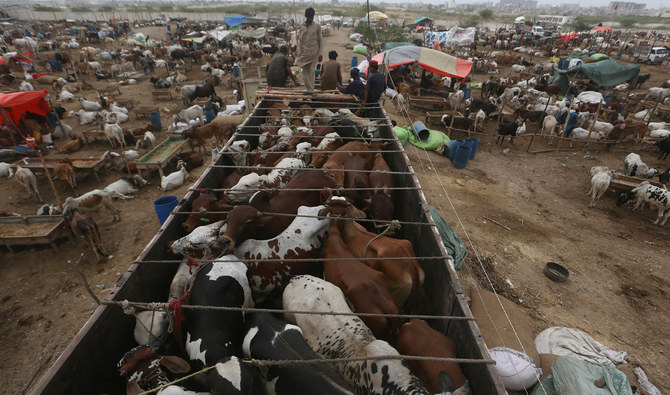
Livestock arrives at a market setup for the upcoming Eid al-Adha festival, in Karachi, Pakistan on June 30, 2022. (AP)
Short Url
Updated 01 July 2022
Follow

Ahead of Eid, lumpy skin disease spreads fast among cattle in northwestern Pakistan

  • Influx of animals into Khyber Pakhtunkhwa from other provinces has intensified problem, officials say
  • Provincial administration says willing to release more funds for procurement of vaccines for animals

PESHAWAR: The livestock department in Pakistan’s Khyber Pakhtunkhwa has ramped up efforts to control the spread of lumpy skin disease (LSD) among cattle ahead of the Muslim festival of Eid Al-Adha, a senior official said on Wednesday, adding that he feared the influx of animals into the province from other areas of the country would unleash a larger outbreak of the disease.

The Eid Al-Adha holiday is one of the two most important festivals of the Islamic calendar. Marking the willingness of Ibrahim, or Abraham, to sacrifice his son on God’s command, Muslims mark the holiday by slaughtering animals such as sheep and goats. The meat is shared among family and friends and also donated to the poor.

Cattle markets across Pakistan, the second largest Muslim country in the world, fill up ahead of Eid, with thousands of animals brought to major livestock bazars across the country, including in Khyber Pakhtunkhwa.

This year, the situation has.been complicated by breakouts of the lumpy skin disease that causes fever and multiple nodules on the skin and mucous membrane of animals. The virus was first reported in Punjab in October last year but later also spread among cattle in Sindh.

Prevalent in Africa since 1929, LSD is transmitted by bloodsucking insects like ticks and mosquitoes. It does not affect people and is rarely fatal.

“With the arrival of Eid Al-Adha, animals have been brought from Punjab and Sindh provinces and we fear the disease will spread further instead of being contained,” Sayed Asad Ali Shah, who works as epidemiologist with the livestock department, told Arab News.

He said precautionary measures, such as the formation of a task force and a cell for online reporting of the disease, had already been taken after LSD was first reported in Punjab and Sindh. Special checkpoints had been set up at various entry points of the province to keep infected animals from entering Khyber Pakhtunkhwa, he added.

However, the infection, which was previously reported in a few districts of Khyber Pakhtunkhwa, had now spread across the province.

“A total of 8,265 LSD cases were reported until Tuesday,” Shah said. “The disease has also claimed the lives of 203 animals.”

“After conducting a series of meetings, the government has released Rs100 million for vaccine procurement,” he said. “We have an estimated population of nine million cattle excluding buffaloes in the province. So far, we have vaccinated 135,761 animals and used anti-tick spray on millions of others.”

Speaking to Arab News, the provincial government spokesperson, Barrister Muhammad Ali Saif, said the government was working closely with the livestock department to adopt precautionary measures and release necessary funds to control the disease.

“This is a serious problem and the disease is partly spreading because of the buying and selling of animals ahead of Eid Al-Adha,” he said. “People should cooperate with the government to contain the spread of this viral disease. We will also release more funds to procure more vaccines to protect animals.”

But Rehmat Gul Miani, a resident of Gomal, a dusty village on the outskirts of southern Tank district, said several LSD cases had been reported in his area but authorities were not doing enough to vaccinate animals.

“Several animals in our neighborhood have been infected,” he said. “Livestock officials should take measures to contain the disease before Eid Al-Adha. Otherwise, people will be reluctant to buy sacrificial animals even at cheaper rates.”


Pakistan’s Forward Sports, key Adidas supplier, plans to launch Saudi operations this year, says CEO

Updated 9 sec ago
Follow

Pakistan’s Forward Sports, key Adidas supplier, plans to launch Saudi operations this year, says CEO

  • Forward Sports produces 15 million footballs each year which are exported worldwide and used in major tournaments
  • Its CEO Khawaja Masood Akhtar says this is the ‘best time’ for cross-border partnerships between Pakistan, Saudi Arabia

SIALKOT: Forward Sports, one of the world’s largest manufacturer of footballs and a key supplier to global brands, is planning to start operations in Saudi Arabia through a joint venture this year, its chief executive officer (CEO) told Arab News last week.

Headquartered in the northeastern city of Sialkot, the Pakistani sports equipment company has been working with global sports brand Adidas for two decades and was one of the two manufacturers of Adidas’ Al Rihla, the official 2022 World Cup ball.

Forward Sports produces 15 million footballs each year which are exported worldwide and recently replaced a Chinese competitor as Adidas’s largest football supplier, according to Forward Sports CEO Khawaja Masood Akhtar.

In an exclusive interview with Arab News, Akhtar said his company is in early stages of its expansion to Saudi Arabia, where it plans to start with a “minimum headcount” from Pakistan.

“We are going to have a JV (joint venture) with one of the most influential persons in Riyadh in sports goods,” Akhtar said, without disclosing the name of the Saudi partner.

“We want to start, I can say, within this year, and we are just on the beginning stage, and the first stage will be only marketing.”

Akhtar’s statement follows a meeting between Forward Sports’ representatives and Saudi officials during the Future Investment Initiative (FII) summit in Riyadh in Oct. last year. This month, Forward Sports officials also met with the ambassador of Saudi Arabia to Pakistan, Nawaf bin Said Al-Malki, in Islamabad to discuss the company’s operations in the Kingdom.

Pakistan and Saudi Arabia share a long-standing strategic partnership in political, security and economic domains, underpinned by deep religious and cultural ties. Both countries have moved closer to broaden their cooperation in recent months, signing a landmark defense pact in Sept. and agreeing to launch an economic cooperation framework a month later to strengthen bilateral trade and investment relations.

’BEST TIME’ FOR JOINT VENTURES

Akhtar called it the “best time” for cross-border partnerships between Pakistan and Saudi Arabia, adding that his company intends to understand the Saudi market before starting manufacturing operations in the Kingdom.

“Investment is not so much important,” he said, when asked about how much amount his company would be spending on its expansion to Saudi Arabia.

“At the moment, we don’t know how much we are going to put and how much they are going to put. We are just at a very beginning level.”

In the initial phase, he said, Forward Sports plans to operate with a small team, relying largely on the existing infrastructure of its Saudi partner.

“We will want to keep very minimum headcounts there from Pakistan in the beginning, maybe two or three people,” Akhtar said. “We want to hire [people] from Saudi Arabia.”

He said his company’s manufacturing operations in Saudi Arabia would be structured to comply with localization laws, with the bulk of production remaining in Pakistan.

“Either we will do 80:20 or 70:30, means 80 percent or 70 percent job is done in Pakistan. This depends on the article, which article we are going to produce there,” Akhtar told Arab News.

“So only 30 percent or 20 percent will be done in Saudi Arabia. This is a law to put ‘Made-in-KSA [on the balls]... so we have to respect that percentage.”

EXPANSION WON’T HURT PAKISTAN’S EXPORTS

Therefore, manufacturing, finishing, packaging and logistics of Forward Sports would largely remain in Pakistan, according to its CEO. The company’s expansion will not replace Pakistan’s exports or undermine domestic jobs.

“I don’t think so it will be replacing anything from Pakistan,” he said. “It would not hurt (Pakistani exports).”

Commercial opportunities in Saudi Arabia’s sports sector are expected to grow significantly before the Kingdom hosts the 2034 FIFA World Cup.

Akhtar said the move to expand their operations to the Kingdom is aimed at creating new demand, but they have not yet made a decision on whether to make footballs for future FIFA World Cups in Saudi Arabia.

“This, this is again, we don’t know,” he said. “We have to sit with a brand. If they agree, then we can be producing some balls also in Saudi Arabia.”

CAPACITY NOT A CONSTRAINT

Akhtar said Forward Sports already has the ability to scale up production if the demand rises.

“For us to make high volume is no problem. We touched like 75,000 balls per day,” he said, adding that current production has eased to 50,000 balls per day following the recent FIFA World Cup cycle.

REASSURANCES TO COUNTRYMEN

Despite the Saudi expansion, Akhtar said his company’s headquarters would stay in Pakistan, reassuring Pakistani workers and stakeholders that they would not lose anything.

“Don’t think we are going to lose anything in Pakistan,” he said. “We will remain here, and we will be increasing our capacities in Pakistan.”