Lebanon must act against torture, human rights groups warn

Ziad Itani, a Lebanese actor, who was exonerated of spying for Israel, is carried after he was released by Lebanese authorities. (AP/File Photo)
Short Url
Updated 27 June 2022
Follow

Lebanon must act against torture, human rights groups warn

  • Country’s anti-torture unit lacks govt budget, laws and courts ‘ineffective’

LONDON: Lebanese authorities must protect people from torture and ill-treatment in detention, a group of organizations including Human Rights Watch said on Monday.

The appeal came on International Day in Support of Victims of Torture.

Aya Majzoub, Lebanon researcher at HRW, said: “Despite an improvement to Lebanon’s anti-torture framework on paper, torture remains prevalent, and accountability for torture and ill-treatment is elusive.

“Lebanon needs to show that it is serious about combating torture, and it should start by moving forward the many torture complaints that have been languishing before the judiciary without effective investigations.”

In 2019, 44-year-old Hassan Al-Dika died in custody reportedly as a result of torture. An HRW investigation found that judicial authorities failed to investigate Al-Dika’s allegations of torture before his death.

They had also tasked the same security agency that Al-Dika accused of torture with investigating his claims.

And in the case of actor Ziad Itani, who was accused and later exonerated of spying for Israel, Lebanese justice authorities have yet to take action regarding his claims of torture at the hands of State Security officials.

The Lebanese Parliament passed a law criminalizing torture in 2017. Two years later the government appointed five members to the National Preventative Mechanism against Torture.

But the unit has yet to be allocated a budget to allow the fulfillment of its mandate.

“The Lebanese authorities should promptly and impartially investigate all complaints of torture, allocate a sufficient budget to allow the torture prevention unit to get to work, and bring the anti-torture law in line with international standards,” Majzoub said.

Torture remains prevalent in Lebanon, despite complaints regularly being filed under the 2017 law.

The HRW warned that the 2017 law fails to abide by Lebanon’s obligations under the UN Convention against Torture, because it fails to criminalize cruel, inhuman or degrading treatment.


UN warns of abuse of Palestinians returning to Gaza through Rafah crossing

Updated 7 sec ago
Follow

UN warns of abuse of Palestinians returning to Gaza through Rafah crossing

  • Human Rights Office describes pattern of ill-treatment, abuse and humiliation of returnees by Israeli forces, and by armed Palestinians allegedly backed by Israeli military
  • Meanwhile, reports continue of airstrikes, gunfire and shelling across Gaza, and Israeli forces demolish a UN-run school

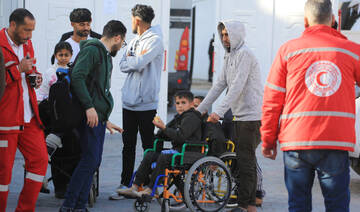
NEW YORK CITY: The Rafah crossing on the border between Gaza and Egypt opened for a fourth consecutive day on Thursday, allowing a limited number of people to pass through.
However, the UN voiced concerns about reported mistreatment of Palestinians returning to the war-ravaged enclave.
The UN’s Office for the Coordination of Humanitarian Affairs also said reports continue across civilian areas in Gaza of airstrikes, gunfire and shelling, resulting in casualties and damage to infrastructure.
And Israeli forces on Wednesday demolished Jabalya Preparatory Boys’ School in northern Gaza, OCHA said. Run by the UN Relief and Works Agency for Palestine Refugees, it was the last remaining school in a compound of six. Its destruction means the entire educational complex has been razed to the ground.
A limited flow of people were allowed to use the Rafah crossing, Gaza’s main physical connection to the outside world, for four days in a row since it reopened on Monday, OCHA said. Only 98 returnees were received by UN teams inside Gaza between Monday and Thursday, it added, and the crossing remains closed on Fridays.
The UN Human Rights Office warned of what it described as a pattern of ill-treatment, abuse and humiliation of returnees by Israeli forces, and by armed Palestinians allegedly backed by the Israeli military.
According to accounts collected by the UN’s Human Rights Office, armed Palestinians handcuffed and blindfolded returnees, threatened and intimidated them, conducted searches and stole personal belongings and money. Returnees also reported violence, degrading interrogations and invasive body searches upon arrival at Israeli checkpoints.
The accounts point to conduct that violates the rights of Palestinians to personal security and dignity, and freedom from torture and other ill-treatment, the Human Rights Office said.
Meanwhile, the UN said it attempted to coordinate 11 humanitarian missions with the Israeli authorities on Wednesday and Thursday. Six were fully facilitated, but four faced lengthy delays at holding points along designated routes. Two of those missions were only partially completed, the other two eventually went ahead despite the delays.
A mission to monitor humanitarian cargo at the Kissufim crossing, east of Khan Younis, was denied on Wednesday after the crossing was closed.
The purposes of the missions included the collection of water, sanitation supplies, fuel and other items, medical evacuations through the Rafah crossing, and the transportation of returnees to Nasser Hospital in Khan Younis, OCHA said.