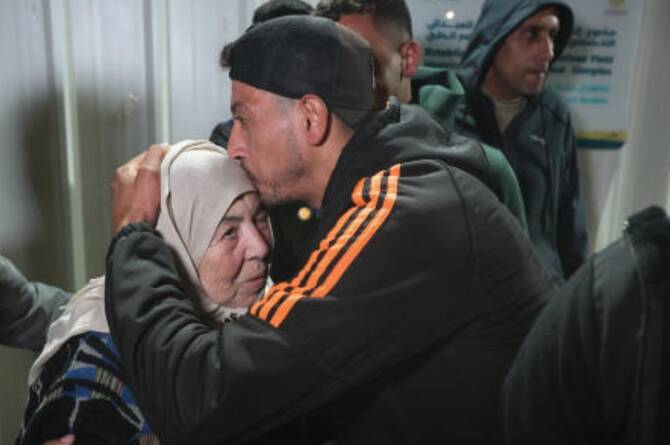
NEW YORK CITY: The Rafah crossing on the border between Gaza and Egypt opened for a fourth consecutive day on Thursday, allowing a limited number of people to pass through.
However, the UN voiced concerns about reported mistreatment of Palestinians returning to the war-ravaged enclave.
The UN’s Office for the Coordination of Humanitarian Affairs also said reports continue across civilian areas in Gaza of airstrikes, gunfire and shelling, resulting in casualties and damage to infrastructure.
And Israeli forces on Wednesday demolished Jabalya Preparatory Boys’ School in northern Gaza, OCHA said. Run by the UN Relief and Works Agency for Palestine Refugees, it was the last remaining school in a compound of six. Its destruction means the entire educational complex has been razed to the ground.
A limited flow of people were allowed to use the Rafah crossing, Gaza’s main physical connection to the outside world, for four days in a row since it reopened on Monday, OCHA said. Only 98 returnees were received by UN teams inside Gaza between Monday and Thursday, it added, and the crossing remains closed on Fridays.
The UN Human Rights Office warned of what it described as a pattern of ill-treatment, abuse and humiliation of returnees by Israeli forces, and by armed Palestinians allegedly backed by the Israeli military.
According to accounts collected by the UN’s Human Rights Office, armed Palestinians handcuffed and blindfolded returnees, threatened and intimidated them, conducted searches and stole personal belongings and money. Returnees also reported violence, degrading interrogations and invasive body searches upon arrival at Israeli checkpoints.
The accounts point to conduct that violates the rights of Palestinians to personal security and dignity, and freedom from torture and other ill-treatment, the Human Rights Office said.
Meanwhile, the UN said it attempted to coordinate 11 humanitarian missions with the Israeli authorities on Wednesday and Thursday. Six were fully facilitated, but four faced lengthy delays at holding points along designated routes. Two of those missions were only partially completed, the other two eventually went ahead despite the delays.
A mission to monitor humanitarian cargo at the Kissufim crossing, east of Khan Younis, was denied on Wednesday after the crossing was closed.
The purposes of the missions included the collection of water, sanitation supplies, fuel and other items, medical evacuations through the Rafah crossing, and the transportation of returnees to Nasser Hospital in Khan Younis, OCHA said.

UN warns of abuse of Palestinians returning to Gaza through Rafah crossing
https://arab.news/8k5nh
UN warns of abuse of Palestinians returning to Gaza through Rafah crossing
- Human Rights Office describes pattern of ill-treatment, abuse and humiliation of returnees by Israeli forces, and by armed Palestinians allegedly backed by Israeli military
- Meanwhile, reports continue of airstrikes, gunfire and shelling across Gaza, and Israeli forces demolish a UN-run school
How Syria’s government responded to February’s floods
- Floodwaters battered fragile camps and infrastructure, exposing the vulnerability of millions still displaced by years of war
- Interim authorities mobilized emergency efforts in Idlib and Latakia, evacuating communities and restoring key roads and bridges
LONDON: All Nour owned was washed away in a single stormy night at the Karamah displacement camp in northwest Syria’s Idlib province — a tent, a few pieces of furniture and some clothing.
She had already lost everything once before. Years earlier, fighting forced her family to flee their home in the countryside of Aleppo.
“When we fled our home in Aleppo back in 2014, I was only 13 and couldn’t even save a single doll,” said Nour, whose name has been changed at her request.
“Just as I couldn’t carry anything back then, I couldn’t carry anything when my home got flooded two weeks ago,” she said. “The neighbors told me to run quickly, and I had to save myself and my child.”
In early February, torrential rains swept through Idlib, Latakia and Hama, inundating camps, homes and farmland. Tents collapsed, crops were destroyed and lives were lost as thousands of already vulnerable families struggled through harsh winter conditions.
The flooding has become an early test of the interim government’s ability to respond to disasters, having come to power just over a year ago following more than a decade of civil war.
Flash flooding triggered by heavy rain on Feb. 7 hit Idlib province and northern Latakia, damaging at least 1,850 tents and destroying 149 within two days, according to the UN humanitarian office, OCHA.
Floodwaters reached at least 21 displacement sites, affecting about 5,300 people and submerging entire shelters.
The impact extended beyond camps. In Latakia’s Qastal Maaf district, at least 30 homes were damaged, while 47 houses were affected in the northwestern Idlib province.
The floods also claimed lives. In northern Latakia, two children were reportedly killed on Feb. 8 after being swept away by floodwaters in a rugged valley in the Jabal Al-Turkman area.
Syrian Arab Red Crescent volunteer Samiha Rakhamiya died while attempting to rescue stranded residents, while six other staff were injured when their vehicle slid into a valley en route to assist affected communities.
Infrastructure damage deepened the disruption. Two bridges linking about 15 villages in Jabal Al-Turkman collapsed, severing access between communities, state media reported.
One bridge over the Northern Great River connected the villages of Al-Sultran and Al-Sarraf. Residents now face journeys of more than two hours instead of minutes.
Officials said surging water levels, exceeding 450 cubic meters per second on Feb. 8, carried debris that clogged a dam and forced water to spill over, eroding surrounding land and blocking roads.
Mustafa Joulha, director of the northern district in Latakia, told state agency SANA that drainage systems were also overwhelmed, worsening flooding in nearby areas.
Authorities deployed emergency teams to clear debris, reopen roads and assess damage.
The floods also strained essential services in Idlib. Ain Al-Bayda hospital was forced out of service, with patients transferred to facilities in Jisr Al-Shughour and Idlib City.
In response, Syrian authorities and humanitarian organizations launched coordinated relief efforts.
An emergency committee was formed, and joint assessment missions surveyed affected camps on Feb. 8.
By Feb. 9, the Ministry of Emergency and Disaster Management said civil defense teams carried out search and rescue operations, evacuated residents from high-risk areas, and also prioritized drainage work and road rehabilitation to restore access.
Displacement shelters were opened near Kherbet Al-Jouz and in northern Latakia. Authorities also reported the availability of 1,500 housing units in Afrin and 100 in Latakia, while dozens of families were evacuated by Feb. 12 from six displacement camps in western Idlib.
Syria’s minister of emergency and disaster, Raed Al-Saleh, told SANA that 173 families were evacuated from camps in Idlib’s Badama and Khirbet Al-Jouz to temporary shelter centers.
In addition, emergency teams have conducted drainage operations, cleared culverts within the camps, reopened more than 25 roads and 30 water channels, and removed five earthen berms as part of preparations for further weather systems.
Aid agencies simultaneously coordinated with local authorities to deliver multi-sector assistance. Camp coordination, health, and shelter teams have been relocating the most affected households, repairing and replacing tents, and distributing essential supplies.
Despite the authorities’ rapid response, the scale of need remains immense as the nation has yet to recover from the devastation left by the civil war which erupted in 2011.
The UN refugee agency, UNHCR, estimates that 7.4 million people remain internally displaced in Syria, with the majority concentrated in the northwest. Camps are clustered along the Syria-Turkiye border, particularly in the Harim area and the Atma-Qah-Sarmada-Al-Dana belt.
Of the total internally displaced population, 5.2 million are estimated to be living outside formal displacement sites, according to the UNHCR.
Although more than 1 million people have returned to their hometowns since the fall of Bashar Assad’s regime on Dec. 8, 2024, many are still struggling to rebuild their lives.
Conditions in displacement camps are especially precarious. During aid distributions in Idlib, Medecins Sans Frontieres described shelters as “extremely fragile.” The organization’s logistics manager, Osama Joukhadar, said displaced people “are exposed to the cold, wind, and snow.”
“Every winter, families struggle just to survive,” he added in a Feb. 18 statement. “We are trying to provide basic support, small but essential help to assist families get through the cold months.”
For many, what began as temporary refuge in those camps has hardened into long-term uncertainty.
About 88 percent of shelter sites in Idlib are informal, self-settled camps, often built on private or agricultural land, according to the Red Cross Red Crescent Climate Centre.
Residents say returning home is often impossible.
“All the camps around us are in very bad condition, but they do not have the ability to return to their hometowns,” said Hajem Al-Asaad, a displaced resident in the Harim Mountains.
“Even if you own land, you cannot live on barren land — you need a home,” he told MSF. “Our homes are destroyed. I need at least $500 to $1,000 just to make basic repairs.”
Humanitarian support has expanded alongside emergency response efforts. The Syrian government deployed mobile medical teams and ambulances across Idlib, and more than two tonnes of medicines and emergency supplies were delivered to local health authorities.
In Latakia, damaged infrastructure is gradually being restored. A key bridge connecting Atira and Kalaz in the province’s countryside has been rehabilitated, and road clearance projects are underway to help residents return, Syria’s Al-Ekhbariah TV reported on Feb. 19.
Yet even as aid reaches affected areas, the floods underscore a deeper vulnerability.
About 90 percent of Syrians live below the poverty line, according to UN estimates, and the Notre Dame Global Adaptation Initiative Index ranks Syria among the world’s most climate-vulnerable, with limited capacity to respond to environmental shocks.
In the first two months of 2026 alone, Syria experienced both severe snowstorms and widespread flooding.
These crises are layered on the legacy of 14 years of conflict, which devastated homes, infrastructure and essential services across the country.
In Daraa province alone, more than 95,000 homes were damaged during the war, including 33,400 that were completely destroyed, the interim government said on Feb. 25.
Nationwide, electricity generation has fallen sharply, leaving most areas with only a few hours of state power each day.
Years of conflict destroyed power plants, transmission lines and substations, reducing effective generation from about 9.5 gigawatts before the war to around 1.5 to 3 gigawatts in recent years, against demand of roughly 6.5 gigawatts or more.
Against this backdrop, disasters like February’s floods do not just disrupt lives — they compound years of loss.
For Nour and millions like her, the war may no longer dominate headlines, but its consequences remain immediate. And when the floodwaters rise, there is often little left to save.


