

Concerns grow in US over Taliban’s treatment of Afghan women and minorities

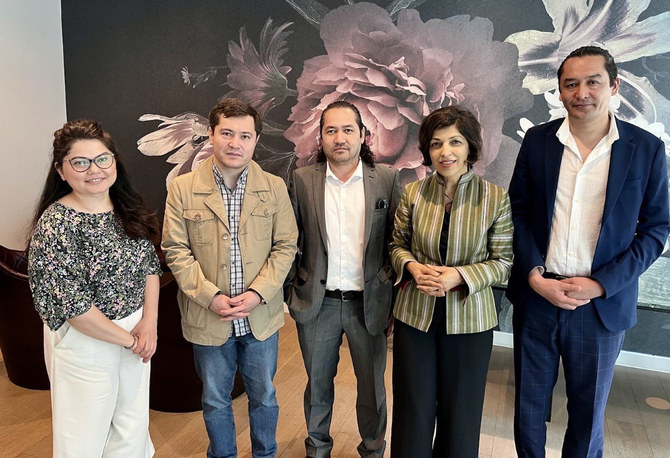
US special envoy Rina Amiri (2nd right) meets has expressed concern over recent violent attacks on minority groups in Afghanistan. (Twitter photo)
Short Url
Updated 24 June 2022
Follow

Concerns grow in US over Taliban’s treatment of Afghan women and minorities

  • ‘We are very disturbed at what we see as a consistent negative trajectory of the situation of women and human rights,’ said US special envoy Rina Amiri
  • She added that the US is concerned about an increase in attacks on minority groups in the country, including the Hazara, Hindu and Sikh communities

WASHINGTON: Confidence is diminishing among US authorities that the Taliban will reverse course and allow women and girls in Afghanistan to pursue an education, or take action to improve the general human rights situation in the country, according to Rina Amiri, the US special envoy for Afghan women, girls and human rights.

During a briefing on Thursday, attended by Arab News, she said Washington is working to identify the key issues that are having negative effects on women and minority groups in the country.

“We are very disturbed at what we see as a consistent negative trajectory of the situation of women and human rights in Afghanistan,” Amiri said.


She added that the US is concerned about an increase in attacks on minority groups in the country, including the Hazara, Hindu and Sikh communities. A group affiliated with Daesh claimed responsibility for an attack on a Sikh temple in Kabul last week, during which two people were killed and several injured.

Amiri said US authorities are looking for more ways to engage with the Afghan people and provide humanitarian aid, especially in the aftermath of the devastating earthquake that hit the mountainous regions in the east of the country in the early hours of Wednesday this week. More than 1,000 people were killed and hundreds of homes and other buildings were destroyed.


The Taliban government, which has been under US sanctions since regaining control of the country in August last year following the withdrawal of US troops, has appealed for international aid to help cope with the humanitarian crisis caused by the earthquake. The UN has pledged its full support for efforts to help the victims and mobilized its agencies to provide assistance.

Amiri said that the US sanctions imposed on the Taliban government are designed and balanced in such a way that they do not affect women or other vulnerable groups in the country.

She added that after the Taliban took control of Afghanistan they reneged on prior commitments to allow girls to attend school and pursue an education, and to respect the human rights of all people in Afghanistan.


She attributed the most repressive measures directed against women to hard-line elements within the ruling group, and said the majority of Afghan people do not agree with the restrictions on the rights of women.

Taliban policies toward minorities are impeding the ability of the US to help the Afghanistan, Amiri said. Nevertheless, she added, Washington has committed $127 million to humanitarian aid for the people of the country.

She said that she has visited Europe and the Gulf region to explore ways in which the US might collaborate with other countries to help Afghan women and minority groups, and called on all nations to hold the Taliban accountable for the plight of women in their country.

“The situation in Afghanistan is the worst in the world when it comes to the rights of women,” added Amiri.


Palestinian woman hospitalized following seizure in US ICE detention

Updated 9 sec ago
Follow

Palestinian woman hospitalized following seizure in US ICE detention

  • Kordia, a 33-year-old Muslim Palestinian woman living in the US and whose ‌mother is an ‌American citizen, was detained by US immigration ‌authorities ⁠early ​last year

WASHINGTON: A Palestinian woman, who lost dozens of family members in the Gaza war, has ​been hospitalized following a seizure in US immigration detention, the Department of Homeland Security said on Monday.
On February 6, 2026, at about 8:45 p.m., “medical staff at the Prairieland Detention Center in Alvarado, Texas, notified ICE that detainee Leqaa Kordia was admitted to Texas Health Huguley Hospital in Burleson, Texas, for further evaluation following a seizure,” a DHS spokesperson said.
Kordia, a 33-year-old Muslim Palestinian woman living in the US and whose ‌mother is an ‌American citizen, was detained by US immigration ‌authorities ⁠early ​last year.
She ‌was detained during a meeting with immigration officials at the Newark Immigration and Customs Enforcement Field Office, where she was accompanied by her attorney. At the time of her detention last year, Kordia was in the process of securing legal residency.
In a weekend statement cited by media, her family and legal team said they have not received communication from US authorities about her ⁠health. The family could not immediately be reached for comment. DHS says ICE will ensure ‌she receives proper medical care.
Rights groups have long ‍reported on detainee complaints about conditions ‍in ICE detention facilities, calling the conditions inhumane. The federal government ‍has denied treating detainees inhumanely.
Amnesty International says 175 members of Kordia’s family have been killed during Israel’s assault on Gaza since late 2023 following an attack by militant group Hamas.
The Homeland Security Department says Kordia, who was raised in the ​Israeli-occupied West Bank, was arrested for immigration violations related to overstaying her expired student visa. The DHS also says she was ⁠arrested by local authorities in 2024 during pro-Palestinian protests at Columbia University that the department cast as being supportive of Hamas.
Kordia and other protesters, including some Jewish groups, say the government wrongly equates criticism of Israel’s assault on Gaza and its occupation of Palestinian territories with antisemitism, and advocacy for Palestinian rights with support for extremism.
Kordia has said she was targeted for pro-Palestinian activism and cast the conditions in her detention facility as “filthy, overcrowded and inhumane.”
President Donald Trump’s administration cracked down on pro-Palestinian protests by threatening to freeze federal funds for universities where protests occurred and by attempting to deport ‌foreign protesters. It has faced legal obstacles while rights advocates say the crackdown hurts free speech and lacks due process.