

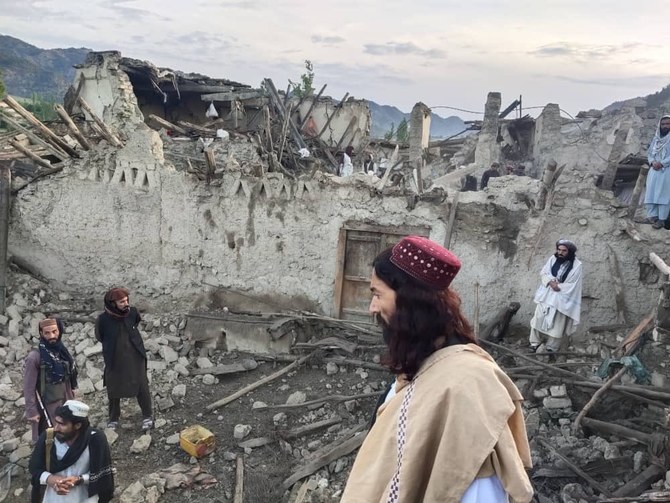

KABUL: The Taliban chief called on Wednesday for international assistance after the deadliest earthquake in decades struck eastern Afghanistan, killing at least 1,000 people, with warnings that the death toll is likely to rise.
The 6.1 magnitude earthquake hit rural, mountainous areas of Paktika and Khost provinces near the Pakistani border on Tuesday night, flattening homes as people slept inside.
Mohammad Amin Huzaifa, head of the Information and Culture Department in Paktika, told reporters that more than 1,000 people were killed and more than 1,500 others injured in the Gayan and Barmal districts of Paktika alone. He said that the figures were expected to increase.
In an emergency meeting, the Afghan government approved 100 million Afghanis ($1.1 million) for relief efforts, but as the country is already facing a financial and humanitarian crisis, the Taliban supreme leader, Mullah Hibatullah Akhundzada, called on the international community for help.
“We also ask the international community, aid organizations and humanitarian agencies to support the people of Afghanistan during this great disaster, and help the victims as much as possible,” he said.
Offers of immediate assistance came from Pakistan. Tremors were also recorded in the country, but authorities did not report damage or casualties. The Pakistani foreign office said that it was working to extend aid.
The earthquake was the deadliest in Afghanistan since 1998, when magnitude 6.5 tremors killed more than 4,000 people in Takhar province in the country’s north.
Sakhi Rahman, a resident of Paktika, told Arab News that medical facilities in the province were overwhelmed by casualties.
“We may have a maximum of 300 to 400 hospital beds in the whole province,” he said. “We need ambulances and helicopters to transfer the wounded to Kabul and other provinces where they can receive proper and timely treatment.”
Another resident, Ahmad Gul, said that dozens of people were killed in every village of the mountainous area.
“The disaster is very big. We have minimum facilities available in the province,” he said. “We must leave everything else and pay attention to saving more people.”
Rescuers were rushed to the area, but the response is complicated by the fact that many international aid agencies left Afghanistan after the Taliban takeover last August, as US-led forces withdrew following two decades of war.
In response to the Taliban takeover, many nations imposed sanctions on Afghanistan, paralyzing its banking sector and cutting billions of dollars worth of development aid.
Abdul Fatah Jawad, head of the Afghan aid group Ehsas Welfare and Social Services Organization, told Arab News that international help was urgently needed.
“UN agencies, international organizations and charity foundations must give priority to providing emergency assistance to the provinces hit by last night’s earthquake,” he said.
“The government alone isn’t going to be able to address this massive calamity.”


