

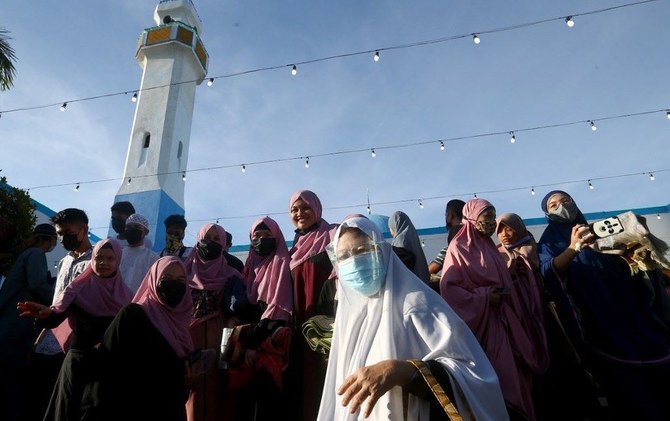
‘Most important moment of my life’: Filipinos embark on Hajj after two-year hiatus

Philippine Muslims stand outside a mosque in Manila on May 13, 2021. (AFP)
Short Url
Updated 23 June 2022
Follow

‘Most important moment of my life’: Filipinos embark on Hajj after two-year hiatus

  • About 3,500 Philippine Muslims are going to participate in Hajj this year
  • Number is lower than the country’s quota as travel costs have increased after pandemic

MANILA/DAVAO CITY: Bazer Sulaiman was ready to perform the Hajj in 2020, when coronavirus travel restrictions swept the world, preventing him and millions of other foreign pilgrims from reaching Makkah for two years.

One of Islam’s five main pillars of faith, the Hajj was restricted over pandemic fears to only 1,000 people living in Saudi Arabia in 2020. Last year, the Kingdom limited the pilgrimage to 60,000 domestic participants, compared with the pre-pandemic 2.5 million.

But this year, as it has already lifted most of its COVID-19 curbs, Saudi Arabia will welcome one million pilgrims from abroad — and 3,500 of them will come from the Philippines.

A predominantly Christian country of 110 million people, the Philippines has a Muslim minority comprising about a tenth of its population. Most Filipino Muslims live in the country’s south, in parts of Mindanao, Palawan and the Sulu Archipelago.

“It’s the most important moment of my life. I have been waiting for this,” Sulaiman, a 59-year-old retired policeman, told Arab News.

Embarking on his journey to Makkah and Madinah on Wednesday, the two holiest sites of Islam, Sulaiman will fly more than 8,500 km from Parang, Maguindanao province, in the southern part of Mindanao.

“I want to meet my fellow Muslims from the other side of the planet,” he said. “I want to strengthen my faith.”

This year, the Philippines has been allotted a quota of 4,074 pilgrims, but not all of them will be able to join the Hajj as the transportation industry still has not rebounded from two years of pandemic closures and travel costs are high, Malo B. Manonggiring, who heads the bureau of pilgrimage of the National Commission on Muslim Filipinos, told Arab News.

“They (the pilgrims) may be ready, but the problem is their financial capability because the cost of doing the Hajj now is $3,390. Before it was less than $3,000,” he said.

“The quota given to us was 4,074, but we are analyzing the situation, which is why we lowered it to 3,500.”

Mike Bantilan, a 58-year-old who is traveling to Makkah from Cotabato City in Maguindanao, has been supported by his family to perform the pilgrimage.

“There were donations from my relatives,” he said. “Because of my excitement and thinking of the memorable journey, there were nights I couldn’t sleep.”

Bantilan has already processed all the documents, and prepared himself physically, as he will travel this week.

“It’s obligatory for all Muslims who can afford to attend the Hajj,” he said. “I am doing this for Allah.”


Blair pressured UK officials over case against soldiers implicated in death of Iraqi

Former British Prime Minister Tony Blair. (File/AFP)
Updated 5 sec ago
Follow

Blair pressured UK officials over case against soldiers implicated in death of Iraqi

  • Newly released files suggest ex-PM took steps to ensure cases were not heard in civilian court
  • Baha Mousa died in British custody in 2003 after numerous assaults by soldiers over 36 hours

LONDON: Former UK Prime Minister Tony Blair pressured officials not to let British soldiers be tried in civil courts on charges related to the death of an Iraqi man in 2003, The Guardian reported on Tuesday.

Baha Mousa died in British Army custody in Basra during the Iraq War, having been repeatedly assaulted by soldiers over a 36-hour period.

Newly released files show that in 2005 Antony Phillipson, Blair’s private secretary for foreign affairs, had written to the prime minister saying the soldiers involved would be court-martialed, but “if the (attorney general) felt that the case were better dealt with in a civil court he could direct accordingly.”

The memo sent to Blair was included in a series of files released to the National Archives in London this week. At the top of the memo, he wrote: “It must not (happen)!”

In other released files, Phillipson told Blair that the attorney general and Ministry of Defence could give details on changes to the law they were proposing at the time so as to avoid claims that British soldiers could not operate in a war zone for fear of prosecution. 

In response, Blair said: “We have, in effect, to be in a position where (the) ICC (International Criminal Court) is not involved and neither is CPS (Crown Prosecution Service). That is essential. This has been woefully handled by the MoD.”

In 2005, Cpl Donald Payne was court-martialed, jailed for a year and dismissed from the army for his role in mistreating prisoners in custody, one of whom had been Mousa.

Payne repeatedly assaulted, restrained and hooded detainees, including as part of what he called “the choir,” a process by which he would kick and punch prisoners at intervals so that they made noise he called “music.”

He became the first British soldier convicted of war crimes, admitting to inhumanely treating civilians in violation of the 2001 International Criminal Court Act.