

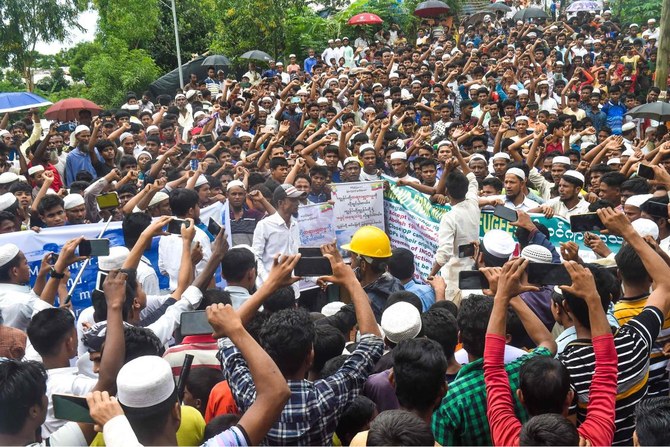
Rohingya refugees in Bangladesh demand repatriation to Myanmar

Sunday’s demonstrations come after the foreign secretaries of Bangladesh and Myanmar last week held a meeting — their first in nearly three years — by video conference. (AFP)
Short Url
Updated 20 June 2022
Follow

Rohingya refugees in Bangladesh demand repatriation to Myanmar

  • Officials from both countries held virtual talks on resettlement last week
  • Almost 1 million people live in cramped settlements in Cox’s Bazar

DHAKA: Rohingya refugees in Bangladesh have demanded repatriation back to Myanmar as calls to return sounded within the community to mark World Refugee Day on Monday, five years after hundreds of thousands fled a brutal military crackdown in their home country.

More than 1.1 million Rohingya refugees live in dozens of cramped settlements in Cox’s Bazar, a fishing port in southeast Bangladesh with no work, poor sanitation and little access to education.

After a ban on rallies due to a massive 100,000-strong protest in August 2019, authorities allowed tens of thousands of Rohingya to stage demonstrations on Sunday, where they demanded to be repatriated back to Myanmar.

“We want to be repatriated, as long as the demands we made are met and there is a conducive environment in Rakhine,” 24-year-old refugee Osman Johar, who took part in the rallies, told Arab News.

The Rohingya at Cox’s Bazar had demanded to be recognized as official citizens in Myanmar, and for the government to stop torturing members of the community and other ethnic minorities in the country, among other demands.

“There is no security of life for us in camp at this moment. We don’t have facilities to achieve higher education. There is no proper healthcare and no freedom of movement. Above all I want to say that we are not fully safe in the camps,” Johar added.

Various crimes have taken place across the congested camps in recent years, but the killing of prominent Rohingya leader and founder of the Arakan Rohingya Society for Peace and Human Rights, Mohibullah, last September, had sparked fear among the refugee community.

A community leader from the rights group, who had requested anonymity out of concern for his safety, said that refugees felt unsafe because there have been cases of kidnapping, looting and extortion in the camps in Cox’s Bazar.

“People live here in fear,” he told Arab News. “We want to return to Myanmar. But before that the Myanmar authorities should recognize our identity as Rohingya.”

A UN fact-finding mission had concluded that the 2017 military crackdown in Myanmar, which included killings and forced mass exodus of the Rohingya, had included “genocidal acts.”

Shamsud Douza Nayan, Bangladesh’s additional refugee relief and repatriation commissioner at Cox’s Bazar, said that the demonstrations on Sunday were peaceful and were joined by several thousand Rohingya.

“The Rohingya gathered in different small groups inside the camp areas demanding their earliest repatriation,” Nayan told Arab News.

While negotiations have stalled for years, Sunday’s rallies took place after officials from Bangladesh and Myanmar held a virtual meeting last week to discuss repatriation of the Rohingya, said Mainul Kabir, director-general of the Rohingya desk at Bangladesh’s Foreign Ministry.

“It was very cordial, but still we don’t know when we can actually begin the repatriation process,” Kabir said. 


US intercepts fifth sanctioned tanker as it exerts control over Venezuelan oil distribution

Updated 4 sec ago
Follow

US intercepts fifth sanctioned tanker as it exerts control over Venezuelan oil distribution

WASHINGTON: US forces boarded another oil tanker in the Caribbean Sea on Friday, the US military said, as the Trump administration targets sanctioned tankers traveling to and from Venezuela as part of a broader effort to take control of the South American country’s oil.
The predawn raid was carried out by Marines and Navy sailors launched from the aircraft carrier USS Gerald R. Ford, part of the extensive force the US has built up in the Caribbean in recent months, according to US Southern Command, which declared “there is no safe haven for criminals” as it announced the seizure of the tanker called the Olina. The Coast Guard then took control of the vessel, officials said.
Southern Command and Homeland Security Secretary Kristi Noem both posted unclassified footage on social media Friday morning of a US helicopter landing on the vessel and US personnel conducting a search of the deck and tossing what appeared to be an explosive device in front of a door leading to inside the ship.
In her post, Noem said the ship was “another ‘ghost fleet’ tanker ship suspected of carrying embargoed oil” and it had departed Venezuela “attempting to evade US forces.”
The Olina is the fifth tanker that has been seized by US forces as part of the effort by President Donald Trump’s administration to control the production, refining and global distribution of Venezuela’s oil products, and the third since the US ouster of Venezuela President Nicolás Maduro in a surprise nighttime raid.
In a post on his social media network later in the day, Trump said the seizure was conducted “in coordination with the Interim Authorities of Venezuela” but offered no elaboration.
The White House did not immediately respond to requests for more details.
Venezuela’s government acknowledged in a statement that it was working with US authorities to return the tanker, “which set sail without payment or authorization from the Venezuelan authorities,” to the South American nation.
“Thanks to this first successful joint operation, the ship is sailing back to Venezuelan waters for its protection and relevant actions,” according to the statement.
Samir Madani, co-founder of TankerTrackers.com, said his organization used satellite imagery and surface-level photos to document that at least 16 tankers left the Venezuelan coast in contravention of the quarantine US forces have set up to block sanctioned ships from conducting trade. The Olina was among that flotilla.
US government records show that the Olina was sanctioned for moving Russian oil under its prior name, Minerva M, and flagged in Panama.
While records show the Olina is now flying the flag of Timor-Leste, it is listed in the international shipping registry as having a false flag, meaning the registration it is claiming is not valid. In July, the owner and manager of the ship on its registration was changed to a company in Hong Kong.
According to ship tracking databases, the Olina last transmitted its location in November in the Caribbean, north of the Venezuelan coast. Since then, however, the ship has been running dark with its location beacon turned off.
While Noem and the military framed the seizure as part of an effort to enforce the law, other officials in the Trump administration have made clear they see it as a way to generate cash as they seek to rebuild Venezuela’s battered oil industry and restore its economy.
In an early morning social media post, Trump said the US and Venezuela “are working well together, especially as it pertains to rebuilding, in a much bigger, better, and more modern form, their oil and gas infrastructure.”
The administration said it expects to sell 30 million to 50 million barrels of sanctioned Venezuelan oil, with the proceeds to go to both the US and Venezuelan people. But the president expects the arrangement to continue indefinitely. He met Friday with executives from oil companies to discuss his goal of investing $100 billion in Venezuela to repair and upgrade its oil production and distribution.
Vice President JD Vance told Fox News this week that the US can “control” Venezuela’s “purse strings” by dictating where its oil can be sold.
Madani estimated that the Olina is loaded with 707,000 barrels of oil, which at the current market price of about $60 a barrel would be worth more than $42 million.