

Rohingya refugee children celebrate ‘lifeless’ Eid on remote Bangladesh island

Rohingya children play at a refugee camp in Bhasan Char island, Bangladesh. (AN Photo)
Short Url
Updated 02 May 2022
Follow

Rohingya refugee children celebrate ‘lifeless’ Eid on remote Bangladesh island

  • Nearly 30,000 refugees have been relocated to Bhasan Char since end of 2020
  • Refugee children say they miss friends, family, Eid festivities

DHAKA: Rohingya refugee children relocated with their families to a remote Bangladeshi island said on Monday they missed Eid Al-Fitr celebrations with friends and relatives.

Nearly 30,000 refugees have been moved to Bhasan Char — an island settlement in the Bay of Bengal several hours’ sail away from the mainland — since the end of 2020 with promises of a better life and livelihoods.

The facility, expected to eventually house 100,000 people, is part of Bangladesh’s effort to ease pressure on congested camps at Cox’s Bazar, where more than 1 million Rohingya refugees who fled violence and persecution in Myanmar are living.

The second Eid Al-Fitr on Bhasan Char has not eased the feeling of isolation for its residents, with children reminiscing about the festivities they had experienced at Cox’s Bazar. 
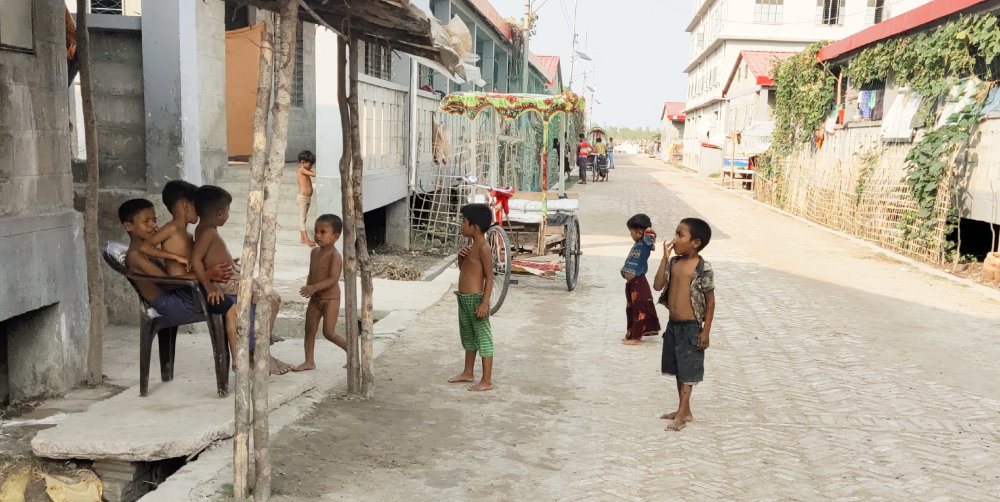


Rohingya children play at a refugee camp in Bhasan Char island, Bangladesh. (AN Photo)

“My Eid celebrations are almost lifeless,” Mohammed Noman Yusuf, 16, told Arab News.

“Most of my friends are still living in Cox’s Bazar camps, and I am missing them a lot. It’s not possible to meet them in person so I resorted to phone calls.”

To mark Eid Al-Fitr, authorities have provided families with food packages and new clothes, but an estimated 7,000 children at Bhasan Char still long for more than what the island life has to offer.

“Where should I go wearing this new cloth?” Yusuf said. “It’s an island and definitely a confined place. There is little room to roam around here and there with friends, which is part of my Eid celebrations.”

Mohammed Ayub, 12, is among those missing his life at Cox’s Bazar, where he recalled far more things to do to mark the end of the Ramadan holy month. 
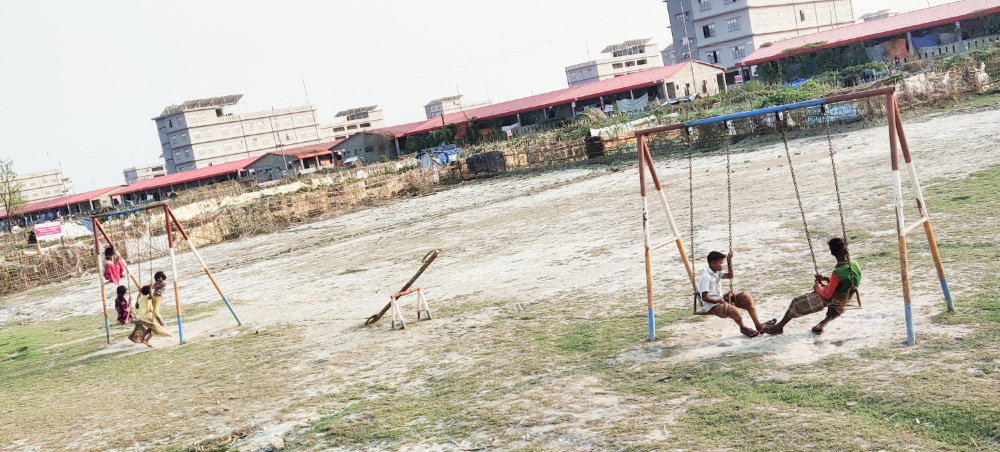


Rohingya children play at a refugee camp in Bhasan Char island, Bangladesh. (AN Photo)

“My Eid celebrations at Cox’s Bazar were much more colorful. Most of my friends and relatives are living there. I used to enjoy the merry-go-round rides during the Eid fair held at Cox’s Bazar,” Ayub told Arab News.

“But here we don’t get such things on the occasion of Eid.”

The boy’s spirits were significantly lifted when his father gifted him a pair of trousers to mark the religious holiday this year, but Ayub still dreams of the feast that had accompanied Eid celebrations.

“Having rich food like beef and chicken during Eid boosts our celebrations, but without them there’s nothing special in our kitchen on this Eid,” he said.

Nasima Akter, 12, told Arab News that she used to visit the beach at Cox’s Bazar to celebrate Eid Al-Fitr, but noted that this year was better because they had more neighbors. However, she missed her relatives who remained at the mainland refugee camps.

“Many of our relatives are still living at Kutupalong, Cox’s Bazar. I can’t see them on Eid days. It’s very sad for me,” Akter added.

Moazzam Hossain, Bangladesh’s additional refugee relief and repatriation commissioner, told Arab News that authorities were making arrangements to add to the festivities for the children.

“With limited resources, we are trying our best to make Eid celebrations more colorful and joyful for the Rohingyas at the island,” Hossain said.

Backlash as Australia kills dingoes after backpacker death

Updated 58 min 43 sec ago
Follow

Backlash as Australia kills dingoes after backpacker death

  • The euthanization program has stirred debate about how to manage the local population of dingoes
  • Wildlife experts said killing the animals was the wrong response and may threaten the island’s dingo population

SYDNEY: Australian authorities have sparked a backlash by killing a group of dingoes linked to the death of a young Canadian woman on an island in the country’s east.
The Queensland government said six animals were put down after 19-year-old backpacker Piper James’s body was found on January 19 at a beach on the World Heritage-listed island of K’gari.
The euthanization program has stirred debate about how to manage the local population of dingoes, a sandy-colored canine believed to have first arrived in Australia 4,000 to 5,000 years ago.
An autopsy conducted on James’ body found evidence “consistent with drowning” but also detected injuries corresponding to dingo bites.
“Pre-mortem dingo bite marks are not likely to have caused immediate death,” said a spokesperson for the Coroners Court of Queensland.
The coroner’s investigation into the cause of death was expected to take several weeks.
In response, the Queensland government said a pack of 10 dingoes involved would be euthanized after rangers had observed some “aggressive behavior.”
Six of the dingoes had already been euthanized, the state’s environment minister, Andrew Powell, told reporters Sunday.
“Obviously, the operation will continue,” he said.
The traditional owners of K’gari, the Butchulla people, said the state’s failure to consult with them before euthanizing the dingoes — or wongari in their language — was “unexpected and disappointing.”
“Once again, it feels as though economic priorities are being placed above the voices of the people and traditional owners, which is frustrating and difficult to accept,” the Butchulla Aboriginal Corporation said in a statement to Australian media this week.
‘You are food’
Wildlife experts said killing the animals was the wrong response and may threaten the island’s dingo population, estimated at just 70-200 animals.
Given their small numbers, killing a pack of 10 animals would harm the population’s genetic diversity, said Mathew Crowther, professor of quantitative conservation biology at the University of Sydney.
“There’s no moral from the dingoes’ point of view. They’re just being wild animals, doing wild things,” Crowther said.
Dingoes tend to lose their fear of people as they interact with tourists, some of whom defy advice against feeding the animals.
“That’s the worst thing you can do to a wild animal,” Crowther said.
“They just relate humans to food, and if you don’t give them food, well, you are food — that’s basically how it is.”
Dingoes are wild, predatory animals and need to be treated with respect, said Bill Bateman, associate professor in the school of molecular and life sciences at Curtin University.
The canines are more likely to attack children or people who are alone, and may be triggered when people turn their backs or run, he said.
“These are important animals, and therefore we need to change the way we deal with them, otherwise we’re just going to keep reacting to these attacks and driving the population of dingoes down,” Bateman said.
Wildlife managers, rangers, Indigenous people and tourism operators need to work together so that humans and dingoes can coexist on the island, he said.
Todd James, the father of Piper, has described on social media how his family’s hearts were “shattered” by her death.
News of the dingoes’ euthanization was “heart-wrenching,” he told Australian media, adding however that he recognized it may be necessary for safety because of the pack’s behavior.