

Hajj clothing prices soar in southwest Pakistan as inflation bites

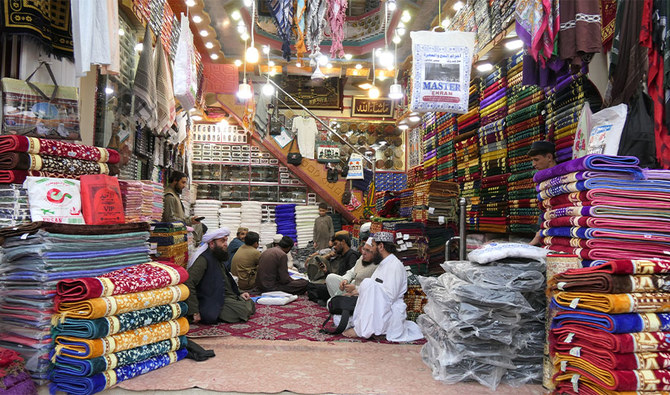
Pakistani Hajj pilgrims gather inside an Ihram clothing shop in Masjid Road in Quetta, Pakistan on June 16, 2022. (AN Photo)
Short Url
Updated 19 June 2022
Follow

Hajj clothing prices soar in southwest Pakistan as inflation bites

  • Pilgrims are required to don two-piece seamless white garment during Hajj
  • Prices of Ihram clothes have gone up by 80 percent in Balochistan

QUETTA: As he arranges different varieties of Ihram clothing at his shop in Quetta, Abdullah Jan hopes to attract prospective pilgrims, but he does not expect to earn much during this pilgrimage season, as Pakistan is facing record high inflation that renders many unable to afford the mandatory Hajj clothing.

Ihram is a special four to five-meters-long white garment, a two-piece seamless wrap, that male pilgrims don as they enter the holy city of Makkah to complete their Hajj rituals.

It is available in many varieties, with Turkish, Chinese and Pakistani designs made from wool or cotton threads being most popular among pilgrims. 

“The prices of Ihram have gone up by 80 percent this season,” Jan told Arab News at the shop on Masjid Road in downtown Quetta, the capital of southwestern Balochistan province, where his father has been selling religious clothing for the last 60 years. 
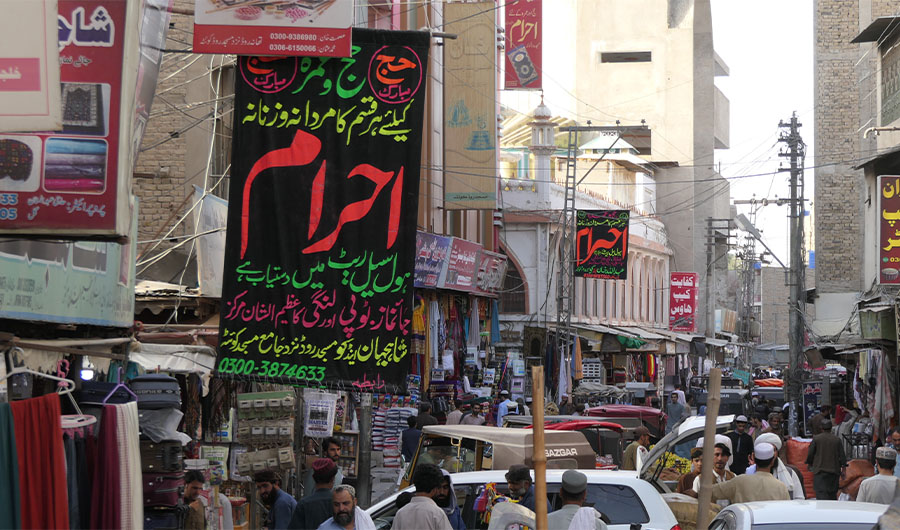


Shops selling Hajj clothing display their banners in Masjid Road in Quetta, Pakistan on June 16, 2022. (AN Photo)

“The Ihram we used to sell for Rs800 ($4) is now being sold for Rs1,400-1,500,” he said.

One of Islam’s five main pillars of faith, the Hajj was restricted over coronavirus fears to just 1,000 people residing in Saudi Arabia in 2020. Last year, the Kingdom limited the pilgrimage to 60,000 domestic participants, compared with the pre-pandemic 2.5 million.

This year, as the Kingdom has already lifted most of its COVID curbs, it will welcome 1 million pilgrims from abroad. Over 81,000 pilgrims will come from Pakistan, including 5,000 from Balochistan province.

But as the main rituals will begin in the first week of July, many of those who will participate in them will buy just one set of clothing. 
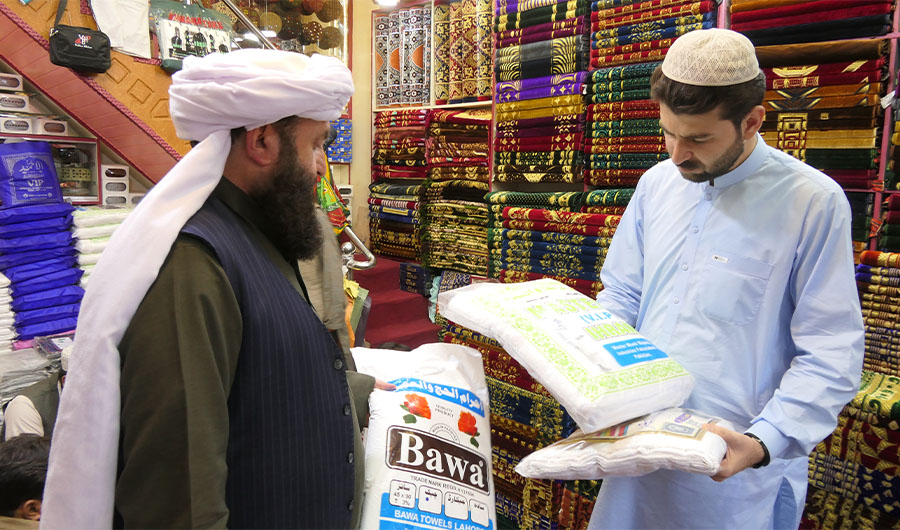


Syed Naqeebullah looks at different varieties of Ihram clothing at a shop in Masjid Road in Quetta, Pakistan on June 16, 2022. (AN Photo)

“People who used to buy a pair of Ihrams for the 40-day pilgrimage can now afford only one Ihram, without the prayer beads and rugs that they used to buy as gifts for their friends and family,” Jan said.

Muhammad Amir, who owns the Majeed Towel Factory in Faisalabad, said his production has declined because of a drop in demand orders from across the country. He used to sell about 30,000 pieces of Ihram clothing, but this year his sales dropped by half. 
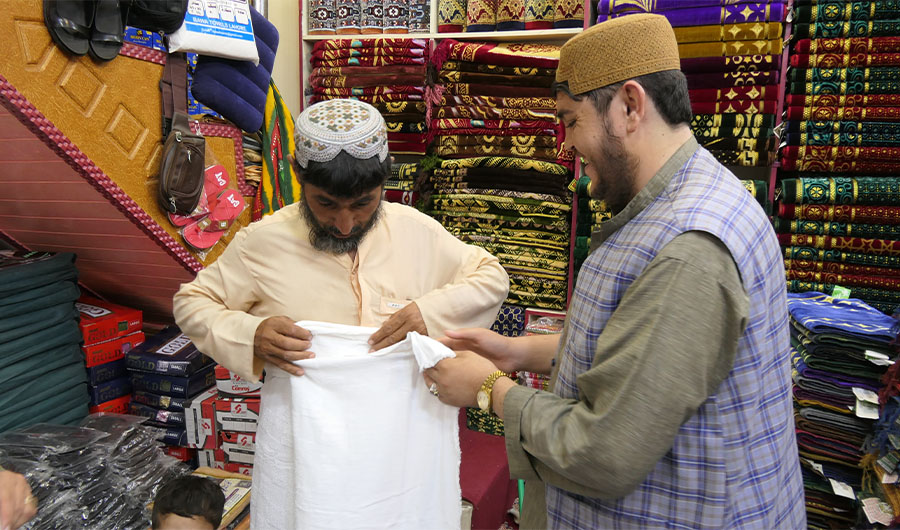


A man pilgrim tries Ihram clothing at a shop in Masjid Road in Quetta, Pakistan on June 16, 2022. (AN Photo)

“Our factory has been sending Ihrams to Rawalpindi, Lahore, Quetta, Peshawar and many other cities of the country,” Amir said. “This season, we have dispatched around 15,000 pieces.”

Syed Naqeebullah arrived in Quetta’s biggest Ihram market to buy the white dress for his father who will depart for Saudi Arabia next week.
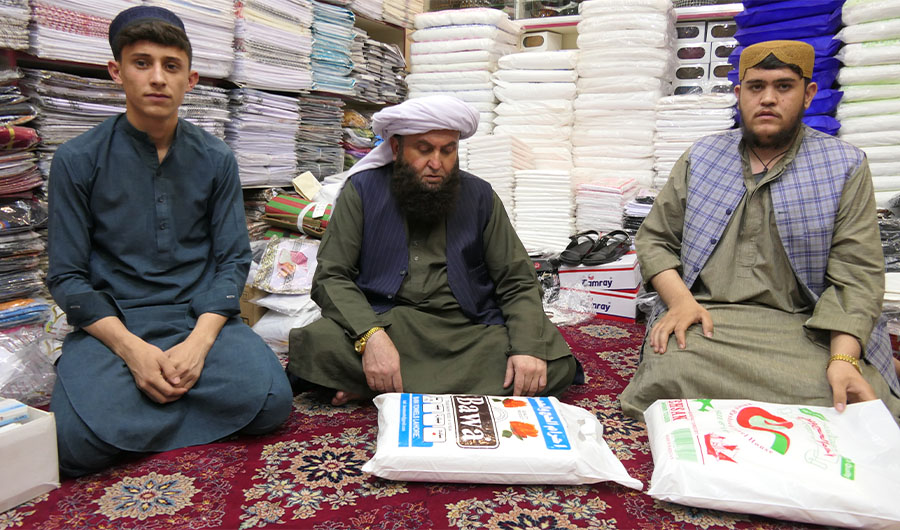


Ihram seller Haji Abdullah Jan, center, sits with his sons inside thier shop in Masjid Road in Quetta, Pakistan on June 16, 2022. (AN Photo)

“I have bought a towel Ihram made with wool for my father because it’s more comfortable than the other designs, but I have witnessed an increase in prices,” he said. “A pilgrim has to buy Ihram to start his Hajj journey, hence he pays the amount without caring about the price.”

Pakistan’s seafood exports to China hit nearly $255 million in 2025 as market reach widens

Updated 26 January 2026
Follow

Pakistan’s seafood exports to China hit nearly $255 million in 2025 as market reach widens

  • Frozen fish and cephalopods lead exports as shipments expand beyond China’s coastal hubs
  • Growth reflects Pakistan’s push to diversify exports and tap China’s inland consumer markets

ISLAMABAD: Pakistan’s seafood exports to China rose to nearly $255 million in 2025, underscoring Beijing’s growing importance as a destination for Pakistani marine products, according to data from China’s General Administration of Customs (GACC) published by state-run APP on Monday.

The figures point to a broader geographic and product diversification of Pakistan’s seafood trade with China at a time when Islamabad is seeking to boost foreign exchange earnings and reduce reliance on a narrow set of export sectors.

“The gains were driven by sustained demand for frozen fish, cephalopods, and a growing range of processed seafood products in both coastal and inland markets,” APP said in a report, citing China Customs data.

Frozen fish remained the single largest export category, contributing about $64.6 million to Pakistan’s seafood shipments to China. Imports were concentrated in major coastal and metropolitan entry points, with Guangdong province emerging as the largest destination by value and volume, importing 8.48 million kilograms worth $15.7 million. Shandong and Beijing followed, each exceeding 7 million kilograms, while Shanghai, Tianjin and Zhejiang also recorded substantial volumes.

At the same time, smaller but notable shipments were recorded in inland provinces including Sichuan, Yunnan, Guizhou and Chongqing, suggesting a widening distribution footprint supported by expanding cold-chain logistics and growing demand away from China’s traditional port cities.

Cephalopods emerged as another key growth pillar. Exports of frozen cuttlefish and squid reached nearly $31 million, while frozen octopus rose to almost $12 million, reflecting demand from catering chains and seafood processors supplying China’s foodservice and ready-to-cook segments.

Affordable pelagic fish also performed strongly. Frozen sardines, sardinella, brisling and sprats recorded imports of around $14.9 million, supported by household consumption and mass-market food manufacturers.

In addition to core frozen categories, Pakistan exported roughly $14.4 million each in two higher-value segments classified by China Customs as “fish” and “fish products,” indicating a gradual shift toward processed and value-added seafood lines.

Analysts cited in the APP report attributed the overall growth to improved compliance with Chinese food safety standards, expanded approvals for Pakistani processing facilities and competitive pricing backed by Pakistan’s marine resource base. Investments in cold-chain logistics and streamlined customs procedures were also seen as supporting higher volumes and broader market access.