
RIYADH: A number of people were killed or wounded in two separate shootings in the US on Thursday as President Joe Biden appealed to Congress to take action against gun violence.
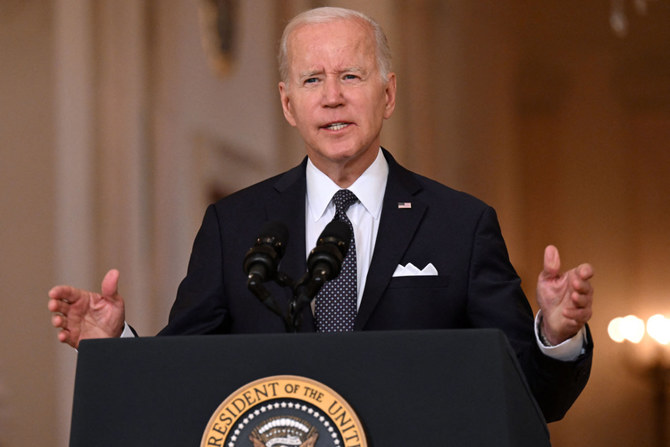
“Enough, enough,” Biden said in an impassioned address to the nation, after mass shootings he said had turned schools, supermarkets and other everyday places into “killing fields.”
At almost the same time that Biden was speaking, a shooting was going on outside a church in Ames in the state of Iowa. Police later said three people, including the shooter died.
The shooting happened outside the Cornerstone Church, a megachurch on the outskirts of Ames, according to the Story County Sheriff’s Office. The church is near Interstate 35, about 30 miles (48.28 kilometers) north of Des Moines.
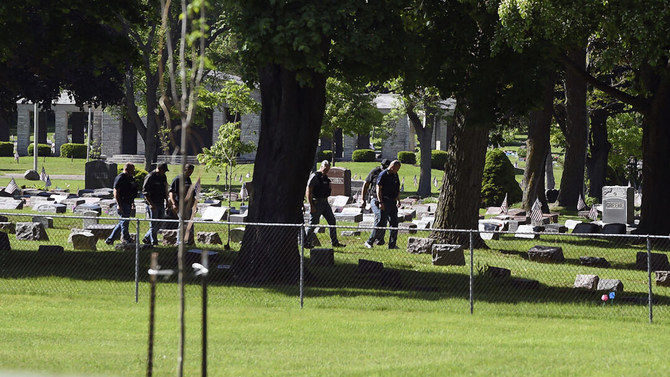
Hours earlier, US police reported that two people were shot at Graceland Cemetery in Racine, Wisconsin state.
Sgt. Kristi Wilcox said a juvenile was treated and released and a second person was flown to a hospital in Milwaukee. It was not immediately known if any suspects were in custody.
Ascension All Saints Hospital, which is next to the cemetery, said it is treating an undisclosed number of victims from the shooting.
The shooting comes the day after a gunman killed his surgeon and three other people at a Tulsa medical office.
The Wisconsin and Iowa incidents were latest in a series of mass shootings in the US including the school massacre in Uvalde, Texas, and an attack on a supermarket in Buffalo, New York.
Racine Mayor Cory Mason released a statement saying the “heinous shooting at a cemetery while a family was already mourning the loss of a loved one is a new low for these perpetrators of violence in our community. The violence has got to stop!“
‘How much more carnage?’
Speaking at the White House, Biden urged voters to use their “outrage” to turn it into a central issue in November’s midterm elections if legislators fail to act.
He acknowledged the stiff political headwinds as he sought to drive up pressure on Congress to pass stricter gun limits after such efforts failed following past attacks.
He repeated calls to restore a ban on the sale of assault-style weapons and high-capacity magazines — and said if Congress won’t embrace all of his proposals, it must at least find compromises like keeping firearms from those with mental health issues or raising the age to buy assault-style weapons from 18 to 21.
“How much more carnage are we willing to accept?” Biden asked after last week’s shootings by an 18-year-old gunman, who killed 19 students and two teachers at an elementary school in Uvalde, Texas, and another attack Wednesday in Tulsa, Oklahoma, where a gunman shot and killed four people and himself at a medical office.
“Don’t tell me raising the age won’t make a difference,” he said.
The most recent shootings came close on the heels of the May 14 assault in Buffalo, New York, where a white 18-year-old wearing military gear and livestreaming with a helmet camera opened fire with a rifle at a supermarket in a predominantly Black neighborhood, killing 10 people and wounding three others in what authorities described as “racially motivated violent extremism.”
“This time we have to take the time to do something,” Biden said, calling out the Senate, where 10 Republican votes would be needed to pass legislation.
'It’s about protecting children'
For all the passion of Biden’s address, and for all his big asks and smaller fallback alternatives, any major action by Congress is still a long shot.
“I know how hard it is, but I’ll never give up, and if Congress fails, I believe this time a majority of the American people won’t give up either,” he added. “I believe the majority of you will act to turn your outrage into making this issue central to your vote.”
Adding a stark perspective to young people’s deaths, he noted that Centers for Disease Control data shows “guns are the number one killer of children in the United States of America,” ahead of car crashes.
“Over the last two decades, more school-age children have died from guns than on-duty police officers and active-duty military — combined,” he said.
Aware of persistent criticism from gun-rights advocates, Biden insisted his appeal wasn’t about “vilifying gun owners” or “taking away anybody’s guns.”
“We should be treating responsible gun owners as an example of how every gun owner should behave,” Biden said. “This isn’t about taking away anyone’s rights, it’s about protecting children, it’s about protecting families.”
He called on Congress to end “outrageous” protections for gun manufacturers, which severely limit their liability over how their firearms are used, comparing it to the tobacco industry, which has faced repeated litigation over its products’ role in causing cancer and other diseases.
“Imagine if the tobacco industry had been immune from being sued, where we’d be today,” Biden said.
All major broadcast networks broke away from regular programing to carry Biden’s remarks at 7:30 p.m. EDT, before the start of prime-time shows.
(With AP)