

Global economic impact of Russian invasion of Ukraine to be felt for years: WEF panel

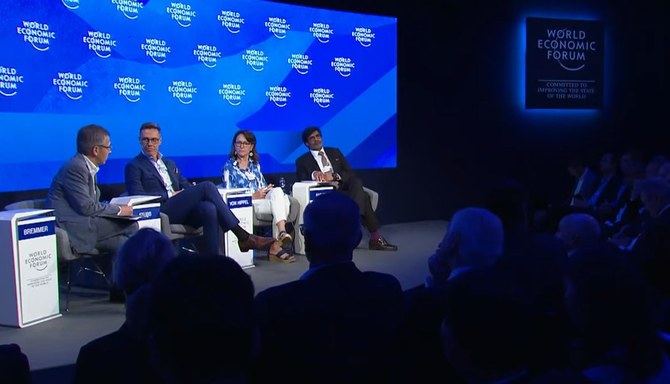
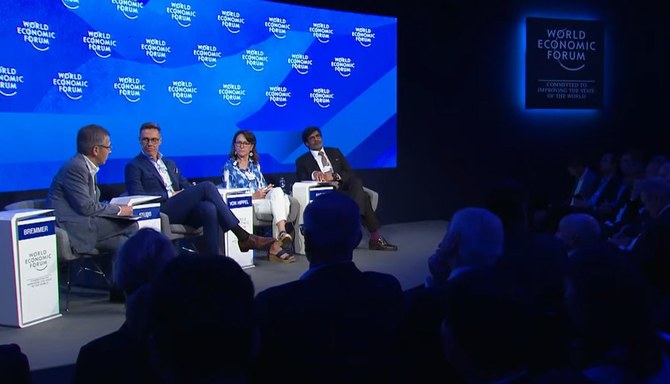
Former Finnish PM Alexander Stubb said that the global economy would feel the pinch as a result of the Russian invasion of Ukraine, especially in terms of inflation, energy prices and food security. (Screengrab)
Short Url
Updated 24 May 2022
Follow

Global economic impact of Russian invasion of Ukraine to be felt for years: WEF panel

  • Former Finnish PM Alexander Stubb: Zelensky can’t give up, and it’s much easier to defend your country and your identity than to attack
  • Alexander Stubb: The Russian military is surprisingly weak, and it’s difficult for Putin to define a victory

DAVOS: The war in Ukraine is likely to continue impacting the economies of Europe and the wider world for years to come, former Finnish Prime Minister Alexander Stubb said during a panel at the World Economic Forum on Monday.

Stubb said the global economy would feel the pinch as a result of the Russian invasion of Ukraine, especially in terms of inflation, energy prices and food security.

While Vladimir Putin remains in power in Russia, Stubb said he could not see the return of an equilibrium between Moscow and Europe and that it would be hard for either the Russians or the Ukrainians to define a victory in the conflict.

“Zelensky can’t give up, and it’s much easier to defend your country and your identity than to attack,” he said. “The Russian military is surprisingly weak, and it’s difficult for Putin to define a victory,” he added.

“I think it has to be a territorial definition; for Putin, it’s only Donetsk, perhaps a little bit more, including Crimea.

“Whereas for Zelensky, he could never approve that. I don’t have an answer for when this is going to end.”

Stubb also said he believes that the driving force behind the war is Putin’s desire to make himself a great leader in Russian history.

Stubb’s co-panelist Karin von Hippel, director-general of the Royal United Services Institute, said more definition was needed between Putin and the Russian people, calling the Ukraine invasion “Putin’s war.”

She continued: “It’s hard to say if he knows the truth about what’s really going on in Ukraine; we don’t know how far he’s willing to go.”

She said that under Russia’s leadership, Putin would not abandon the ideology that Ukraine should form part of Russia.

“No Western country can shake hands with him after this. Some may, but a large part can’t,” she added.

Von Hippel said that while she believed in global governance and was a supporter of the UN project, she felt “deeply disappointed” by its response to the Ukraine conflict, saying it had “failed” in its duty.

Samir Saran, president of the Observer Research Foundation, said he believed the developing world — in Asia, Africa and Latin America — should not be paying for what he called a war of European making. 

“When will the world start blaming the West for this inflation?” he asked, before concluding the moment would come sooner than European leaders think.

Saran also said that if a reported disconnect between Putin and the Russian people were to disappear and they were to fully support the conflict, the consequences would be felt by the global economy for at least another decade.


Two high-speed trains derail in Spain, police sources say 21 people killed

Updated 4 min 43 sec ago
Follow

Two high-speed trains derail in Spain, police sources say 21 people killed

  • The accident happened near Adamuz, in Cordoba province. So far, 21 people ​have been confirmed dead by police

MADRID: A high-speed train derailed and smashed into another oncoming train in southern Spain on Sunday, pushing the second train off the tracks in a collision that police sources confirmed to Reuters had killed at least 21 people.
The accident happened near Adamuz, in Cordoba province. So far, 21 people ​have been confirmed dead by police, with state broadcaster Television Espanola adding that 100 people had been injured, 25 seriously. The driver of one of the trains, which was traveling from Madrid to Huelva, was among those who died, the TV station added.
“The Iryo 6189 Malaga — (to Madrid) train has derailed from the track at Adamuz, crashing onto the adjacent track. The (Madrid) to Huelva train which was traveling on the adjacent track has also derailed,” said Adif, which runs the rail network, in a social media post.
Adif said the accident happened at 6:40 p.m. (1740 GMT), about 10 minutes after the Iryo train left Cordoba heading toward Madrid.
Iryo is a private rail operator, majority-owned by Italian state-controlled railway group Ferrovie dello Stato. The train involved was a Freccia 1000 train which was traveling between ‌Malaga and Madrid, ‌a spokesperson for Ferrovie dello Stato said.
The company said in a statement that it ‌deeply ⁠regretted what ​had happened ‌and had activated all emergency protocols to work closely with the relevant authorities to manage the situation.
The second train was operated by Renfe, which also did not respond to a request for comment.
Adif has suspended all rail services between Madrid and Andalusia.

HORRIFIC SCENE
The Iryo train had more than 300 passengers on board, while the Renfe train had around 100.
Paco Carmona, Cordoba fire chief, told TVE the first train heading to Madrid from Malaga had been evacuated.
The other train’s carriages were badly damaged, he said, with twisted metal and seats. “There are still people trapped. We don’t know how many people have died and the operation is concentrating on getting people out of areas which are very narrow,” he ⁠said. “We have to remove the bodies to reach anyone who is still alive. It is proving to be a complicated task.”
Transport Minister Oscar Puente said he was following events ‌from rail operator Adif’s headquarters in Madrid.
“The latest information is very serious,” ‍he posted on X. “The impact was terrible, causing the first two ‍carriages of the Renfe train to be thrown off the track. The number of victims cannot be confirmed at this time. ‍The most important thing now is to help the victims.”
The mayor of Adamuz, Rafael Moreno, told El Pais newspaper that he had been among the first to arrive at the scene of the accident alongside the local police and saw what he believed to be a badly lacerated body several meters from the accident site.
“The scene is horrific,” he said. “I don’t think they were on the same track, but it’s not clear. Now ​the mayors and residents of the area are focused on helping the passengers.”

CALLS FOR MEDICS
Images on local television showed a reception center set up for passengers in the town of Adamuz, population 5,000, with locals coming ⁠and going with food and blankets amid nighttime temperatures of around 42 degrees Fahrenheit (6 degrees Celsius).
A woman named Carmen posted on X that she had been on board the Iryo train to Madrid. “Ten minutes after departing (from Cordoba) the train started to shake a lot, and it derailed from coach 6 behind us. The lights went out.”
Footage posted by another Iryo train passenger, also on X, showed an Iryo staffer in a fluorescent jacket instructing passengers to remain in their seats in the darkened carriages, and those with first aid training to keep watch over fellow passengers. He also urged people to maintain mobile phone batteries to be able to use their torches when they disembarked.
Salvador Jimenez, a journalist for RTVE who was on board the Iryo train, shared images showing the nose of the rear carriage of the train lying on its side, with evacuated passengers sitting on the side of the carriage facing upwards.
Jimenez told TVE by phone from beside the stricken trains that passengers had used emergency hammers to smash the windows and climb out, and they had seen two people taken ‌out of the overturned carriages on stretchers.
“There’s a certain uncertainty about when we’ll get to Madrid, where we’ll spend the night, we’ve had no message from the train company yet,” he said. “It’s very cold but here we are.”