



DAVOS, Switzerland: The president of the World Economic Forum has said the Geneva-based organization is sending a strong signal to Moscow by not inviting Russian officials and businesses to this year’s Davos summit while issuing an invitation to the Ukrainian leader to address the gathering.
“When it comes to Russia, we chose not to invite Russian business or Russian officials because there are limits,” Borge Brende told Katie Jensen, the host of Frankly Speaking, the Arab News talk show which features interviews with leading policymakers and business leaders.
“Russia has broken basic humanitarian law and international law. They are not sticking to the UN Charter and we have seen so many atrocities.”

Borge Brende with Katie Jensen on Frankly Speaking. (AN photo)
At the same time, Brende said, the WEF will not only have Ukraine President Volodomyr Zelensky “on video” but also several of his ministers.
“From Kyiv we will have two of his deputy prime ministers. We also have the foreign minister in Davos,” he said, adding that some chief executives will be coming together to form a group of CEOs for Ukraine to “secure the rebuilding of the country.”
Defending the WEF’s decision, he said: “The key for unlocking this is with (President Vladimir) Putin and the Kremlin. We need to see that they are taking steps to again rejoin compliance with international law before they will be reinvited to Davos. We have a strong moral obligation to also send this kind of signal in such a situation.”
Brende appeared on “Frankly Speaking” on the eve of the first in-person WEF annual meeting since the start of the COVID-19 pandemic. This is the first time the event, which kicked off on Sunday, is being held in Davos in May.
He denied that for an organization that prides itself on its impartiality and reputation as a bridge builder, the decision not to invite one side amounts to a failure on the WEF’s part to encourage debate.
Opinion
This section contains relevant reference points, placed in (Opinion field)
Brende said it is true that for the last 50 years the WEF has always tried to bring leaders together, but “there are limits.”
“It’s an ongoing war in Ukraine, where we see that children are being killed in their schools every day. You see women being raped. We see war crimes taking place and there is no willingness for dialogue,” he said.
“Davos is about willingness to find common solutions, and if countries at least are willing to sit down and discuss the future, then it is something else. But today we see no kind of this willingness from Russia’s side. That’s why we’re very sad that we cannot have this dialogue. Hopefully in the future, but not today.”
Brende, a former foreign minister of Norway, dismissed comparisons between the charges of atrocities Israel is accused of committing against Palestinian civilians and those being leveled against Russia in Ukraine. He also denied that this is because Ukraine is seen as closer to home for many Europeans.
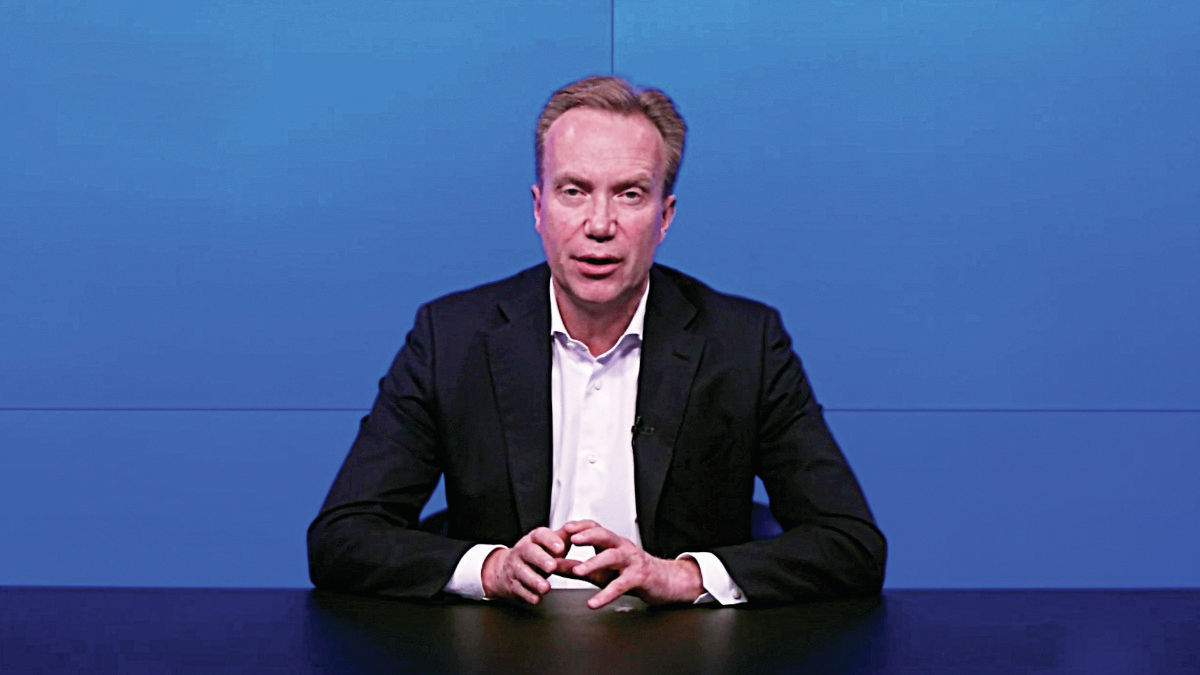
WEF President Borge Brende. (AN photo)
“It is unacceptable what is now happening in Ukraine and the war is ongoing,” he reiterated, explaining why inviting Russia to the annual meeting is not the same thing as, say, inviting Israel or Iran.
“When it comes to Israel and the situation in the Palestinian areas, it is at least some willingness to dialogue. We’ve seen it through the Abrahams Accords, but we also see in Davos that we are bringing together business leaders from both Israel and the Palestinian side in an initiative called ‘Breaking the Impasse.’ And they’re sitting there with global politicians, but also politicians from these areas to discuss if there is a way forward for establishing a two-state solution. At least there is a dialogue going on and we hope for future solutions.”
Asked if he thought the recently imposed sanctions on Russia were enough to end the conflict or whether an expanded NATO was the solution, Brende said: “I think Russia is incredibly surprised by the strength of the Ukrainian army. They were supposed to take Kyiv, the capital, in two, three days. Kharkiv, the second largest city, in two, three days. They have seen the resistance among the Ukrainians that, I am sure, has surprised them and that is why they’re pulling back too.”
ALSO READ: WEF president lauds Saudi reforms, ‘strong delegation’ attending Davos
In the months to come, Brende said, it is likely that Russia will continue with its attacks. “But Ukraine can easily turn into the Vietnam of Russia, or Afghanistan of Russia,” he said.
“When more than 40 million people are fighting back so strongly as the freedom-seeking Ukrainians, Russians will have a huge challenge. It shows that even a very modern and a very strong army cannot kill the freedom-fighting people around the world. I think this is a lesson for many countries to bring with them and reflect over.”
The WEF says its annual meeting in Davos provides “a unique collaborative environment” for public figures and global leaders to “reconnect, share insights, gain fresh perspectives and build problem-solving communities and initiatives.” However, critics say the event has become more of a show featuring politicians sticking to pre-prepared scripts.
Brende countered that this year’s summit would see progress made on many of the most important topics. “We will, for example, have new coalitions when it comes to fighting climate change,” he said.
“We will focus a lot on trade and investments. We know that there will be no real economic recovery without a trade recovery, so that’s why it’s so important that we also have trade ministers, 30 of them together with (World Trade Organization chief Ngozi Okonjo-Iweala), saying that no new tariffs, no more protectionism and no more bans on exporting food.”
“Many of the challenges that we are faced with cannot be sold without business. So, with the 1,400 CEOs and chairs in Davos, I am pretty sure we are going to make progress,” Brende said, adding that “25 percent of the participants are women — it should have been 50, but we are making progress.”
Brende disputed the claim that the WEF summit in Davos has a perception problem, made most recently by the Financial Times newspaper, which said this week that the organization does not project the right image.
“I think we definitely are able to bring together leaders from all walks of life. It’s easy to be critical, but I think the past has also shown that the World Economic Forum has a positive impact,” he said.
“It was in Davos, for example, where the Global Alliance for Vaccines and Immunizations (GAVI) was launched (in 2001). It was here where (the anti-apartheid icon) Nelson Mandela came to Europe for the first time and launched the economic plan for South Africa.
“This time around, it is really about how to make sure that the weak recovery does not end in a new recession. It is to make sure that we walk the talk from COP26 in Glasgow. Business leaders, 120 of them, will commit to going net zero by 2050. So, this is really the place where corporate and governmental leaders are coming together, making a difference.”
Watch the full Frankly Speaking episode below:
As 2,500 members of the global elite descend on Davos, Brende said this year’s meeting could not be more timely because “global challenges need global solutions.”
“Unfortunately, because of the polarized world, we don’t see as much collaboration to really solve wars, climate change and also a weakening recovery,” he said. “But we will try in Davos to get leaders together, and at least mobilize the private sector to support in these very critical areas.”
Brende also acknowledged the reality of the continuing COVID-19 pandemic, saying that it is “very important to be preparing for the next one, because we will see new diseases and pandemics unfortunately in the coming decades too.
“We moved much closer to nature. In just the last 10 years, we have lost wilderness across the world the size of the country of Mexico, so animals and human beings are much closer. And then we will also see more diseases like this.
“And we should not forget that we’re not out of the woods yet. China, the second largest economy in the world, is partly locked down now in some of the biggest and largest cities in the country, and this will also have an impact on the global economy because China is growing slower and the demand from China will of course go down.”
Looking to the future, Brende said: “We have to learn from this pandemic, that we have to have medicine, we have to have medical equipment much closer than before. We can’t wait for weeks for this to arrive. We have to be able to step up vaccination fast. We know that we have paid a huge price: 15 million people have lost their lives so far in this pandemic.”


