

Briton facing death penalty in Iraq over pottery smuggling pleads with court

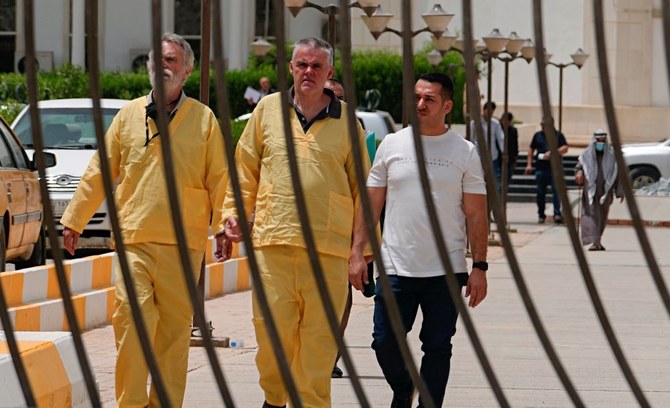
Jim Fitton, left, and Volker Waldmann outside a courtroom in Baghdad, Iraq, Sunday, May 15, 2022. (AP Photo)
Short Url
Updated 16 May 2022
Follow

Briton facing death penalty in Iraq over pottery smuggling pleads with court

  • Jim Fitton, 66, took 12 stones and shards of broken pottery from an archaeological site in Eridu, southeastern Iraq
  • Fitton said that his background as a geologist meant that he liked to collect fragments as a hobby, but did not intend to sell them

LONDON: A retired British geologist facing an Iraqi court over allegations that he attempted to smuggle historical items has argued that he did not realize he was committing a crime.

Jim Fitton, 66, took 12 stones and shards of broken pottery from an archaeological site in Eridu, southeastern Iraq.

Fitton, who is facing the death penalty, appeared in the Baghdad court with German national Volker Waldmann.

He told the three-judge panel that he did not act with criminal intent, adding that there were no signs warning him against taking the shards of pottery.

Fitton told the judges that he “suspected” the items had ancient heritage, but that he “didn’t know about Iraqi laws” at the time, and that he was unaware that taking the shards was a criminal offense.

He was confused because “there were fences, no guards or signage.”

Fitton said that his background as a geologist meant that he liked to collect fragments as a hobby, but did not intend to sell them.

The chief judge in the Baghdad court told Fitton that the location and importance of the site meant that the items were clearly protected.

“These places, in name and by definition, are ancient sites. One doesn’t have to say it is forbidden,” Jaber Abdel Jabir said.

Fitton pleaded that some of the shards he had recovered were “no larger than my fingernail,” but the judge responded: “Size doesn’t matter.”

The 66-year-old and Waldmann were arrested as they attempted to fly out of the country at the end of a geological tour in March. Pottery shards and stones were recovered from their luggage.

Waldmann said that the two artifacts found among his belongings were given to him by Fitton.

The court will reconvene on May 22 to determine if the men hoped to profit from the shards. They are facing the death penalty, but some legal experts have said that this is an unlikely result, even if it is the statutory sentence for smuggling artifacts.

Fitton’s lawyers are expected to submit further evidence, including information from government employees who were present at the sites where the shards and stones were recovered.


Turkiye blocks aid convoy to Syria’s Kobani: NGOs

Updated 5 sec ago
Follow

Turkiye blocks aid convoy to Syria’s Kobani: NGOs

  • They said the aid was blocked before it reached the Turkiye-Syria border
  • “Blocking humanitarian aid trucks carrying basic necessities is unacceptable,” said the platform

ANKARA: Turkish authorities have blocked a convoy carrying aid to Kobani, a predominantly Kurdish town in northern Syria encircled by the Syrian army, NGOs and a Turkish MP said on Saturday.
They said the aid was blocked before it reached the Turkiye-Syria border, despite an agreement announced on Friday between the Syrian government and the country’s Kurdish minority to gradually integrate the Kurds’ military and civilian institutions into the state.
Twenty-five lorries containing water, milk, baby formula and blankets collected in Diyarbakir, the main city in Turkiye’s predominantly Kurdish southeast, “were prevented from crossing the border,” said the Diyarbakir Solidarity and Protection Platform, which organized the aid campaign.
“Blocking humanitarian aid trucks carrying basic necessities is unacceptable, both from the point of view of humanitarian law and from the point of view of moral responsibility,” said the platform, which brings together several NGOs.
Earlier this week, residents of Kobani told AFP they were running out of food, water and electricity because the city was overwhelmed with people fleeing the advance of the Syrian army.
Kurdish forces accused the Syrian army of imposing a siege on Kobani, also known as Ain Al-Arab in Arabic.
“The trucks are still waiting in a depot on the highway,” said Adalet Kaya, an MP from Turkiye’s pro-Kurdish DEM party who was accompanying the convoy.
“We will continue negotiations today. We hope they will be able to cross at the Mursitpinar border post,” he told AFP.
Mursitpinar is located on the Turkish side of the border, across from Kobani.
Turkish authorities have kept the border crossing closed since 2016, while occasionally opening it briefly to allow humanitarian aid to pass through.
DEM and Turkiye’s main opposition CHP called this week for Mursitpinar to be opened “to avoid a humanitarian tragedy.”
Turkish authorities said aid convoys should use the Oncupinar border crossing, 180 kilometers (110 miles) away.
“It’s not just a question of distance. We want to be sure the aid reaches Kobani and is not redirected elsewhere by Damascus, which has imposed a siege,” said Kaya.
After months of deadlock and fighting, Damascus and the Syrian Kurds announced an agreement on Friday that would see the forces and administration of Syria’s Kurdish autonomous region gradually integrated into the Syrian state.
Kobani is around 200 kilometers from the Kurds’ stronghold in Syria’s far northeast.
Kurdish forces liberated the city from a lengthy siege by the Daesh group in 2015 and it took on symbolic value as their first major victory against the militants.
Kobani is hemmed in by the Turkish border to the north and government forces on all sides, pending the entry into the force of Friday’s agreement.