Pope appoints Lebanese priests to lead Eastern Churches dioceses

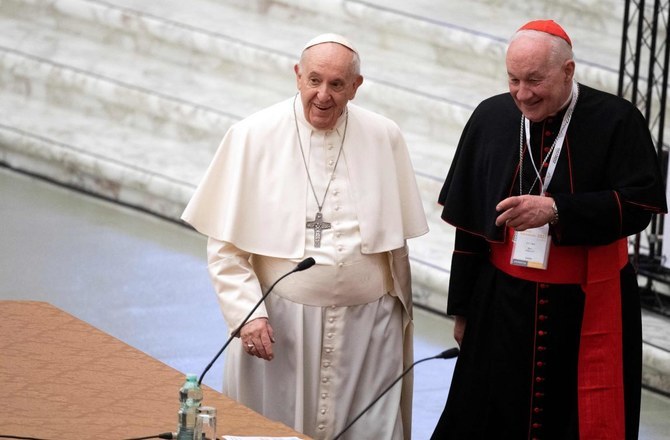
Pope Francis appointed three Lebanese Catholic priests to lead some of the most prominent dioceses in the Eastern Catholic Churches, in a move seen by Vatican observers as a “further sign of attention toward that country’s clergy and faithful.” (AFP)
Short Url
Updated 13 May 2022
Follow

Pope appoints Lebanese priests to lead Eastern Churches dioceses

  • All the new bishops were born in Lebanon, where they completed all their theological studies
  • The Catholic Church in Lebanon is considered the most important and influential in the Middle East

VATICAN CITY: Pope Francis appointed three Lebanese Catholic priests to lead some of the most prominent dioceses in the Eastern Catholic Churches, in a move seen by Vatican observers as a “further sign of attention toward that country’s clergy and faithful.”
The leader of the Catholic Church granted his assent to the election of Rev. Joseph Abdel-Jalil Chami as archbishop of Hassake-Nisibi, Syria.
Rev. Elie Joseph Warde was appointed bishop of the Syrian Catholic Eparchy of Cairo and patriarchal vicar for Sudan and South Sudan, and Rev. Jules Boutros was posted to the position of bishop of the Syrian Patriarchal Curia of Antioch.
All the new bishops were born in Lebanon, where they completed all their theological studies, a communique issued by the Vatican Press Office said.
The Catholic Church in Lebanon is considered the most important and influential in the Middle East, representing today nearly 50 percent of the Christian population.
“This clearly represents a further sign of attention by Pope Francis toward the clergy and the faithful who live in Lebanon, an Arab country where the Catholic presence has historically been remarkable, and the cohabitation between different religions is fruitful,” Fr. Giuseppe Ciutti, an Italian priest who spent time in Iraq, told Arab News.
He added that the pontiff “has always expressed his closeness and appreciation for Lebanese Christians.”
The pope’s planned trip to Lebanon next month was postponed as the 85-year-old Francis experienced difficulty walking due to a flare-up of pain in his right knee, in addition to a long-term case of sciatica, which also causes pain in the legs.
The trip had been announced by the Lebanese government for June 12-12. The Vatican never officially confirmed the trip, but the pope referred to plans relating to it several times in recent interviews. It is now likely to take place in the autumn.


US mediating prisoner exchange talks between Damascus and Druze: source to AFP

Updated 6 sec ago
Follow

US mediating prisoner exchange talks between Damascus and Druze: source to AFP

  • The talks aim to “get the authorities to release 61 civilians from Sweida who have been detained,” held by the National Guard
  • Aid trucks have entered the province several times since July

BEIRUT: The United States is leading negotiations between a prominent Druze leader and the Syrian government to secure an exchange of prisoners held since sectarian clashes in a Druze-majority Syrian province last year, a source with knowledge of the matter told AFP Tuesday.
Thousands are estimated to have been killed when clashes erupted between Druze fighters and Sunni Bedouin tribes in the southern Sweida province in July.
The Syrian government in the capital Damascus said their forces intervened to stop the clashes, but witnesses and monitors accused them of siding with the Bedouin.
The Druze source, who requested anonymity, told AFP that “there are currently negotiations mediated by the United States between Sheikh Hikmat Al-Hijri and the Damascus government.”
The talks aim to “get the authorities to release 61 civilians from Sweida who have been detained... since the events of July, in exchange for 30 personnel of the interior and defense ministries” held by the National Guard, the armed group that operates under prominent Druze leader Hijri.
The Syrian Observatory for Human Rights said the fighting in Sweida left more than 2,000 people dead, including 789 Druze civilians who were “summarily executed by defense and interior ministry personnel.”
While a ceasefire was reached later in July, the situation remained tense and the province difficult to access.
Residents accuse Syrian authorities of imposing a siege on Sweida, which Damascus denies, and tens of thousands of people remain displaced from the violence.
Aid trucks have entered the province several times since July.
In August, dozens of small factions in Sweida announced they would join the National Guard, seeking to unify military efforts under Hijri, who is considered the Druze figure most hostile to Damascus.
Hijri has since demanded the creation of a separate region for his minority community, and has formed a de facto authority in Sweida city and its surrounding areas outside of the central government’s grasp.
Israel bombed Syria during the violence, striking the Syrian army headquarters and near the presidential palace, saying it was acting to defend the minority group.