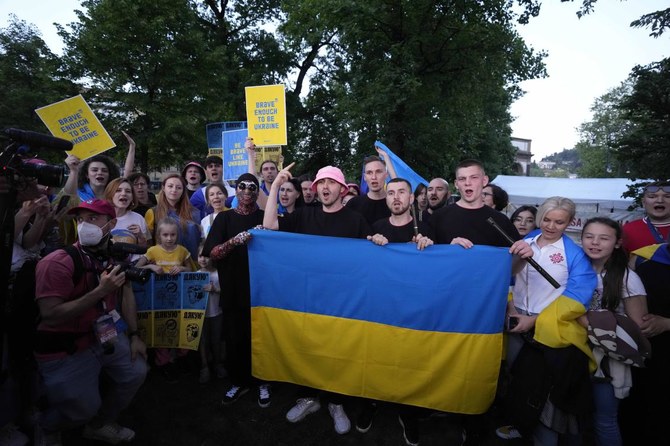
TURIN, Italy: Kalush Orchestra are aiming to “lift the spirits” of their fellow Ukrainians by riding a wave of public support to win the Eurovision Song Contest in the Italian city of Turin on Saturday night.
Their entry “Stefania,” sung in Ukrainian, fuses rap with traditional folk music and is a tribute to frontman Oleh Psiuk’s mother.
The bookmakers have made it the clear favorite for the annual contest, which normally draws a television audience of close to 200 million, based on the plight of Ukraine following Russia’s invasion in February.
“Any victory in any aspect is very important for Ukraine these days, so winning the Eurovision Song Contest of course would lift the spirits of so many Ukrainians while we don’t have much good news these days,” Psiuk told Reuters in an interview on Thursday.
The band takes its name from the Western Ukrainian city of Kalush. It finished second in the country’s national song contest but replaced winner Alina Pash after controversy over a visit she made to Crimea in 2015, a year after it was annexed by Russia.
“We are here to showcase Ukrainian culture because attempts are being made these days to kill Ukrainian culture, and we want to show that Ukrainian culture is alive, it’s unique, and it has its own beautiful signature,” Psiuk added.
One of the regular band members has stayed behind in Ukraine to help defend Kyiv, according to Psiuk, who added that he planned to return home after Eurovision and resume work with a volunteer group trying to find accommodation and medicine for his compatriots.
“Even here, outside Ukraine, we are worried about our family members that stay there, and you wake up every morning without being sure whether everyone you love is still alive and where another missile could hit,” he added.
Russia, which says it is conducting a “special military operation” in Ukraine, has been excluded from the contest this year.
Italy is hosting after winning last year with Maneskin’s rocky “Zitti e Buoni” (Shut Up and Behave).
The contest is decided by a combination of votes by the official jury and viewers from participating nations.
Eurovision fans, converging on Turin for an event that combines glitz, energy and a fair dollop of eccentricity, welcome the chance to let their hair down.
“Eurovision is like a bridge to that normal life we had before the war started,” Vitalii Lirnyk, a member of the official Ukrainian Eurovision fan club, said in Turin.
“And maybe, for like a couple of minutes, for an hour a day, we can just feel safe and normal,” added Lirnyk, who has lived in the United States for the past few years.


![]()

Ukraine’s Kalush Orchestra seek to lift spirits at Eurovision
Short Url
https://arab.news/pja9z
Ukraine’s Kalush Orchestra seek to lift spirits at Eurovision
- Their entry "Stefania", sung in Ukrainian, fuses rap with traditional folk music and is a tribute to frontman Oleh Psiuk's mother
- The bookmakers have made it the clear favourite for the annual contest based on the plight of Ukraine following Russia's invasion in February


Latest updates





© 2026 SAUDI RESEARCH & PUBLISHING COMPANY, All Rights Reserved And subject to Terms of Use Agreement.