UN chief urges free, transparent elections in Lebanon May 15

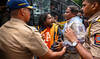
The UN chief called for Lebanon’s parliamentary elections on May 15 to be “free, fair transparent and inclusive”. (AFP)
Short Url
Updated 05 May 2022
Follow

UN chief urges free, transparent elections in Lebanon May 15

  • The UN chief called for Lebanon’s parliamentary elections on May 15 to be “free, fair transparent and inclusive”
  • The May 15 elections for parliament are the first since Lebanon’s economic meltdown began in late 2019

UNITED NATIONS: The UN chief called for Lebanon’s parliamentary elections on May 15 to be “free, fair transparent and inclusive” in a report circulated Wednesday and urged the quick formation of a government afterward that gives priority to implementing reforms addressing the country’s multiple crises.

Secretary-General Antonio Guterres said in the report to the UN Security Council that political polarization in the country has deepened and the Lebanese people “are struggling daily to meet basic essential needs.” He pointed to frequent protests across the country sparked by “public frustration with the political situation and the economic and financial crisis.”

The May 15 elections for parliament are the first since Lebanon’s economic meltdown began in late 2019. The government’s factions have done virtually nothing to address the collapse, leaving Lebanese to fend for themselves as they plunge into poverty, without electricity, medicine, garbage collection or any other semblance of normal life.

The elections are also the first since the August 4, 2020, catastrophic explosion at Beirut port that killed more than 215 people and wrecked large parts of the city. The destruction sparked widespread outrage at the traditional parties’ endemic corruption and mismanagement.

Guterres, who visited Lebanon last December, said no one has yet been held accountable for the explosion and the Lebanese people are demanding “truth and justice.” He reiterated his call for “a swift, impartial, thorough and transparent investigation” and stressed that “the independence of the judiciary must be respected.”

In the May 15 election, a total of 103 lists with 1,044 candidates are vying for the 128-seat legislature, which is equally divided between Christians and Muslims.

Self-declared opposition groups remain divided along ideological lines on virtually every issue, including over how to revive the economy, and as a result, there are an average of at least three different opposition lists in each of the 15 electoral districts, a 20 percent increase from the 2018 elections.

Guterres noted that proposals submitted in the past two years for a women’s quota were still pending in parliament, and he urged that the new government be quickly formed “with full participation of women and young people.”

The secretary-general’s semi-annual report on implementation of a 2004 Security Council resolution reiterated that its key demands — that the Lebanese government establish its sovereignty throughout the country and that all Lebanese militias disarm and disband — have not been fulfilled.

Guterres said Hezbollah’s maintenance “of sizeable and sophisticated military capabilities outside the control of the government of Lebanon remains a matter of grave concern.” He noted Hezbollah leader Hassan Nasrallah’s February announcement that it now has the ability to transform thousands of its missiles “into precision missiles” and has been manufacturing drones “for a long time.”

The secretary-general urged the Lebanese state to “increase its efforts to achieve a monopoly over the possession of weapons and the use of force throughout its territory.”

“I continue to urge the government and the armed forces of Lebanon to take all measures necessary to prohibit Hezbollah and other armed groups from acquiring weapons and building paramilitary capacity outside the authority of the state,” the UN chief said, stressing that this violates Security Council resolutions.

Guterres said Hezbollah’s continued involvement in the war in neighboring Syria also risks entangling Lebanon in regional conflicts and undermining its stability.

He called on countries in the region with close ties to Hezbollah to encourage its disarmament and transformation into “a solely civilian political party.” Both Syria and Iran have close ties to Hezbollah.


Iran government stages mass rallies as alarm grows over protest toll

Updated 5 sec ago
Follow

Iran government stages mass rallies as alarm grows over protest toll

PARIS: Iranian authorities on Monday sought to regain control of the streets with mass nationwide rallies in the wake of protests on a scale unprecedented in recent years, as alarm grew over a deadly crackdown.
The foreign minister said Iran was ready for both war and talks after repeated threats from Washington to intervene militarily over the crackdown on protests, which activists fear has left at least hundreds dead.
Over two weeks of demonstrations initially sparked by economic grievances have turned into one of the biggest challenges yet to the theocratic system that has ruled Iran since the 1979 Islamic revolution ousted the shah.
In a sign of the severity of the crisis, the authorities have imposed an Internet blackout lasting more than three-and-a-half days that activists say is aimed at masking the extent of the crackdown.
Seeking to regain the initiative, the government called for rallies nationwide backing the Islamic republic on Monday.
Thousands of people filled the capital’s Enghelab (Revolution) Square brandishing the national flag as prayers were read for victims of what the government has termed “riots,” state TV showed.
Addressing the crowds, parliament speaker Mohammad Bagher Ghalibaf said Iran is fighting a “four-front war,” listing economic war, psychological war, “military war” with the United States and Israel and “today a war against terrorists,” referring to the protests.
Flanked by the slogans “Death to Israel, Death to America” in Persian, he vowed the Iranian military would teach US President Donald Trump “an unforgettable lesson” if Iran were attacked.
Trump said Sunday that Iran’s leadership under Ayatollah Ali Khamenei, in power since 1989 and now 86, had called him seeking “to negotiate” after he repeatedly threatened to intervene militarily if Tehran killed protesters.
“The Islamic Republic of Iran is not seeking war but is fully prepared for war,” Foreign Minister Abbas Araghchi told a conference of foreign ambassadors in Tehran broadcast by state television.
“We are also ready for negotiations but these negotiations should be fair, with equal rights and based on mutual respect.”
Foreign ministry spokesman Esmaeil Baghaei said a channel of communication is open between Araghchi and Trump’s special envoy for the Middle East Steve Witkoff despite the lack of diplomatic relations.
Meanwhile, the foreign minister of Oman, which has on occasion acted as a mediator, met Araghchi in Tehran on Saturday.
Soaring toll
The European Union has voiced support for the protesters and on Monday said it was “looking into” imposing additional sanctions on Iran over the repression of demonstrations.
Iran’s shutdown of the Internet has now lasted more than 84 hours, said monitor Netblocks. The blackout has severely affected the ability of Iranians to post videos of the protests that have rocked big cities since Thursday.
A video circulating on Sunday showed dozens of bodies outside a morgue south of Tehran.
The footage, geolocated by AFP to the district of Kahrizak, showed bodies wrapped in black bags, with what appeared to be grieving relatives searching for loved ones.
The Norway-based NGO Iran Human Rights (IHR) said it confirmed the killing of at least 192 protesters but that the actual toll could be much higher.
“Unverified reports indicate that at least several hundreds, and according to some sources, more than 2,000 people, may have been killed,” said IHR.
More than 2,600 protesters have been arrested, IHR estimated.
The US-based Human Rights Activists News Agency said it had confirmed the deaths of 544 people.
Iranian state media has said dozens of members of the security forces have been killed, with their funerals turning into large pro-government rallies. The government has declared three days of national mourning for those killed.
State outlets were at pains to present a picture of calm returning, broadcasting images of smooth-flowing traffic.
Tehran Governor Mohammad-Sadegh Motamedian insisted in televised comments that “the number of protests is decreasing.”
’Stand with the people’
Reza Pahlavi, the US-based son of Iran’s ousted shah, urged Iran’s security forces and government workers to join the protests against the authorities.
“Employees of state institutions, as well as members of the armed and security forces, have a choice: stand with the people and become allies of the nation, or choose complicity with the murderers of the people,” he said in a social media post.
He also urged protesters to replace the flags outside Iranian embassies.
“The time has come for them to be adorned with Iran’s national flag,” he said.
The ceremonial, pre-revolution flag has become an emblem of the global rallies that have mushroomed in support of Iran’s demonstrators.