

For tribesmen in southwestern Pakistan, no Eid celebrations without traditional headgear

1 / 5
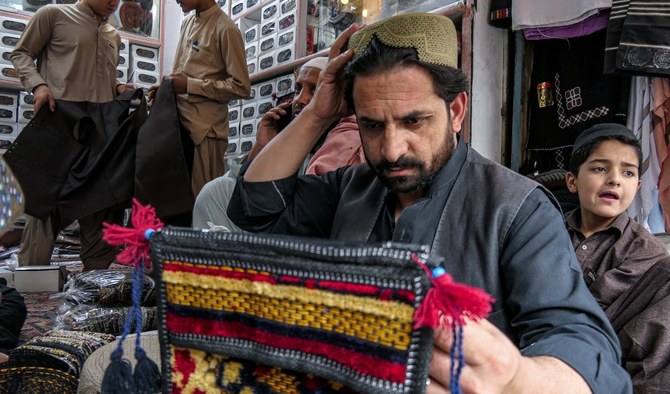
A man tries on a traditional Pashtun cap at a shop in Quetta’s Circular Road, Balochistan, southwestern Pakistan (AN Photo)
2 / 5
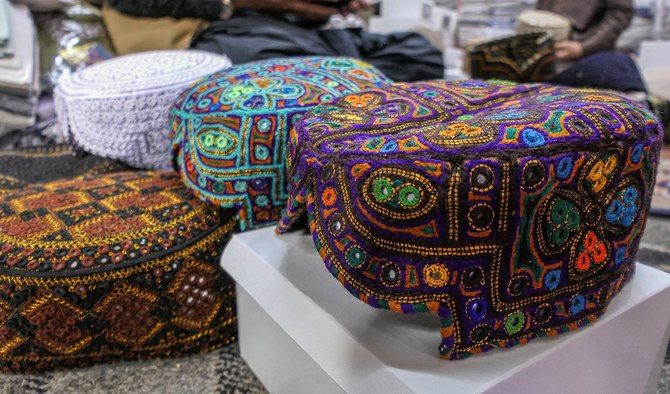
Baloch caps are on display at a shop in Quetta’s Circular Road, Balochistan, southwestern Pakistan, on April 29, 2022. (AN Photo)
3 / 5
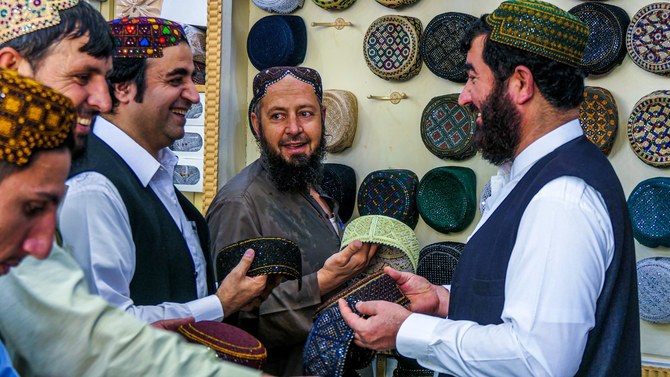
Baloch and Pashtun men buy traditional caps for their Eid Al-Fitr attire at a shop in Quetta’s Circular Road, Balochistan, southwestern Pakistan. (AN Photo)
4 / 5
Baloch and Pashtun caps are on display at a shop in Quetta’s Circular Road, Balochistan, southwestern Pakistan. (AN Photo)
5 / 5
Sellers display traditional caps on a pushcart in Quetta’s Circular Road, Balochistan, southwestern Pakistan. (AN Photo)
Short Url
Updated 03 May 2022
Follow

For tribesmen in southwestern Pakistan, no Eid celebrations without traditional headgear

  • Every year before Eid men throng shops in Quetta’s Circular Road to buy new headdress
  • Basic caps cost just $3, ones featuring embroidery up to 30 times more

QUETTA: Colorful caps are a source of pride for Baloch and Pashtun tribesmen in southwest Pakistan and provide a significant income for shopkeepers ahead of Eid Al-Fitr.

No celebrations in the region are complete without traditional headgear, and every year before Eid men throng the shops in Circular Road, Quetta, the provincial capital of Balochistan, to buy new headdress.

Some caps are woven with colorful threads, while others are fitted with tiny, round pieces of glass. They come in many shapes and sizes, with the major Baloch and Pashtun tribes — which make up the two main ethnic groups in Balochistan province — having their own styles.

Mehmood Shah, who traveled 45 kilometers from Mastung district to Quetta to buy a new cap for the religious holiday celebrations, said: “Our forefathers have been wearing cultural caps and turbans for many centuries now, especially during the Eid festival.

“Wearing the traditional headgear on the holy festival is essential dressing for Baloch and Pashtun tribesmen.”

Prices vary. An ordinary cap can be as cheap as $3, but one that features embroidery can cost 30 times more.

Naseer Ahmed, who has been selling traditional headgear for the last two decades, said that handmade Bugti and Yaqoobi caps were the most expensive and sought-after ones, not only in Pakistan but in other countries too.

“I have been sending these caps across Balochistan and Afghanistan because demand for caps and turbans rises before Eid Al-Fitr,” he added.

The difference between Baloch and Pashtun headgear can easily be spotted: Baloch caps feature colorful ornaments, while Pashtun ones are known for their simplicity, and woven with a single thread.

Zia ul Haq, a member of the Pashtun Kakar tribe, told Arab News that Eid was a time when attire was important for everyone in the province.

Although the cultures of Balochis and Pashtuns were different, their love for headgear was the same, he said.

“Without caps and turbans, we feel discomfort,” he added. “Every single Baloch and Pashtun, whether child, young, or old, they all wear their cultural dress during the three days of Eid.”


Protesters try to attack driver after truck speeds through anti-Iran demonstration in Los Angeles

Updated 12 January 2026
Follow

Protesters try to attack driver after truck speeds through anti-Iran demonstration in Los Angeles

LOS ANGELES: Los Angeles police responded Sunday after somebody drove a U-Haul box truck down a street crowded with marchers demonstrating in support of the Iranian people, causing protesters to scramble out of the way and then run after the speeding vehicle to try to attack the driver.
The U-Haul truck, with its side mirrors shattered, was stopped several blocks away and surrounded by police cars. ABC7 news helicopter footage showed officers keeping the crowd at bay as demonstrators swarmed the truck, throwing punches at the driver and thrusting flagpoles through the driver’s side window.
The police department confirmed its officers were on the scene but didn’t immediately say if anyone was arrested.
Two people were evaluated by paramedics and both declined treatment, the Los Angeles Fire Department said.
Several hundred people had gathered Sunday afternoon in the Westwood neighborhood to protest against the Iranian theocracy. The LA police department eventually issued a dispersal order, and by 5 p.m. only about a hundred protesters were still at the scene, ABC7 reported.
Activists say a crackdown on nationwide protests in Iran has killed more than 530 people. Protesters flooded the streets in Iran’s capital of Tehran and its second-largest city again Sunday.