

Non-Muslims around the world take on Ramadan fasting challenge to help tackle Islamophobia

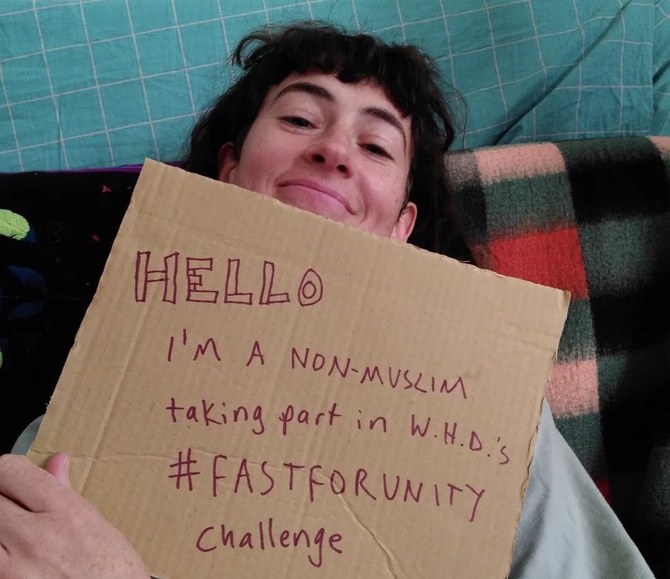
British Singer Kate Stables was one of the non-Muslims who took part in the fasting challenge. (Instagram/@thisisthekit)
Short Url
Updated 29 April 2022
Follow

Non-Muslims around the world take on Ramadan fasting challenge to help tackle Islamophobia

  • People in more than 25 countries took part in the annual Fast for Unity, which is organized by the New York-based World Hijab Day Organization
  • This year it is raising money to support efforts to foster healthy environments for Muslim students in the US

LONDON: Non-Muslims around the world took part in two Ramadan challenges this month designed to show solidarity with Muslims against a rising tide of Islamophobia, and improve religious tolerance and understanding.

People from more than 25 countries took part in the annual Fast For Unity and the 30-Day Ramadan Hijab Challenge initiatives, both of which are organized by the World Hijab Day Organization, a non-profit group that aims to counter discrimination against Muslims. They began on the first day of Ramadan, which this year fell on April 2.

The fasting challenge “invites non-Muslims to fast for a day, two, 10 or all 30 to experience how Muslims fast and go on a spiritual journey of self-reflection, self-discipline, and take a stand against Islamophobia,” the organization told Arab News.

British Singer Kate Stables was one of the non-Muslims who took part in the challenge. In a message posted on Instagram, she said this is the second year she has done so and added: “I’ve found that there’s a lot to learn from changing gear completely for a month and taking the time and space to think about what I’m doing and how I’m doing it, and the world and people around me.

“And as the name suggests, #FastForUnity is an initiative to dismantle Islamophobia and to join us together in our communities regardless of religion or differences. More acceptance and empathy everyone, please.”

The hijab challenge, also known as the #Hijab30, was launched in 2014. It invites “women of all ethnic backgrounds to don the hijab for 30 days to take a stand to end discrimination against women in hijabs and respect individual choices.”

The organization behind the challenges is based in New York and was founded in 2013. It organizes World Hijab Day on Feb. 1 each year, in recognition of the millions of Muslim women who choose to wear the traditional head covering, along with a number of other initiatives.

For example, it has also launched a campaign to raise money to support efforts to foster healthy environments for Muslim students in the US, and said that there has been an increase in donations during the last 10 days of Ramadan. These final days of the holy month hold special significance for Muslims, who believe that the Qur’an was revealed to the Prophet Muhammad on one of those days.

The World Hijab Day Organization said that a report published in 2021 by the Massachusetts branch of the Council on American-Islamic Relations “revealed that 61 percent of Muslim students in the US have been mocked, verbally harassed or physically abused for their Muslim faith.”

Meanwhile the American Muslim Poll, carried by the Institute for Social Policy and Understanding in 2020, found that “30 percent of Muslim students said that a teacher or other school official was the source of the bullying.”

The donations will go toward “creating educational workshops for schools to promote a safe, healthy and inclusive environment for Muslim students,” and provide “school administrators and teachers with tools to shatter bigotry, discrimination and prejudice, which will ultimately help their whole classroom learn better.”


Bangladesh halts controversial relocation of Rohingya refugees to remote island

Updated 29 December 2025
Follow

Bangladesh halts controversial relocation of Rohingya refugees to remote island

  • Administration of ousted PM Sheikh Hasina spent about $350m on the project
  • Rohingya refuse to move to island and 10,000 have fled, top refugee official says

DHAKA: When Bangladesh launched a multi-million-dollar project to relocate Rohingya refugees to a remote island, it promised a better life. Five years on, the controversial plan has stalled, as authorities find it is unsustainable and refugees flee back to overcrowded mainland camps.

The Bhasan Char island emerged naturally from river sediments some 20 years ago. It lies in the Bay of Bengal, over 60 km from Bangladesh’s mainland.

Never inhabited, the 40 sq. km area was developed to accommodate 100,000 Rohingya refugees from the cramped camps of the coastal Cox’s Bazar district.

Relocation to the island started in early December 2020, despite protests from the UN and humanitarian organizations, which warned that it was vulnerable to cyclones and flooding, and that its isolation restricted access to emergency services.

Over 1,600 people were then moved to Bhasan Char by the Bangladesh Navy, followed by another 1,800 the same month. During 25 such transfers, more than 38,000 refugees were resettled on the island by October 2024.

The relocation project was spearheaded by the government of former Prime Minister Sheikh Hasina, who was ousted last year. The new administration has since suspended it indefinitely.

“The Bangladesh government will not conduct any further relocation of the Rohingya to Bhasan Char island. The main reason is that the country’s present government considers the project not viable,” Mizanur Rahman, refugee relief and repatriation commissioner in Cox’s Bazar, told Arab News on Sunday.

The government’s decision was prompted by data from UN agencies, which showed that operations on Bhasan Char involved 30 percent higher costs compared with the mainland camps in Cox’s Bazar, Rahman said.

“On the other hand, the Rohingya are not voluntarily coming forward for relocation to the island. Many of those previously relocated have fled ... Around 29,000 are currently living on the island, while about 10,000 have returned to Cox’s Bazar on their own.”

A mostly Muslim ethnic minority, the Rohingya have lived for centuries in Myanmar’s western Rakhine state but were stripped of their citizenship in the 1980s and have faced systemic persecution ever since.

In 2017 alone, some 750,000 of them crossed to neighboring Bangladesh, fleeing a deadly crackdown by Myanmar’s military. Today, about 1.3 million of them shelter in 33 camps in the coastal Cox’s Bazar district, making it the world’s largest refugee settlement.

Bhasan Char, where the Bangladeshi government spent an estimated $350 million to construct concrete residential buildings, cyclone shelters, roads, freshwater systems, and other infrastructure, offered better living conditions than the squalid camps.

But there was no regular transport service to the island, its inhabitants were not allowed to travel freely, and livelihood opportunities were few and dependent on aid coming from the mainland.

Rahman said: “Considering all aspects, we can say that Rohingya relocation to Bhasan Char is currently halted. Following the fall of Sheikh Hasina’s regime, only one batch of Rohingya was relocated to the island.

“The relocation was conducted with government funding, but the government is no longer allowing any funds for this purpose.”

“The Bangladeshi government has spent around $350 million on it from its own funds ... It seems the project has not turned out to be successful.”