
FRANKFURT: Berlin is home to Germany’s largest Muslim community. And as Isikali Karayel, who manages the funeral parlor Markaz, noted: “The first generation of immigrants from countries with a Muslim majority to come to Germany is getting older.”
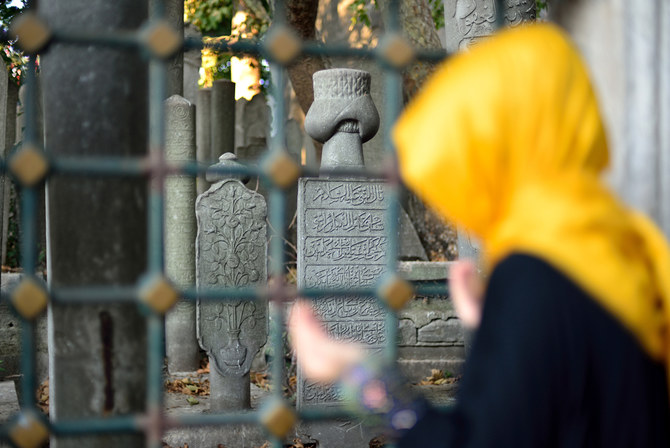
That means there is a rising demand for Muslim funerals, and for Muslim burial places. But the latter are becoming increasingly hard to find, according to Karayel.
Markaz, which Karayel has been managing since 2013, is one of around a dozen Islamic funeral parlors in Berlin, where between 250,000 to 300,000 of Germany’s estimated five million Muslims live. Karayel estimates that around half of the Muslim families in the city choose to have their loved ones repatriated when they die — despite the high costs of doing so — while the other half choose to bury their family members in Berlin.
Karayel told Arab News that finding Muslim burial plots in Berlin has been an issue ever since he started work in the funeral business in 2008, but the crisis came to a head just a couple of months ago. “There was no space left,” he said. “All of a sudden there was just no possibility of burying Muslims in Berlin.”
The lack of graves for Muslims in Berlin has been a problem for decades. Web designer Katja Neppert remembers how she was confronted with the issue around 10 years ago when she was volunteering in the city’s Neukölln quarter, which has a large Arab community. Neppert befriended many Muslims, and learned that one of their major concerns was the lack of graves in the city.
“Many gave a high priority to the issue of Muslim cemeteries in Berlin,” Neppert told Arab News. She has since committed herself to the cause. “I am deeply convinced of it. A last resting place for a loved one is a basic human need.” Neppert helped to launch a campaign for more graves for Muslims in Berlin, a campaign that has achieved some success, but also suffered several setbacks.
The main problem is one of space: To accommodate more graves, more space is needed. The city’s old Tempelhof airport, which was shut down in 2008, seemed like a perfect solution, with plenty of room for redevelopment, but a citizen’s initiative put an end to that possibility and the area is now a public park.
So Neppert and her fellow campaigners began to lobby the then-local district mayor Franziska Giffey (now Governing Mayor of Berlin) to create a Muslim cemetery in Neukölln itself. In 2016, they began a series of protests in which they carried symbolic coffins through the streets. Their efforts bore fruit and a local cemetery with enough room for around 1,000 graves was made available. However, within three years, all that space was taken.
According to the Senate Department for the Environment, Urban Mobility, Consumer Protection, and Climate Action of Berlin, there are six cemeteries in the city that provide space for Muslim graves. Currently, however, Gatow Cemetery in the city’s Spandau borough is the only one with any room left for Muslims. And, as Karayel pointed out, its location is far from ideal — Spandau is the westernmost borough of Berlin and is comparatively hard to reach.
“That is not exactly ideal for a widow who lives in Neukölln,” Karayel said. “It would take her almost an hour to visit the grave of her late husband.”
Karayel said he regularly has to convey disappointing messages to already mourning families.
“Today, for example, I made the arrangements for a funeral that will take place only next week due to the lack of room,” he said. Such delays can cause great distress for relatives.
Karayel is disappointed by local politicians, who have failed to address a long-standing problem. “In the past 10 years everyone promised to do something, but nothing happened,” he said.
But he also was also critical of Muslim organizations in Berlin, especially for their lack of collective action, saying, “They all want the success for themselves and, in the end, they cannot agree on anything.”
Karayel fears that someday soon he will be forced to tell grieving family members that there is simply nowhere to bury their loved ones in Berlin — a situation he finds unacceptable.
“This is not just any town in the country,” he said. “It is the capital!”