BEIRUT: Lebanon’s efforts to secure $3 billion in International Monetary Fund support to help it tackle its financial crisis could be derailed by divisions over how to deal with massive financial sector losses, the economy minister told Reuters on Wednesday.
The Association of the Banks of Lebanon (ABL) said at the weekend that it rejected the latest draft of the government’s recovery plan, which foresees a bail-in of some deposits, haircuts to others, and asks bank shareholders to inject new capital.
“We won’t be able to secure a full IMF deal without the banking restructuring. It’s a major piece of the prior actions” that the IMF wants Lebanon to take before agreeing to a full support deal, said economy minister Amin Salam.
“You need the government, the central bank and the banking sector to be on the same page. You can’t do it if they’re not all on one page,” added Salam, who is also a member of Lebanon’s negotiating team with the IMF.
The ABL called the plan “disastrous,” however, and said it would leave banks and depositors shouldering the “major portion” of what the government says is $72 billion in losses.
The ABL’s approval is not required for the government to begin implementing a plan — but experts say support from the banking sector could contribute to finding a way out of the crisis.
Banks have said that the state should foot the bill for the losses, including by privatising public assets.
Lebanon reached a preliminary agreement with the IMF earlier this month that listed a number of so-called prior actions that the fund said must be implemented before it could reach a full deal with the country.
These include approval of a reformed banking secrecy law and the “initiation of an externally assisted bank-by-bank evaluation for the 14 largest banks.”
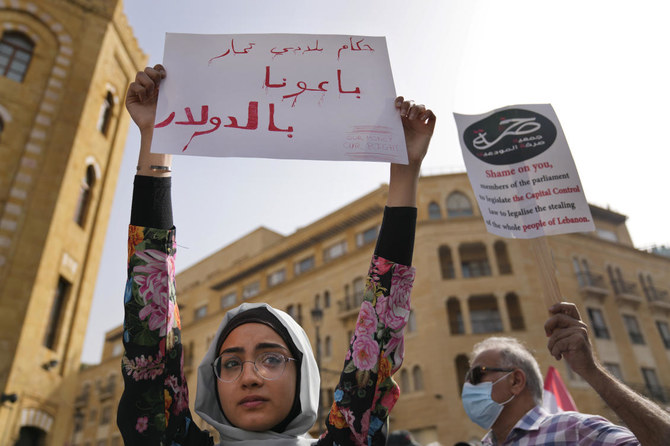
Lebanon’s banks have been major lenders to the government for decades, helping to finance a wasteful and corrupt state that tipped into financial meltdown in 2019.
The collapse has resulted in depositors being shut out of their savings as the local currency lost more than 90 percent of its value.

Standoff with Lebanon banks could derail IMF deal, minister says
https://arab.news/nytz2
Standoff with Lebanon banks could derail IMF deal, minister says
- The Association of the Banks of Lebanon (ABL) said at the weekend that it rejected the latest draft of the government's recovery plan
- "We won't be able to secure a full IMF deal without the banking restructuring,” said economy minister Amin Salam
Lebanese social entrepreneur Omar Itani recognized by Schwab Foundation
- FabricAID co-founder among 21 global recipients recognized for social innovation
DAVOS: Lebanon’s Omar Itani is one of 21 recipients of the Social Entrepreneurs and Innovators of the Year Award by the Schwab Foundation for Social Entrepreneurship.
Itani is the co-founder of social enterprise FabricAID, which aims to “eradicate symptoms of poverty” by collecting and sanitizing secondhand clothing before placing items in stores in “extremely marginalized areas,” he told Arab News on the sidelines of the World Economic Forum in Davos, Switzerland.
With prices ranging from $0.25 to $4, the goal is for people to have a “dignified shopping experience” at affordable prices, he added.
FabricAID operates a network of clothing collection bins across key locations in Lebanon and Jordan, allowing people to donate pre-loved items. The garments are cleaned and sorted before being sold through the organization’s stores, while items that cannot be resold due to damage or heavy wear are repurposed for other uses, including corporate merchandise.
Since its launch, FabricAID has sold more than 1 million items, reached 200,000 beneficiaries and is preparing to expand into the Egyptian market.
Amid uncertainty in the Middle East, Itani advised young entrepreneurs to reframe challenges as opportunities.
“In Lebanon and the Arab world, we complain a lot,” he said. Understandably so, as “there are a lot of issues” in the region, resulting in people feeling frustrated and wanting to move away. But, he added, “a good portion of the challenges” facing the Middle East are “great economic and commercial opportunities.”
Over the past year, social innovators raised a combined $970 million in funding and secured a further $89 million in non-cash contributions, according to the Schwab Foundation’s recent report, “Built to Last: Social Innovation in Transition.”
This is particularly significant in an environment of geopolitical uncertainty and at a time when 82 percent report being affected by shrinking resources, triggering delays in program rollout (70 percent) and disruptions to scaling plans (72 percent).
Francois Bonnici, director of the Schwab Foundation for Social Entrepreneurship and a member of the World Economic Forum’s Executive Committee, said: “The next decade must move the models of social innovation decisively from the margins to the mainstream, transforming not only markets but mindsets.”
Award recipients take part in a structured three-year engagement with the Schwab Foundation, after which they join its global network as lifelong members. The program connects social entrepreneurs with international peers, collaborative initiatives, and capacity-building support aimed at strengthening and scaling their work.


