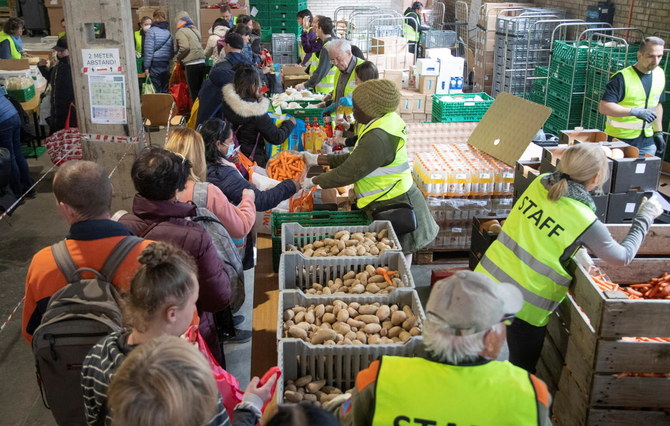
ZURICH: Hundreds of Ukrainians lined up for food handouts in central Zurich on Saturday as wealthy Switzerland struggles to cope with the arrival of around 40,000 refugees since Russia invaded Ukraine in late February.
Refugees in official accommodation receive some financial support from the state, although this is often not enough to live on in a country where the cost of living is among the highest in the world. Those staying with private host families — around half the arrivals, according to the authorities — are falling through the cracks of the welfare system altogether.
Charities in Switzerland say many Ukrainians fleeing the Russian invasion were turning to them for food, clothing and medical treatment, as was evident from the long line outside a Zurich charity’s food bank on Saturday.
Among people lined up outside an Essen fuer Alle (Food for All) food distribution center along railroad tracks was Kristina and her 7-year-old daughter who arrived from Kyiv on March 3 to stay with a Ukrainian family friend in Zurich.
“We come here to take food because we need it,” said Kristina, 42, who did not gave her family name. “Our volunteer (host) cannot give food every time. She’s tired and she also doesn’t have too much money.”
Ariane Stocklin of Christian aid project incontro told Reuters that hers is a common story.
“Some refugees stay with families who can no longer pay for their food. Others are in asylum centers, where the food is insufficient. We see a lot of demand,” Stocklin said.
Even before the Ukraine crisis, welfare payments to refugees were not enough to live on in some areas of Switzerland.
Voters in Zurich decided in 2017 to lower welfare payments to refugees to around 500 Swiss francs ($522) per month, 30 percent below standard social welfare levels.
Heike Isselhorst, a spokesperson for Zurich’s social service department, said people housed by the authorities had basic needs covered.
However, there was no procedure for aiding refugees staying with host families, she said.
Gaby Szoelloesy, who coordinates cantonal social welfare departments, apologized this week to host families who feel left in the lurch.
“But it is simply very, very difficult if we don’t even know of the host family’s commitment because it did not go via official channels,” she told a news conference.
While the government has taken the unusual step of allowing Ukrainian refugees to apply for temporary residency and work permits, this does little to address the present needs of the struggling refugees staying with host families.
One Ukrainian refugee named Anna, 38, arrived in the Zurich suburb of Winterthur in late February with her two young children and her mother. They live in the apartment of a friend’s parents.
“We slept in a refugee center when we arrived, but it was not a good place for the children, no privacy, no good food. They even searched us every time we came back from outside,” she said.
($1 = 0.9571 Swiss francs)


Ukrainian refugees queue for food in wealthy Switzerland
https://arab.news/2ws9c
Ukrainian refugees queue for food in wealthy Switzerland

- Charities in Switzerland say many Ukrainians fleeing the Russian invasion were turning to them for food, clothing and medical treatment
- "We come here to take food because we need it," said Kristina, 42, who did not gave her family name


Four cops killed as separatist militants launch ‘coordinated’ attacks in Pakistan’s southwest — police
- The attacks began in Balochistan’s capital of Quetta at around 6am with a powerful explosion, followed by intense gunfire
QUETTA: Separatist militants, affiliated with the Balochistan Liberation Army (BLA), have launched “coordinated” attacks in several cities of Pakistan’s southwestern Balochistan province and killed at least four policemen, officials said early Saturday.
The attacks in the provincial capital of Quetta began at around 6am with a powerful explosion, followed by intense gunfire that lasted for two hours along with multiple explosions.
Residents of Dalbandin and Nuhski said they heard explosions and gunfire in the districts early Saturday morning, while there were reports of similar attacks in Mastung, Gwadar, Pasni and Turbat.
A senior police official, who requested anonymity, told Arab News that the militants attempted to enter the provincial capital of Quetta but police and other law enforcement agencies stopped them.
“The terrorists attacked a police mobile at Sariab road which resulted in the killing of two policemen,” he said. “Police and other law enforcement agencies denied space to the terrorists in Quetta city and a clearance operation is still going on.”
Balochistan, which borders Iran and Afghanistan, is the site of a decades-long insurgency waged by Baloch separatist groups who often attack security forces and foreigners, and kidnap government officials.
Shahid Rind, the Balochistan chief minister’s aide for media and political affairs, said police and paramilitary Frontier Corps (FC) had foiled the attacks and were chasing the assailants.
“After the killing of more than 70 terrorists at different places in Balochistan in the last two days, terrorists have attempted to attack at a few places in Balochistan, which have been foiled by timely action by the police and FC,” he said on X.
“At present, the pursuit of the fleeing terrorists is underway. More details will be revealed very soon.”
In a statement issued on Saturday, BLA said the group had launched ‘Operation Herof 2.0,’ which included a series of attacks in multiple cities of Balochistan.
Saturday’s attacks follow coordinated attacks carried out by the group in Aug. 2024 in various districts of Balochistan which killed dozens of people.
The separatists accuse the central government of stealing the region’s resources to fund development elsewhere in the country. The Pakistani government denies the allegations and says it is working for the uplift of local communities in Balochistan.
Pakistan Railways has suspended train service from Balochistan to other parts of the country for a day, following Saturday’s attacks.
“Quetta-Peshawar bound Jaffar Express, and Quetta-Chaman passenger trains have been canceled due to the prevailing security situation in Balochistan,” Muhammad Kashif, the railways controller in Quetta division, told Arab News.
At least four police officials in as many districts confirmed to AFP the situation was not completely under control yet.
“At least four policemen were killed in Quetta alone,” he added, speaking on condition of anonymity as he was not authorized to speak to the media.
A senior military official based in Islamabad confirmed the attacks, adding they were “coordinated but poorly executed.”


