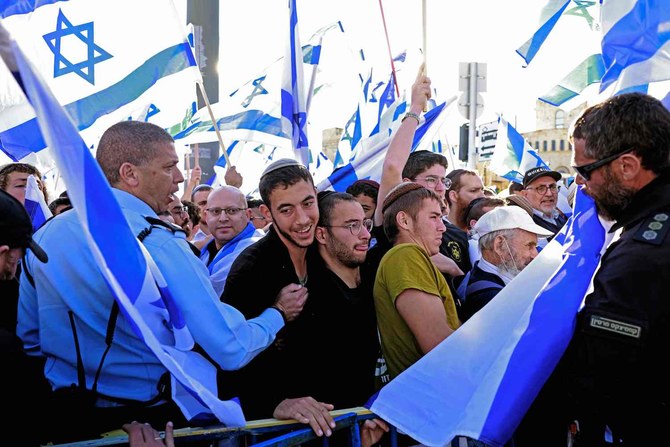
JERUSALEM: Police appear to have prevented hundreds of ultra-nationalist Israelis from marching around predominantly Palestinian areas of Jerusalem’s Old City on Wednesday, an event that served as one of the triggers of last year’s Israel-Gaza war.
Police set up large roadblocks outside the Old City walls, closing the main road leading down to Damascus Gate, the epicenter of last year’s unrest. Bottled up, the marchers waved Israeli flags, chanted and sang.
Earlier in the day, a small group of Palestinian protesters threw rocks at police while hundreds of Jewish visitors entered the Al-Aqsa Mosque compound, known to Jews as the Temple Mount.
The hilltop shrine in Jerusalem’s Old City is the third holiest in Islam, while for Jews it is their holiest site, where two temples stood in antiquity. It is the emotional ground zero for the Israeli-Palestinian conflict and a flashpoint for previous rounds of violence.
Amateur video from the scene appeared to show police using sponge-tipped plastic projectiles intended to be non-lethal as the protesters barricaded themselves inside the mosque. Police said a firebomb thrown by one of the protesters set a carpet outside the mosque on fire, but it was quickly extinguished. No injuries were reported.
Israeli police said a large number of officers were deployed around Jerusalem’s historic Old City, home to religious sites for Jews, Christians and Muslims, out of concern that confrontations could further ignite an already tense situation in the city during the Jewish holiday of Passover and the Muslim holy month of Ramadan.
“At this stage the police are not approving the protest march under the requested layout,” the police said in a statement ahead of the march, without elaborating. They could not be reached for comment Wednesday.
The Palestinian militant group Hamas, which rules the Gaza Strip, said Wednesday that Israel “bears full responsibility for the repercussions” if it allows the march “to approach our holy sites,” but didn’t specify what actions it would take or what its red lines would be.
Several nationalist Israeli politicians said they would be attending the march, including ultra-nationalist parliament member Itamar Ben Gvir, a disciple of the late Rabbi Meir Kahane and a frequent provocateur in sensitive Palestinian neighborhoods of east Jerusalem.
Israeli Prime Minister Naftali Bennett said in a statement that he would bar Ben Gvir from going to Damascus Gate. “I don’t intend to allow petty politics to endanger human lives,” he said.
In a similar situation last May, Palestinian militants in the Gaza Strip fired rockets toward Jerusalem as Israeli nationalists holding a flag march were making their way to the Old City. The events set off an 11-day war between Israel and the militant group Hamas that rules Gaza.
Israeli-Palestinian tensions have surged in recent weeks after a series of deadly attacks inside Israel, followed by military operations in the West Bank. On Monday, Palestinian militants fired a rocket from the Gaza Strip into southern Israel for the first time in months, and Israel responded with airstrikes. These followed days of clashes between Israeli police and Palestinians at the flashpoint holy site in Jerusalem.
Noam Nisan, one of the organizers of the planned march, told Kan public radio that it would proceed as planned Wednesday. “A Jew with a flag in Jerusalem is not a provocation,” he said.
He said that the demonstration was a response to buses being stoned earlier this week while driving to the Western Wall, the holiest place where Jews can pray, located in Jerusalem’s Old City.


![]()

Police restrict Israeli ultra-nationalists’ Jerusalem march
Short Url
https://arab.news/2vyz8
Police restrict Israeli ultra-nationalists’ Jerusalem march
- Police set up large roadblocks outside the Old City walls, closing the main road leading down to Damascus Gate
- Bottled up, the marchers waved Israeli flags, chanted and sang


Latest updates




© 2026 SAUDI RESEARCH & PUBLISHING COMPANY, All Rights Reserved And subject to Terms of Use Agreement.