Russia says Ukraine helicopters strike homes in cross-border attack

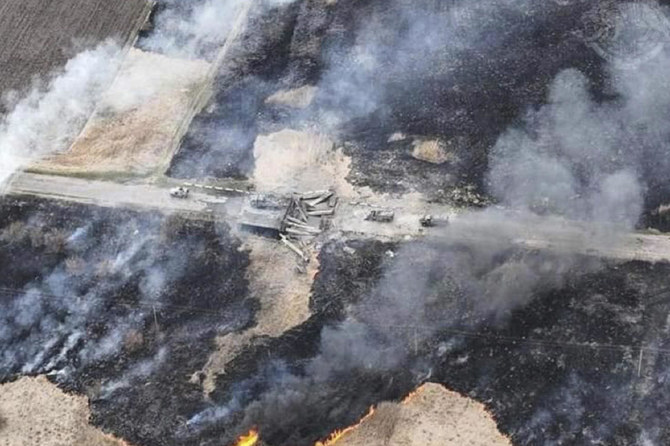
This image released on Thursday by Ukraine’s Defense Ministry reportedly shows Russian military vehicles heading toward Izyum, on a blown up bridge in Kharkiv region. (AP)
Short Url
Updated 14 April 2022
Follow

Russia says Ukraine helicopters strike homes in cross-border attack

  • The governor of the Belgorod region said a village there was also attacked, but that no one was injured
  • Ukraine's defence ministry did not immediately respond to a request for comment on reports of cross-border attacks

DUBLIN: Russian officials on Thursday said Ukrainian helicopters had hit residential buildings and injured seven people in the Bryansk region, the latest of a series of cross-border attacks that Moscow has said may trigger a retaliatory attack on Kyiv.
The governor of the Belgorod region said a village there was also attacked, but that no one was injured.
Ukraine’s defense ministry, which has declined to comment on several border incidents including a strike on a fuel depot in the city of Belgorod earlier this month, did not immediately respond to a request for comment on reports of cross-border attacks.
“On April 14, 2022, using two combat helicopters equipped with heavy offensive weapons, military personnel of the Armed Forces of Ukraine illegally entered the airspace of the Russian Federation,” Russia’s investigative committed said in a statement.
“Moving at low altitude, they carried out at least six air strikes on residential buildings in the village of Klimovo,” it said. Six buildings were damaged and seven people were injured, the statement said.
A health ministry official saying two people had been seriously injured, RIA news agency reported.
Bryansk region authorities closed schools for fear of further strikes, TASS news agency reported.
Vehicles were damaged when a border post came under mortar fire from Ukraine near Klimovo on Wednesday, Russia’s FSB security service told state television.
Russia’s defense ministry on Wednesday said the continuation of “sabotage and attacks” by Ukrainian forces could trigger strikes on Kyiv.
“If such incidents continue, then consequence from the armed forces of the Russian Federation will be attacks on decision making centers, including in Kyiv, which the Russian army has refrained from to date,” the defense ministry said.
Authorities in four Russian regions bordering Ukraine and in Russian-controlled Crimea announced they were stepping up security measures on Monday over what they said were “possible provocations” from the Ukrainian side.
Moscow’s incursion into Ukraine, the biggest attack on a European state since 1945, has seen more than 4.6 million people flee abroad, killed or wounded thousands and left Russia increasingly isolated on the world stage.
The Kremlin says it launched a “special military operation” to demilitarise and “denazify” Ukraine. Kyiv and its Western allies reject that as a false pretext for an unprovoked attack.


Israeli firm loses British Army contract bid

Updated 9 sec ago
Follow

Israeli firm loses British Army contract bid

  • Subsidiary Elbit Systems UK’s campaign for $2.6bn program was marred by controversy
  • Senior govt civil servant overseeing contract was dined, handed free Israel tour

LONDON: A UK subsidiary of Israeli weapons giant Elbit Systems has lost its bid to win a prominent British Army contract, The Times reported.

The loss followed high-profile reporting on controversy surrounding Elbit Systems UK’s handling of the bid.

The subsidiary led one of two major arms consortiums attempting to secure the $2.6 billion bid to prepare British soldiers for war and overhaul army standards.

Rivaling Elbit, the other consortium led by Raytheon UK, a British subsidiary of the US defense giant, ultimately won the contract, a Ministry of Defence insider told The Times.

It had been decided following an intricate process that Raytheon was a “better candidate,” the source said.

Elbit Systems UK’s controversial handling of its contract campaign was revealed in reports by The Times.

A whistleblower had compiled a dossier surrounding the bid that was shown to the MoD last August, though the report was privately revealed to the ministry months earlier.

It alleged that Elbit UK had breached business appointment rules when Philip Kimber, a former British Army brigadier, had reportedly shared information with the firm after leaving the military.

Kimber attending critical meetings at the firm to discuss the training contract that he had once overseen at the ministry, the report alleged.

In one case, Kimber was present in an Elbit meeting and sitting out of view of a camera. He reportedly said he “should not be there,” according to the whistleblower’s report.

In response to a freedom of information request, the MoD later admitted that it had held the dossier for seven months without investigating its claims. Insiders at the ministry blamed the investigative delay on “administrative oversight.”

A month after being pushed on the allegations by The Times, a senior civil servant completed an “assurance review” in September and found that business appointment rules had not been breached.

Other allegations concerned lunches and dinners hosted by Elbit UK in which civil servants at the heart of the contract decision process were invited.

One senior civil servant was dined by the British subsidiary seven times, while rival Raytheon did not host events.

Mike Cooper, the senior responsible owner at army headquarters for the army training program, also traveled to Jerusalem with two senior British military officers.

He took part in a sightseeing tour funded by Elbit Systems, the British subsidiary’s parent company.

In response to the allegations, an MoD spokesperson said in a statement: “The collective training transformation programme will modernise training for soldiers to ensure the British Army can face down the threats of the future.

“We will not comment further until a preferred tenderer announcement is made public in due course.”

Amid mounting criticism of Israel within the British military establishment, four former senior army officers, in a letter to Prime Minister Keir Starmer, recently urged the government to end involvement with Israeli-owned or Israeli-supported weapons companies.

“Now is not the time to return to business as usual with the Israeli government,” they wrote, urging harsher sanctions.