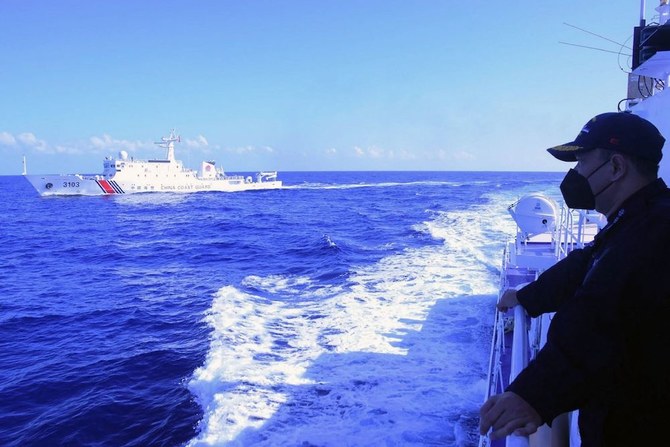
MANILA: The Philippine Coast Guard (PCG) on Sunday reported a recent incident of “close distance maneuvering” by a Chinese Coast Guard (CCG) vessel in the disputed South China Sea that “constrained” the movement of a Philippine ship sailing nearby.
The March 2 incident took place during the PCG’s maritime patrol operations around the Scarborough Shoal, locally known as Bajo de Masinloc, the PCG said in a news release.
It was yet unclear whether the Philippines had lodged a diplomatic protest for the incident. The PCG said it had to wait for the go-signal from the country’s National Task Force for the West Philippine Sea before making the incident public.
The incident involved a CCG vessel with bow number 3305 that conducted close distance maneuvering over an area of approximately 21 yards (19.2 meters) in the direction of Philippine vessel BRP Malabrigo, the PCG said.
“This constrained the maneuvering space of BRP Malabrigo — a clear violation of the 1972 International Regulations for Preventing Collisions at Sea (COLREGS),” the PCG said.
The PCG had asked the country’s Department of Foreign Affairs (DFA) to help address the issue through “rules-based and peaceful approaches,” according to the PCG commandant, Admiral Artemio Abu.
The DFA and the Chinese embassy in Manila did not immediately respond to requests for comment.
China lays claim to most of the waters within a so-called Nine Dash Line in the South China Sea, which is also contested by Brunei, Malaysia, the Philippines, Taiwan and Vietnam.
Abu said it was the fourth reported incident of close distance maneuvering involving CCG and Philippine vessels in the Scarborough Shoal since May last year.
Despite the risks, Abu said the deployment of Philippine assets and personnel to waters within the country’s exclusive economic zones would continue.


![]()

Philippines slams Chinese ship’s ‘close distance maneuvering’ at Scarborough Shoal
Short Url
https://arab.news/vws3w
Philippines slams Chinese ship’s ‘close distance maneuvering’ at Scarborough Shoal
- It is yet unclear whether the Philippines had lodged a diplomatic protest for the incident


Latest updates


© 2026 SAUDI RESEARCH & PUBLISHING COMPANY, All Rights Reserved And subject to Terms of Use Agreement.