

BBC files UN complaint against Iran’s online violence towards women journalists

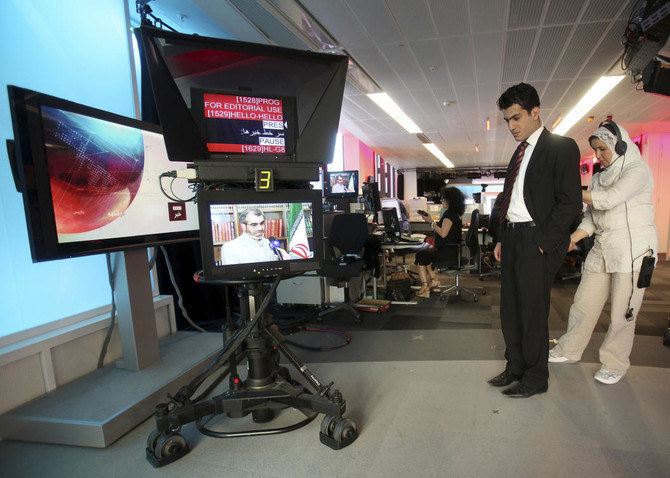
BBC Persian service presenter Fardad Farahzad gets ready to present the news, at the corporation's London headquarters. (AP/File Photo)
Short Url
Updated 25 March 2022
Follow

BBC files UN complaint against Iran’s online violence towards women journalists

  • Appeals calls on UN to take action against Iran’s treatment of BBC News Persian’s women journalists

DUBAI: The BBC World Service has filed a new urgent appeal to the UN this week against Iran over the online violence directed at women journalists working for BBC News Persian.

Women journalists at BBC News Persian face relentless online attacks and harassment, including threats of rape and death, the BBC said.

“We absolutely deplore the violent, misogynistic and gendered harassment our women journalists have to face every day,” said Liliane Landor, senior controller of BBC International News and director of the World Service.

The harassment includes threats of death and rape, attacks on their credibility, hacking and phishing of their emails and telephones, and false and defamatory stories about their personal lives.

The information obtained through hacking and phishing is often used to spread false stories about them online, which is then used in the interrogation of their family members in Iran, the BBC added.

The false stories not only attack them professionally but also aim to taint their character by questioning their relationship with co-workers and commenting on what they wear.

The online abuse and harassment is severely impacting female journalists at BBC News Persian, with many of them saying in interviews that they have opted out of using social media entirely due to fear of harassment.

Landor added: “Trusted and impartial journalism is fundamental to any democracy and it is only by working together that we can ensure the safety of journalists everywhere and ensure women’s voices are included. We have to be able to work unhindered, free from threats and free from abuse.”

The constant attacks have resulted in serious mental and physical health issues, including anxiety, psychological trauma and depression.

The appeal from the BBC calls on Iran to take action against those responsible for the online violence towards women journalists by investigating and prosecuting them.

International counsel for the BBC World Service, Caoilfhionn Gallagher QC and Jennifer Robinson, said: “Women journalists at BBC News Persian face abhorrent online violence every day simply because they are doing their job. This is a paradigm case of what UN experts call ‘gendered censorship’.”

They added: “Misogynist, sexist online abuse and all threats of physical or sexual violence towards journalists are intended to force women offline and to silence women journalists. It is unacceptable and it must stop.”

BBC has made multiple UN complaints since 2017. Since BBC News Persian TV started in 2009, the staff and their families have faced harassment and intimidation, the BBC said.

BBC News Persian staff cannot return home to Iran because of the risk of arrest and prosecution resulting in the media network not having any staff working in the country.

And it is not just the female journalists who are harassed. Their family members have been arrested, detained, repeatedly interrogated, fired from their jobs, had their passports confiscated and pressured to encourage their family members to leave the BBC and return to Iran.

In 2017, Iran announced a national security criminal investigation targeting 152 BBC News Persian staff members and froze any assets they had in Iran.

Iran has “international obligations of due diligence,” said Gallagher and Robinson. “We call on the UN to condemn the attacks and to ensure Iran meets its international obligations.”


Foreign media group slams Israel for refusing to lift Gaza press ban

Updated 07 January 2026
Follow

Foreign media group slams Israel for refusing to lift Gaza press ban

  • Foreign Press Association expresses 'profound disappointment' with Israeli government’s response to a Supreme Court appeal
  • Israel has barred foreign journalists from independently entering the devastated territory since the war started

JERUSALEM: An international media association on Tuesday criticized the Israeli government for maintaining its ban on unrestricted media access to Gaza, calling the move disappointing.
The government had told the Supreme Court in a submission late Sunday that the ban should remain in place, citing security risks in the Gaza Strip.
The submission was in response to a petition filed by the Foreign Press Association (FPA) — which represents hundreds of journalists in Israel and Palestinian territories — seeking immediate and unrestricted access for foreign journalists to the Gaza Strip.
“The Foreign Press Association expresses its profound disappointment with the Israeli government’s latest response to our appeal for full and free access to the Gaza Strip,” the association said on Tuesday.
“Instead of presenting a plan for allowing journalists into Gaza independently and letting us work alongside our brave Palestinian colleagues, the government has decided once again to lock us out” despite the ceasefire in the territory, it added.
Since the outbreak of the Gaza war in October 2023, triggered by an attack on Israel by the Palestinian militant group Hamas, the government has barred foreign journalists from independently entering the devastated territory.
Instead, Israel has allowed only a limited number of reporters to enter Gaza on a case-by-case basis, embedded with its military inside the blockaded Palestinian territory.
The FPA filed its petition in 2024, after which the court granted the government several extensions to submit its response.
Last month, however, the court set January 4 as a final deadline for the government to present a plan for allowing media access to Gaza.
In its submission, the government maintained that the ban should remain in place.
“This is for security reasons, based on the position of the defense establishment, which maintains that a security risk associated with such entry still exists,” the government submission said.
The government also said that the search for the remains of the last hostage held in Gaza was ongoing, suggesting that allowing journalists in at this stage could hinder the operation.
The remains of Ran Gvili, whose body was taken to Gaza after he was killed during Hamas’s 2023 attack, have still not been recovered despite the ceasefire.
The FPA said it planned to submit a “robust response” to the court, and expressed hope the “judges will put an end to this charade.”
“The FPA is confident that the court will provide justice in light of the continuous infringement of the fundamental principles of freedom of speech, the public’s right to know and free press,” the association added.
The Supreme Court is expected to issue a ruling on the matter, though it is unclear when a decision will be handed down.
An AFP journalist sits on the board of the FPA.