

Pakistan says will press ahead with trilateral cooperation with China and Bangladesh

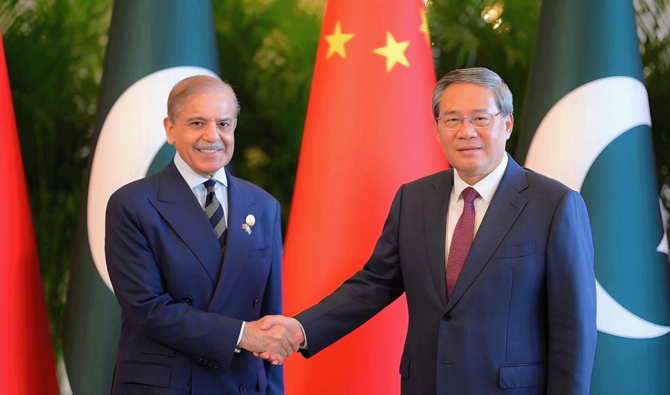
Pakistan's Prime Minister Shehbaz Sharif (left) shaking hands with Chinese counterpart, Li Qiang in Bejing, China on September 4, 2025. (Government of Pakistan)
Short Url
Updated 08 January 2026
Follow

Pakistan says will press ahead with trilateral cooperation with China and Bangladesh

  • Islamabad signals closer engagement with Dhaka amid shifting regional dynamics
  • Trilateral platform gains traction after recent China-Pakistan strategic talks last week

ISLAMABAD: Pakistan said on Thursday it would continue to pursue a trilateral cooperation framework with China and Bangladesh aimed at boosting regional connectivity, trade and development, as consultations among the three countries move forward.

The framework, launched last year at the senior officials’ level, has gained renewed attention as ties between Pakistan and Bangladesh improve following years of limited engagement, while Dhaka’s relations with India, a longtime archrival of Pakistan, have come under strain amid domestic political upheaval.

Addressing reporters on Thursday, Pakistan’s Foreign Office spokesman Tahir Andrabi said Islamabad remained committed to the Pakistan-China-Bangladesh cooperation mechanism and intended to follow up on earlier consultations to deliver “practical outcomes.”

“On the Pakistan, Bangladesh and China mechanism, if you recall, a meeting took place last year [2025] at the level of vice ministers and foreign secretaries,” Andrabi told a weekly media briefing, adding that Pakistan looked forward to “positive outcomes” in line with an agreed joint communiqué.

“So of course, the consultations between the three of us would continue in the future to strive for outcomes which are beneficial for the peace, progress and prosperity of our people,” he said when asked specifically about Bangladesh’s role in the framework.

The trilateral cooperation was also referenced in a joint press communiqué issued after the Seventh Round of the China-Pakistan Foreign Ministers’ Strategic Dialogue held last week.

“The two sides expressed readiness to continue leveraging the China-Afghanistan-Pakistan Trilateral Foreign Ministers’

Dialogue and the China-Bangladesh-Pakistan cooperation mechanism to deliver new outcomes,” the statement said.
Andrabi said Pakistan’s engagement with China would continue across bilateral and trilateral formats, underscoring Islamabad’s preference for cooperative regional approaches focused on economic development rather than bloc politics.

Bangladesh was part of Pakistan until 1971, when it gained independence following a bloody war of independence. Relations between the two countries have shown signs of improvement in recent months, as Dhaka recalibrates its foreign policy after the ouster of former prime minister Sheikh Hasina in 2024. India has so far declined Bangladesh’s request to extradite Hasina, who fled to New Delhi after violent student-led protests.

In a related development, Pakistan’s Air Chief Marshal Zaheer Ahmed Baber Sidhu earlier this week held talks with a high-level Bangladeshi defense delegation on strengthening air force cooperation, including the potential sale of JF-17 Thunder fighter jets jointly developed by Pakistan and China.


Pakistan regulator amends law to facilitate capital raising by listed companies

Updated 19 January 2026
Follow

Pakistan regulator amends law to facilitate capital raising by listed companies

  • The amendments address challenges faced by listed companies when raising further capital from existing shareholders through a rights issue
  • Previously, listed companies were prohibited from announcing a rights issue if the company, officials or shareholders had any overdue amounts

KARACHI: The Securities and Exchange Commission of Pakistan (SECP) has notified amendments to the Companies (Further Issue of Shares) Regulations 2020 to facilitate capital raising by listed companies while maintaining adequate disclosure requirements for investors, it announced on Monday,

The amendments address challenges faced by listed companies when raising further capital from existing shareholders through a rights issue. Previously, listed companies were prohibited from announcing a rights issue if the company, its sponsors, promoters, substantial shareholders, or directors had any overdue amounts or defaults appearing in their Credit Information Bureau (CIB) report.

This restriction constrained financially stressed yet viable companies from raising capital, even in circumstances where existing shareholders were willing to support revival, restructuring, or continuation of operations, according to the SECP.

“Under the amended framework, the requirement for a clean CIB report will not apply if the relevant persons provide a No Objection Certificate (NOC) regarding the proposed rights issue from the concerned financial institution(s),” the regulator said.

The notification of the amendments follows a consultative process in which the SECP sought feedback from market stakeholders, including listed companies, issue consultants, professional bodies, industry associations, law firms, and capital market institutions.

The amendments are expected to enhance market confidence, improve access to capital for listed companies, and strengthen transparency within the rights issue framework, according to the SECP.

“To ensure transparency and protect investors’ interests, companies in such cases must make comprehensive disclosures in the rights offer document,” the regulator said.

“These disclosures must include details of any defaults or overdue amounts, ongoing recovery proceedings, and the status of any debt restructuring.”

The revised regulations strike an “appropriate balance” between facilitating corporate rehabilitation and enabling investors to make informed investment decisions, the SECP added.