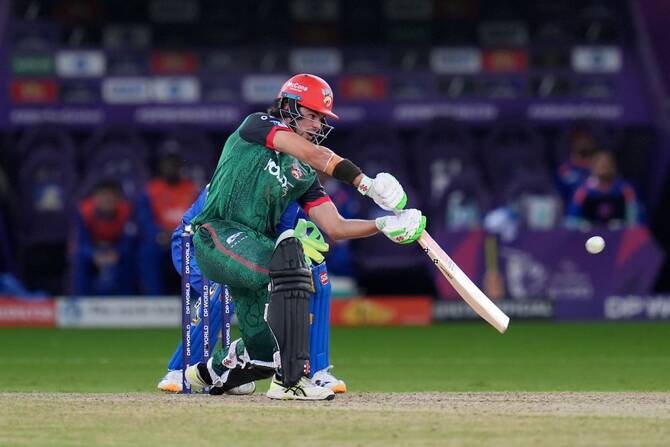
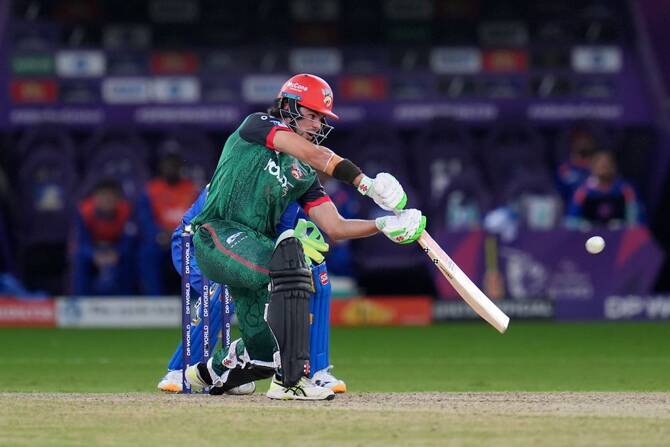
At 6:25 p.m. on Sunday Jan. 4, the Dubai International Stadium was full and expectant, but the start of the DP World ILT 20 final was not to be until 25 minutes later because of a surprise drone show.
This lit up the sky above the stadium with a succession of colorful images. These ranged from welcomes to symbols of the UAE and the tournament, culminating in the trophy itself.
A salvo of fireworks rounded off the spectacular introduction. Such entrees have become de rigueur in cricketing events, but this must be on a par with the best. Without saying it openly, everyone hoped for cricket as spectacular.
The Mumbai Indian Emirates, champions in 2024, won the toss and asked the Desert Vipers to bat, probably in the knowledge that they preferred to chase down a target. This was a repeat of the situation in qualifier one on Dec. 30, when the Vipers scored 233 and won by 45 runs, propelling them straight into the final.
In the final, the MIE did not start well — bowling wides and misfielding. Although both the Vipers’ openers fell, a crucial partnership was built by the Englishmen Sam Curran and Max Holden, both leading the league’s run-scoring charts.
The wily West Indians Kieron Pollard and Romario Shepherd tried to slow the game down but the batters stayed calm to post a total of 182. In reply, the MIE were off to a flying start, scoring 40 for the loss of one wicket after four overs.
In the post-match press conference, I asked the MIE’s coach, Robin Singh, if he felt that his team were ever in control of the match. In reply, he felt that it was at the end of the fourth over when they had a chance of taking control, but then lost two quick and crucial wickets, after which their task became increasingly difficult.
Curran agreed that was a tipping point. Otherwise, he felt his team had been in control, although what might have happened had his partnership with Holden not prospered, no one will ever know.
What we do know is that the Vipers were superior in the field and caught superbly. We also know that their Pakistani contingent contributed magnificently to the Vipers’ success, by 46 runs. Twice losing finalists, in seasons one and three, they were, by common acclaim, deserving winners.
There has been much talk during the tournament about standards and whether they have risen. This is a very subjective issue and depends on what objective criteria are available.
It was instructive to listen to Ian Bishop, former West Indian fast bowler between 1989 and 1998, now a leading commentator, who is of little doubt that standards have risen.
His evidence is based on the heightened performances of UAE players, how these have been achieved by exposure to international players, coaches, training and assessment regimes.
He cites Junaid Siddique, bought at auction for $170,000 by the Sharjah Warriorz; Muhammad Waseem, who “we don’t talk about anymore (as promising) because he is an established player;” and Khuzaima Tanvir, who broke through with the Desert Vipers in season four, claiming 17 wickets, one behind the two leading wicket-takers.
Bishop says that the next developmental stage is for Saudi Arabia and Kuwait players to follow the same pathway. Although only one of the 12 players from these countries made it onto the team sheet — Mohamed Shafeeq for the MIE — others were close.
Jonathan Trott, coach of the Gulf Giants, provided an insight when answering my question about what he had learnt most in his first experience with the ILT20. He responded by saying that it had proved difficult to fit everyone in.
Each playing 11 must have two UAE players and one from an associate member country. This one player must be selected from four and it is probable that the two non-Saudi or Kuwaiti associate players have greater experience of cricket at this level.
Two other experienced commentators, who have been involved since the inception of the ILT20, have reinforced Bishop’s view concerning the strides made by the league.
Wasim Akram, a great of the game for Pakistan between 1992 and 2003, noted the improvement in local talent, especially among the bowlers. He specified Tanvir and Ajay Kumar, who claimed 18 wickets, equal with Afghanistan’s Waqar Salamkheil, the winner of the best bowler award.
Akram also noted the continuing excellence of Muhammad Waseem, who finished narrowly second behind Curran in runs scored. Waseem was fourth in the rating for most-valuable player and first in the UAE player ratings. In Akram’s view, “this league is going places.”
Simon Doull, the former New Zealand bowler turned commentator, echoed the comments of Bishop and Akram, adding a mention for the role of spinners. He said “we once thought that T20 cricket might be the death of spin, but that hasn’t been the case. Every franchise wants a quality wrist spinner.”
This was in response to my question relating to the irony of seeing quality spinners in the ILT20 on a day when Australia and England entered the Sydney Test match without a spinner in their teams — the first time since 1888. Doull also welcomed the league’s expanding regional footprint and the year-on-year improvement in standards.
One vital aspect of standards is, of course, the quality of players and their performances. Several issues are impacting these. One is the competition for the same players with other leagues being played at the same time.
Three franchise tournaments overlapped with the ILT20’s season four. Each has different mandates for the number of overseas players per playing 11 and squad.
In Australia’s Big Bash League, it is three and seven. In the SA20, it is four and seven, whilst in the Bangladesh Premier League, it is four and eight. All three leagues allow franchises to sign replacements to cover player injury and unavailability for other reasons.
Injuries are inevitable. The Desert Vipers, for example, lost their captain, Lockie Ferguson, halfway through the ILT20 schedule. Curran stepped in with great success, whilst the Vipers signed the Pakistan spinner, Usman Tariq, as Ferguson’s replacement.
Tariq made a major contribution to the Vipers’ winning cause. Other players appear to disappear, literally overnight, only to reappear shortly afterwards in the BBL or SA20.
The MIE’s captain, Pollard, was asked at a press conference about the significance of losing both Nicholas Pooran and Rashid Khan to the SA20 around Dec. 20. His reply was very sanguine.
Pooran had been recruited as a wildcard player and Khan had replaced a player injured before the tournament started. Both players are part of the MI franchise stable and it was known that they would join MI Cape Town in the SA20 when it opened.
It seems that these comings and goings are an inherent feature of franchise cricket. Players who are part of serial franchise owners are likely to find themselves shunted between leagues.
This can only be minimized if there is no overlap. It is not confirmed when the fifth edition of the ILT20 will be held — whether it will be between similar dates to season four or revert to January/February.
The BBL’s dates are unlikely to vary greatly, but the SA20 may start in January 2027 because South Africa will have Test matches against England starting on Boxing Day 2026 and New Year 2026-27.
Whatever the case, the well-organized DP World ILT20 has established itself on cricket’s franchise landscape. Now, one is left to ponder what spectacular backdrops may be devised to illuminate the next edition or what changes may be made in its evolution.