

Israel extends foreign media ban law until end of 2027

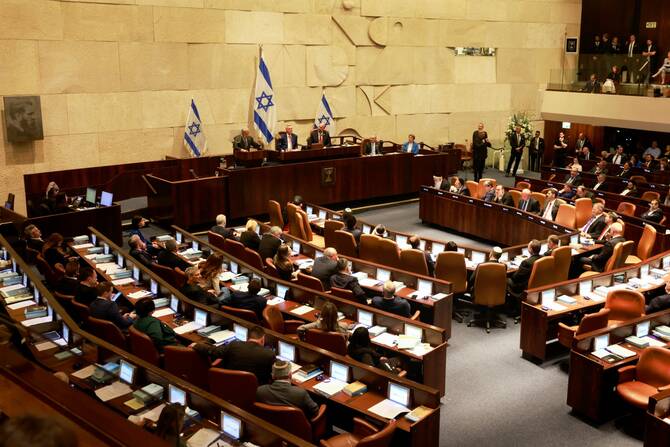
The move has drawn sharp criticism from human rights and media groups, who warn it entrenches restrictions on Arab and foreign outlets amid a broader erosion of press freedoms. (AFP/File)
Short Url
Updated 24 December 2025
Follow

Israel extends foreign media ban law until end of 2027

  • Order replaces temporary emergency legislation that allowed authorization of so-called ‘Al Jazeera bill’
  • Extension of temporary order empowers Communications Ministry to restrict foreign channels deemed to cause ‘real harm to state security’

LONDON: Israel’s Knesset approved late Monday an extension of the temporary order empowering the Communications Ministry to shut down foreign media outlets, pushing the measure through until Dec. 31, 2027.

The bill, proposed by Likud lawmaker Ariel Kallner, passed its second and third readings by a 22-10 vote, replacing wartime emergency legislation known as the “Al Jazeera Law.”

Under the extended order, the communications minister — with prime ministerial approval and security cabinet or government ratification — can restrict foreign channels deemed to cause “real harm to state security,” even outside states of emergency.

Measures include suspending broadcasts, closing offices, seizing equipment, blocking websites, and directing the defense minister to block satellite signals, including in the West Bank, without disrupting other channels.

Administrative orders last 90 days, with possible extensions. Unlike the temporary measure, the new law does not require court approval to shut down a media outlet.

The move has drawn sharp criticism from human rights and media groups, who warn it entrenches restrictions on Arab and foreign outlets amid a broader erosion of press freedoms.

“Israel is openly waging a battle against media outlets, both local and foreign, that criticize the government’s narrative; that is typical behavior of authoritarian regimes,” International Federation of Journalists General Secretary Anthony Bellanger said in November after the bill’s first reading.

“We are deeply concerned about the Israeli parliament passing this controversial bill, as it would be a serious blow to free speech and media freedom, and a direct attack on the public’s right to know.”

In a parallel development, the Israeli Cabinet unanimously approved on Monday the shutdown of Army Radio (Galei Tzahal) after 75 years, with operations ceasing on March 1, 2026.

In a statement, Attorney General Gali Baharav-Miara warned the decision “undermines public broadcasting in Israel and restricts freedom of expression,” lacking a legal basis.


Trending: BBC report suggests sexual abuse and torture in UAE-run Yemeni prisons

Updated 02 February 2026
Follow

Trending: BBC report suggests sexual abuse and torture in UAE-run Yemeni prisons

  • The investigation was produced by British-Yemeni BBC journalist Nawal Al-Maghafi

LONDON: A recent BBC video report diving into what it says was UAE-run prison in Yemen has drawn widespread attention online and raised fresh questions about the role of the emirates in the war-torn country.

The report, published earlier this month and recently subtitled in Arabic and shared on social media, alleged that the prison — located inside a former UAE military base — was used to detain and torture detainees during interrogations, including using sexual abuse as a method.

The investigation was produced by British-Yemeni BBC journalist Nawal Al-Maghafi, who toured the site, looking into cells and what appear to be interrogation rooms.

Al-Maghafi said the Yemeni government invited the BBC team to document the facilities for the first time.

A former detainee, speaking anonymously, described severe abuse by UAE soldiers: “When we were interrogated, it was the worst. They even sexually abused us and say they will bring in the doctor. The ‘so-called’ doctor was an Emirati soldier. He beat us and ordered the soldiers to beat us too. I tried to kill myself multiple times to make it end.”

Yemeni information minister, Moammar al Eryani also appears in the report, clarifying that his government was unable to verify what occurred within sites that were under Emirati control.

“We weren’t able to access locations that were under UAE control until now,” he said, adding that “When we liberated it (Southern Yemen), we discovered these prisons, even though we were told by many victims that these prisons exist, but we didn't believe it was true.”

The BBC says it approached the UAE government for comment, however Abu Dhabi did not respond to its inquiries.

Allegations of secret detention sites in southern Yemen are not new. The BBC report echoes earlier reporting by the Associated Press (AP), which cited hundreds of men detained during counterterrorism operations that disappeared into a network of secret prisons where abuse was routine and torture severe.

In a 2017 investigation, the AP documented at least 18 alleged clandestine detention sites — inside military bases, ports, an airport, private villas and even a nightclub — either run by the UAE or Yemeni forces trained and backed by Abu Dhabi.

The report cited accounts from former detainees, relatives, civil rights lawyers and Yemeni military officials.

Following the investigation, Yemen’s then-interior minister called on the UAE to shut down the facilities or hand them over, and said that detainees were freed in the weeks following the allegations.

The renewed attention comes amid online speculation about strains between Saudi Arabia and the UAE over Yemen.